Commercial Umbrella Procurement: 8 Questions Buyers Ask Before Approving a Supplier
Most commercial umbrella enquiries do not stall on canopy colour or crank finish. They stall when a procurement team, an insurer, or the facilities manager who will sign off the terrace asks for evidence: a wind figure with a test method behind it, a compliance report that matches the project's market, base loading for the exact canopy size, warranty wording, and a spare-parts commitment. A product page rarely carries those documents, and should not be expected to. But the answers need to arrive as one coherent file before a purchase order is raised. These are the eight questions that actually get asked, what a usable answer looks like, and which documents to request in the same email.
Why approvals stall: the gap between a product page and a specification file
We reviewed 85 live commercial umbrella product pages in our own catalogue to see what a buyer can verify without sending a single email. The result was lopsided. Packing and container information appeared on 91% of pages, OEM and branding options on 94%, and LED or solar features on 97%. Warranty terms appeared on 17%, minimum order quantity on 13%, production lead time on 21% and sample policy on 24%. Not one page published a fire-compliance or fabric test report.
That last figure is not a defect in the products. Certificates are issued against a fabric batch and a destination market, so they belong in a project specification file rather than in a product description that has to serve forty countries at once. The problem is the silence around them. When a page does not say how to request the file, buyers tend to assume the file does not exist, and the enquiry moves to whichever supplier sent their paperwork first. The fix is not more adjectives on the page. It is one complete document pack, sent early.
Figures from a review of 85 live product pages in the Foris Hortus catalogue, November 2026. All of these are documentation questions, not product defects.
The eight questions, and what a usable answer looks like
1. What wind rating applies, and how was it measured?
A figure without a method is not a rating. A typical commercial parasol is specified to stay open up to Beaufort 6, roughly 40–50 km/h sustained wind, with a mandatory close-and-stow instruction above that threshold. Ask three things: whether the figure was measured with the canopy open or closed, which test method and canopy size it applies to, and whether the vent is single or double. A rating quoted for a 2.5 m round canopy does not transfer to a 4 × 4 m square one, because the sail area nearly doubles. Our comparison of vent, frame and base behaviour in wind and the longer wind-resistance guide set out how those variables interact.
2. Which base and fixing, and what is the loading?
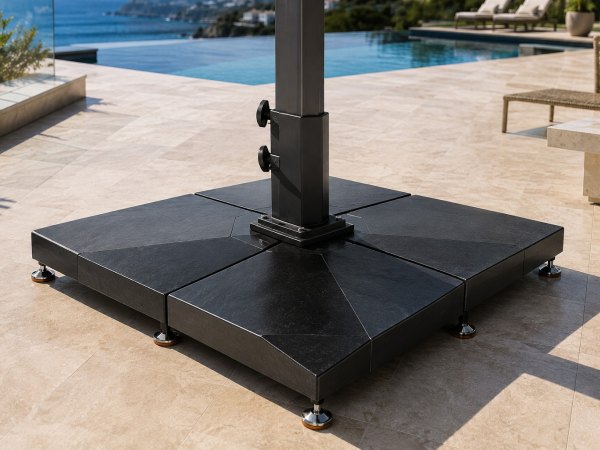
Base weight is a calculation, not an accessory. For a 3 m free-standing centre-pole canopy, 40–60 kg of ballast is the usual starting point; cantilever models and larger square canopies need a heavier plate or an in-ground sleeve, and exposed rooftops need an engineer's loading figure. A 14 kg resin base is a filler weight for a through-table installation, not free-standing ballast for a 3 m canopy. Request the base weight table matched to canopy size, the pole diameter range each base accepts, and whether the fixing is surface-mounted, in-ground or through-table. The base weight and pole fit guide covers the three common ballast materials.
3. Which fire and fabric compliance applies in our market?
Requirements are set by the destination, not by the factory. A US hospitality project may call for CPAI-84 or NFPA 701 on the canopy fabric and CAL 117 on any associated upholstery; European projects commonly reference EN 13561 alongside REACH declarations for coatings. Ask for the report number, the issuing laboratory, the issue date and the exact fabric or coating the report covers. A line that says “fire retardant fabric” with no report number is a description, not evidence. If an insurer is involved, send them the report before you send the order. For the material side of the same conversation, see our acrylic, polyester and olefin comparison.
Ask for the document, not the adjective. Compliance is market-specific and batch-specific. Any supplier, including us, should be able to tell you which report applies to the fabric on your quotation and when it was issued. If the answer is a general assurance, keep asking.
4. What exactly does the warranty cover, and for how long?
A typical commercial umbrella warranty runs three years on the frame and two years on the canopy, with hardware and powder-coat finishes sometimes listed separately. The number matters less than the exclusions. Ask whether wind damage, fading, corrosion at coastal sites and labour are included, whether the term starts at invoice date or delivery date, and what evidence a claim needs. A two-year canopy warranty with a defined fade tolerance is more useful than a five-year claim with no measurement method. Our heavy-duty specification guide explains which construction details the warranty should be referring to.
5. What is the MOQ, and what changes it?
For stock configurations, a 50-piece minimum is a normal factory starting point; custom print, a bespoke powder-coat colour or a non-standard canopy size usually raises it to 100 pieces, because fabric and tooling are bought against that run. What buyers actually need to know is whether mixed sizes or mixed colours can be combined to reach the minimum, and whether a repeat order can be smaller. The mechanics are set out in Commercial Umbrella MOQ Explained, and the current range is visible in the outdoor umbrella catalogue.
6. Can we get a sample, and how long does it take?
Allow 7–10 working days for a stock sample, longer if the canopy has to be printed or dyed to a custom colour. Ask whether the sample is a full production unit or a showroom approximation, whether the sample charge is credited against the bulk order, and who carries the freight. A sample built with different ribs or a different fabric from the production run answers the wrong question. If a physical sample is not practical for your timeline, ask for a fabric swatch card and a component drawing set instead.
7. What is the production lead time, and what starts the clock?
A 25–35 day production window after deposit and approved artwork is typical for a mixed commercial order. Two details decide whether that date holds. The clock normally starts when both the artwork and the deposit have cleared, not when the enquiry was sent. And November to March is when capacity for the following season is booked, so a terrace with a fixed opening date needs to be planned backwards from installation, with sea freight and site works added to the factory days rather than left as an afterthought.
8. What can still be bought in year five?
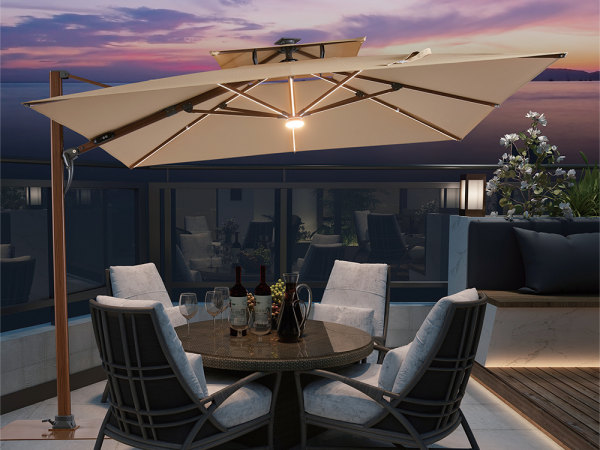
Ask what will still be orderable in year five. A serviceable umbrella should have replaceable canopies, ribs, hubs, cranks or gas springs, tilt mechanisms and, on lit models, replaceable LED strips and drivers. Ask for a parts list with item codes and whether the canopy pattern is archived, so a replacement canopy still matches the ones on the adjacent tables. This is the question that separates a product from a programme; our spare parts and replacement canopy guide lists what is normally kept in stock, and the solar LED cantilever model is a useful example of why LED components should be specified separately.
One email, one project file
Eight separate questions sent over eight separate messages will produce eight partial answers. Send them as one checklist and ask for one file back. A supplier who answers all eight in a single reply has also shown you how the order will be administered later.
- Wind rating, test method, canopy size tested, and open-or-closed condition
- Base weight table, pole diameter range and fixing type
- Compliance reports with numbers, laboratory, dates and covered fabric
- Warranty wording, exclusions, start date and claim procedure
- MOQ by configuration, and whether mixed sizes or colours count
- Sample lead time, specification and credit terms
- Production lead time, clock-start condition and seasonal capacity
- Parts list with item codes, and the canopy pattern archive policy
Put the list in one note through the project inquiry form and it comes back as a single pack against your specification. If the brief is still fluid, the hotel and resort specification guide is the better place to start.
Quick reference: question, evidence, working answer
| Question | Evidence to request | Typical working answer |
|---|---|---|
| Wind | Test method, canopy size, open/closed condition | Beaufort 6, about 40–50 km/h, close above threshold |
| Base | Weight table, pole fit, fixing type | 40–60 kg for a 3 m free-standing canopy |
| Compliance | Numbered report per market and fabric batch | CPAI-84 / NFPA 701 / EN 13561 as applicable |
| Warranty | Full wording with exclusions | 3 years frame, 2 years canopy |
| MOQ | Configuration breakdown | 50 pieces standard, 100 pieces custom |
| Sample | Specification and credit terms | 7–10 working days from stock |
| Lead time | Clock-start condition and capacity calendar | 25–35 days after deposit and artwork approval |
| Spare parts | Coded parts list, pattern archive | Parts availability for 5 years |
The figures above are typical working values for commercial parasol programmes, not contractual commitments. Confirm each one against the written quotation and the project specification before it is issued.
Related reading
In short
Buyers are not really asking whether an umbrella looks good on a terrace. They are asking whether it will pass review, stay put in wind, and still be serviceable when the first canopy fades. Answer those three with documents rather than adjectives, and the conversation about colour becomes the easy part.