
Successful Cases
Four projects, four different problems. What they have in common is the way the shade and the seating were specified together, so a terrace, a courtyard or a rooftop reads as one scheme rather than as a collection of separate purchases.
Each case is written from the site conditions outward: what the space had to cope with, what that changed in the specification, and how the finished area is used. The ranges behind all four are covered on the outdoor umbrella and outdoor furniture pages.
What the four projects have in common
Different sectors and different equipment lists, but the same six decisions were made on all four projects. They are the reason the cases below look alike in the finished photographs even though the specification is not the same.
Shade and seating sized together
The umbrella and the furniture are sized against the same plan, so the cover lands where people actually sit and not only where a pole happens to fit.
Base weight taken from the exposure
Wind exposure and the paved surface decide the ballast. Weight is calculated for the site rather than copied from a catalogue page.
Paved surfaces left intact
Where the paving hides a drainage layer, the whole scheme is held by ballast and no fixing is made in the stone.
Materials matched to salt and sun
Anodised aluminium frames, marine-grade fasteners and solution-dyed canopy fabric on the exposed sites.
Colour taken from the building
Canopy, frame and cushion colours are matched to the facade, so the scheme reads as part of the property rather than as equipment.
Room for a later phase
Because finishes are held per project, an area can be added to in a second phase without a visible colour change.
Four projects, four different problems
The four cases below cover the sectors that come up most often. Each one is a different answer to the same three questions: how much shade, over what, and held down by what. The cards open the full project page.
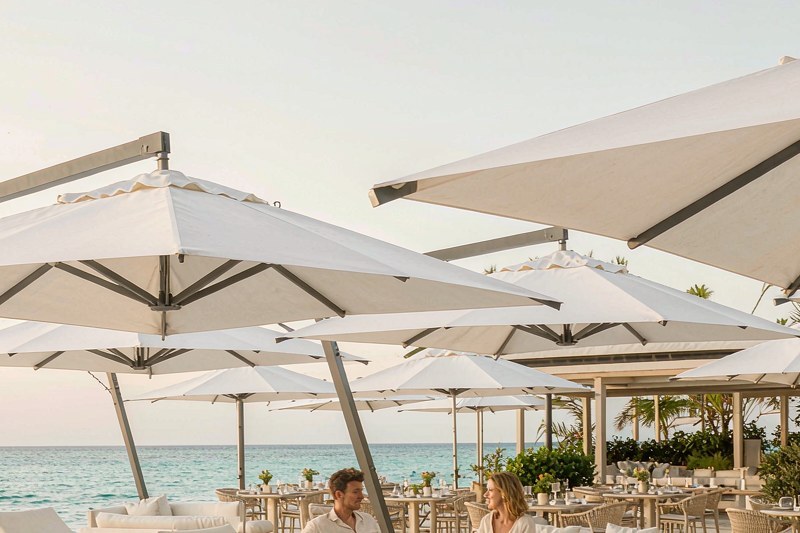 Beachfront Resort, BaliA five-star beachfront resort needed all-day shade across a pool deck and a beach restaurant. Thirty marine-grade aluminium umbrellas were specified: twenty large commercial umbrellas over the loungers and ten cantilever umbrellas over the dining area.
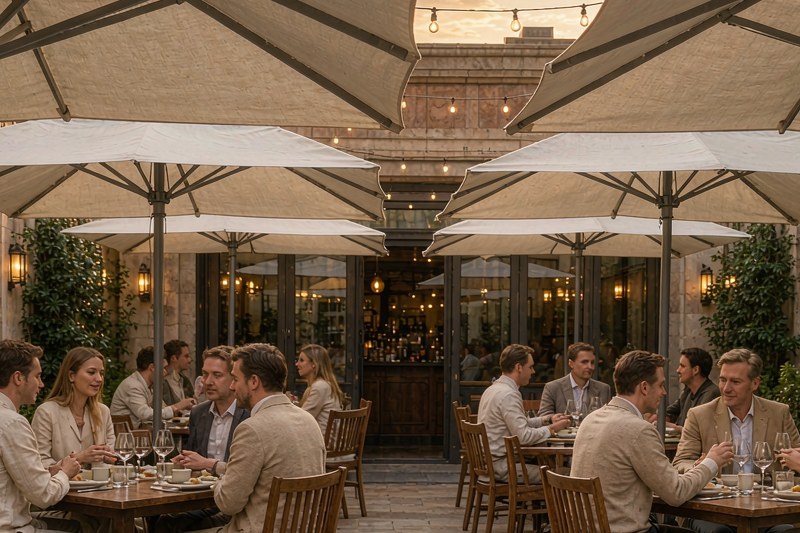 Restaurant Group, Courtyard DiningA restaurant group wanted to extend its dining season onto a paved courtyard and a front terrace. Large commercial umbrellas were combined with a mix of two-seat and four-seat dining sets, so the terrace can be re-set between service and event use.
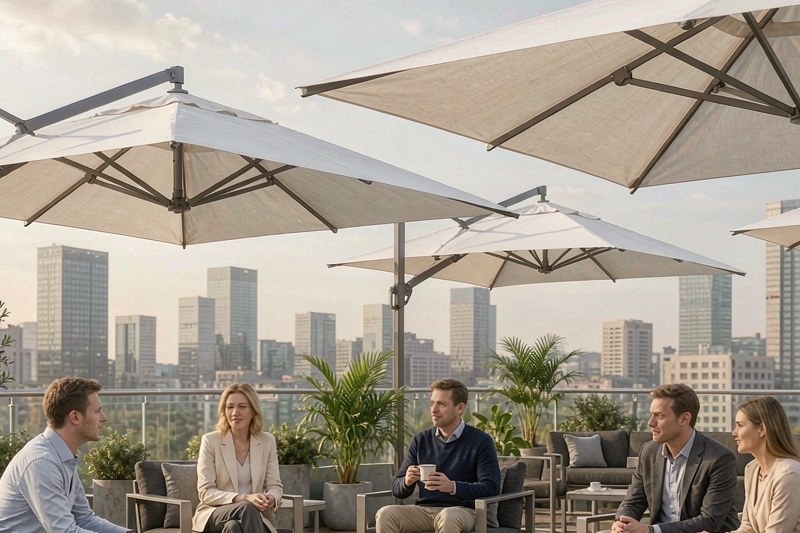 Headquarters Rooftop LoungeA corporate headquarters turned an underused rooftop into a lounge for staff breaks and client meetings. Wide-coverage commercial umbrellas were paired with modular outdoor lounge furniture, so the space can be re-arranged around the number of people using it.
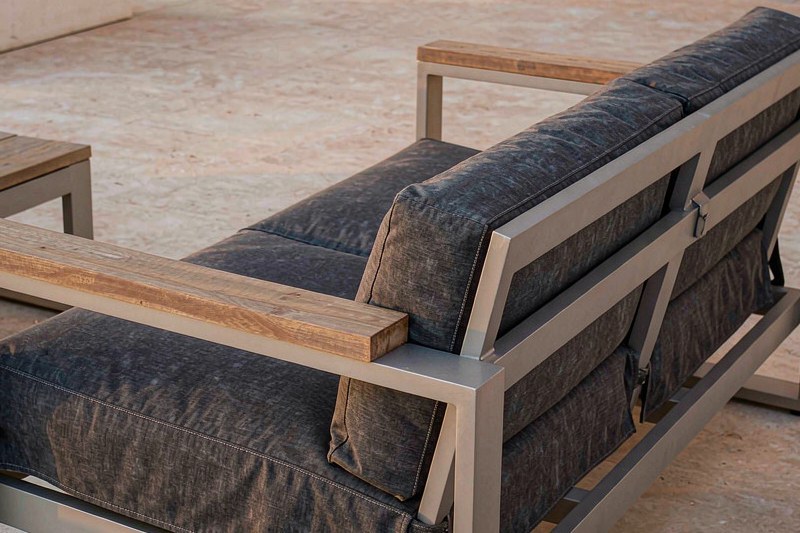
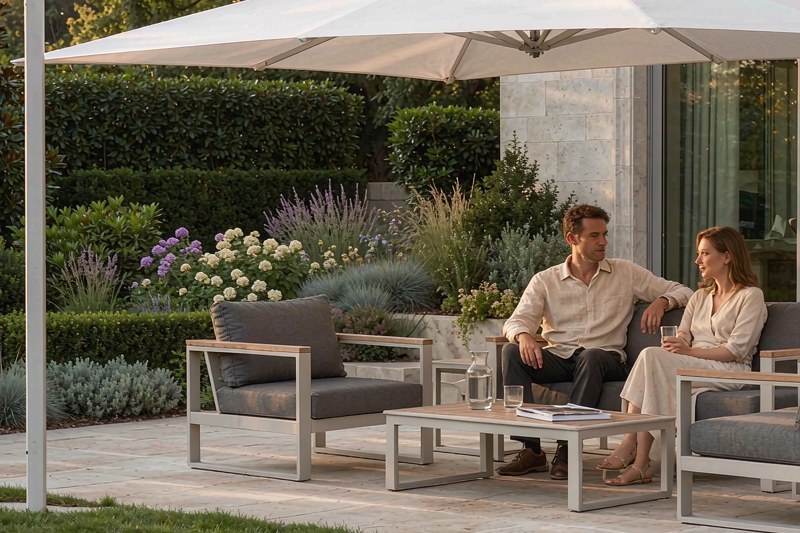
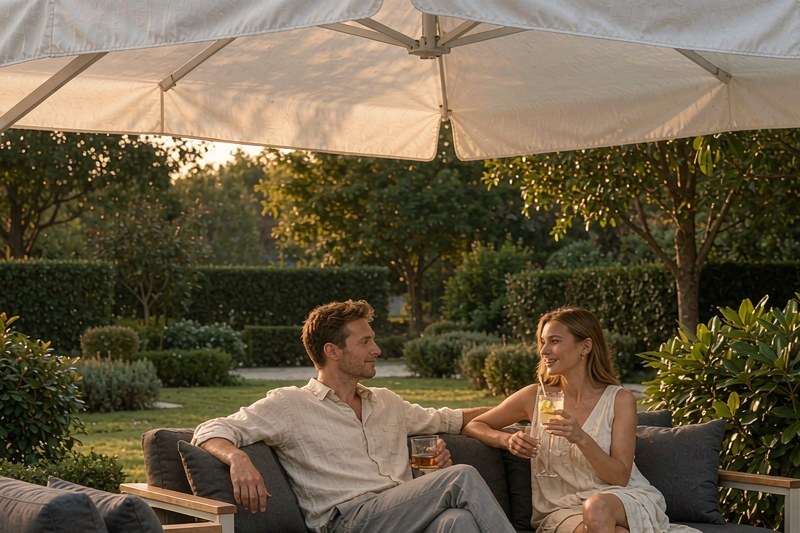 Private Villa GardenA private villa owner wanted a shaded lounge area in the garden for family and guests. A cantilever umbrella was chosen so the shade can be moved without moving the furniture, paired with a modular aluminium sofa set with wood armrests.
How each project was specified
The four projects are different enough that the specification cannot be copied from one to the next. The table is the short version: what the project needed, what was specified, and what changed once it was in place.
| Project | What the project needed | What was specified | What changed |
|---|---|---|---|
| Beachfront resort, Bali | All-day shade across a pool deck and a beach restaurant at a five-star beachfront resort | Thirty marine-grade aluminium umbrellas: twenty large commercial umbrellas over the loungers and ten cantilever umbrellas over the dining area | Loungers and dining are both shaded through the middle of the day, with the dining covers clear of the service route |
| Restaurant group, courtyard dining | A dining season extended onto a paved courtyard and a front terrace | Large commercial umbrellas combined with a mix of two-seat and four-seat dining sets | The terrace can be re-set between service and event use, and the season runs longer than the covered indoor area allows |
| Headquarters rooftop lounge | An underused rooftop turned into a usable lounge for staff breaks and client meetings | Wide-coverage commercial umbrellas paired with modular outdoor lounge furniture | The space can be re-arranged around the number of people using it instead of being fixed to one layout |
| Private villa garden | A usable shaded lounge area in the garden for family and guests | A cantilever umbrella for shade that can be moved, with a modular aluminium sofa set with wood armrests | The shade moves with the sun while the seating stays where the plan puts it |
Site conditions that change the specification
Across the four projects, the same six site conditions kept changing the equipment list. They are worth checking before a specification is priced, because they move the frame section, the base weight and the umbrella type independently of the size of the space.
| Site condition | What it changes in the specification | Where it applied |
|---|---|---|
| Open water close by | Wind speed at the edge of a beach or a harbour is higher than inland, so the frame section and the ballast both go up | Beachfront resort, Bali |
| Paving over a drainage layer | The terrace cannot be drilled, so the scheme is held by weighted bases and the ballast is calculated for the canopy size | Restaurant group, courtyard dining |
| A long or narrow terrace | A centre pole would stand in the walking route, so a side pole or a cantilever umbrella is used and the canopy stays clear of the path | Private villa garden |
| A rooftop with no shelter | Wind speed rises with height and there is no neighbouring building to break it, so ballast is specified for the exposed condition rather than the sheltered one | Headquarters rooftop lounge |
| Sun crossing the terrace during the day | The shade has to move, so a rotating or cantilever umbrella replaces a fixed centre pole | Private villa garden |
| Salt air within sight of the coast | Frames, fasteners and canopy fabric are specified for salt exposure rather than for inland use | Beachfront resort, Bali |
Specification by range
The ranges below are what appears most often in project specifications. Each one starts from the conditions above rather than from a fixed package, so the same range can be specified for a sheltered garden or for an exposed seafront.
How a project order runs
Every project follows the same four steps, whichever range it is built from. Nothing is manufactured before the specification is approved.
1. Plan and feasibility
Send the layout or a photograph of the space. We return a shade plan, a module list and the base weights the site needs.
2. Sample and approval
Frame finish, canopy colour or fabric swatch, and a branding mock-up where a mark is applied. Production does not start until the specification is approved.
3. Production
Umbrellas and furniture are built to the approved specification, with the frame, the canopy and the cushions finished under one roof.
4. Inspection and delivery
Third-party inspection is supported before shipment, and the loading plan is issued so the container can be checked against the quotation.
Ordering: quantity, customisation and lead time
The minimum depends on how far the specification moves away from the catalogue model. The five levels below are the ones projects usually fall into.
| Level | What it covers | Minimum |
|---|---|---|
| Catalogue models | Nothing on the frame, the canopy or the packing changes | 50 pcs |
| Light customisation | Canopy colour, frame finish, printed details or a logo applied to the canopy | 100 pcs |
| Printed cartons | The outer carton carries your branding or handling marks | 200 pcs |
| Structural changes | Sizes, tube sections or frame details changed to the project | 300 pcs |
| Full OEM and ODM | A specification developed for the project, quoted per project | Quoted per project |
Stock umbrella models are produced in about 30 days, and custom fabric, colour or branding adds around 10 days. Shipments are quoted on FOB Ningbo terms, with CIF, CFR and DDP available; indicative sea transit is 18 to 25 days to the US West Coast, 30 to 35 days to Northern Europe and 18 to 22 days to the Gulf. Furniture is normally quoted by container load rather than by piece, and furniture lead times are confirmed on the enquiry, because they depend on the version and the finish chosen.
Warranty, spare parts and after-sales
Every project is covered by a 12-month warranty from the date of loading. Beyond that, the parts that wear are supplied individually, so a scheme does not have to be replaced as a whole when one component reaches the end of its life.
Spare parts for the standard range are available for five years after purchase, and stocked parts normally dispatch within seven days. To order, send the model, the part and the quantity; a photograph of the damaged part is enough to confirm the version. Colour is matched from the model or from a photograph, so a part added in year three matches the scheme already on site instead of standing out from it. Larger quantities can ship with your next order or be sent separately, whichever suits the project better.
What we need from you to quote a project
A project quotation is faster when the site is described in a few specifics. This is what we ask for on most projects, and it is also what makes the difference between a price that holds and a price that has to be revised.
From those we return a shade plan, a module list and the base weights the site needs, before any question of price is settled.
What the two ranges share
Umbrellas and furniture are usually specified on the same project, so the same two questions apply to both: what the site will do to the materials over time, and which part is likely to be replaced first. Both are answered the same way, by specifying the material for the exposure and keeping the wearing parts individually available.
Questions that come up before a project order
These are the questions that decide the specification on most projects, answered the way the four cases above were answered.
Can umbrellas be installed on a terrace that must not be drilled?
Yes. Weighted bases carry the whole scheme where the paving hides a drainage layer or where drilling is not acceptable. The ballast weight is specified from the canopy size and the wind exposure rather than chosen from a fixed list, which is why the same umbrella can need a different base on a sheltered garden and on an exposed seafront.
What wind exposure do the umbrellas handle?
The commercial range is rated to Beaufort 4 to 6, roughly 35 to 45 km/h, with a weighted base specified for the canopy size. In a forecast blow the canopy should be closed, and in severe weather the umbrella should be taken down entirely. Specifying the base for the site is what keeps the frame inside that rating.
Can the canopy colour match an existing building or furniture?
Yes. Canopy colours, frame finishes and printed details are part of light customisation, and we can match from a fabric swatch or a photograph of the scheme already on site. Matching matters most on projects that are built in phases, where a later addition has to sit beside the first order without a visible difference.
Can an area be added to in a later phase?
Yes. Finishes are held per project, so a second phase can be added years later without a colour change between the first and second order. This is also the reason the spare parts are matched from the model rather than from a generic colour name.
What is the minimum order for a custom colour or a logo?
Light customisation, which covers canopy colour, frame finish and printed details, starts at 100 pcs. Printed cartons start at 200 pcs, structural changes at 300 pcs, and a fully developed OEM or ODM specification is quoted per project. Catalogue models with no changes start at 50 pcs.
What happens if a part fails in year three?
The parts that wear are supplied individually. Spare parts for the standard range are available for five years after purchase, and stocked parts normally dispatch within seven days. Send the model, the part and the quantity, and the colour is matched from the model or from a photograph of the part in place.
Do the umbrellas and the furniture have to be ordered together?
No, but specification is easier when they are planned together, because the furniture is sized to the umbrella covers and the two share one colour reference. On the four projects above, the shade and the seating were specified in the same document.
Working on a terrace, a courtyard or a rooftop? Send the plan, or a photograph of the space with the exposure and the route in, and we will return a shade plan, a module list and the base weights the site needs.
Send your project for a quotation
Related: all projects, commercial outdoor umbrellas, outdoor furniture, umbrella bases, LED and solar umbrellas.