Commercial Outdoor Furniture
Commercial outdoor furniture specified for the floor, not for the photograph
Contract outdoor furniture is bought against a different set of questions from residential furniture. Will the fortieth chair match the first one, what happens when a guest damages a cushion in year two, how does the terrace get cleared at night, and how much of a container does the order actually fill.
The pieces below are built on welded aluminium frames and specified piece by piece, so a floor can be extended, a single unit replaced and a cushion re-covered without replacing a set. Frames, weave and upholstery are made in our own workshop in Zhejiang and packed with the cartons, loading plan and HS code already documented.
- Welded aluminium frames, stacked and knock-down builds
- Replacement parts and cushions quoted separately
- Repeatable specification across a whole floor
- Loading plan, carton data and HS code with every order
Three things that make furniture contract grade
None of the three is visible in a product photograph, which is exactly why they are worth asking about before a container is booked.
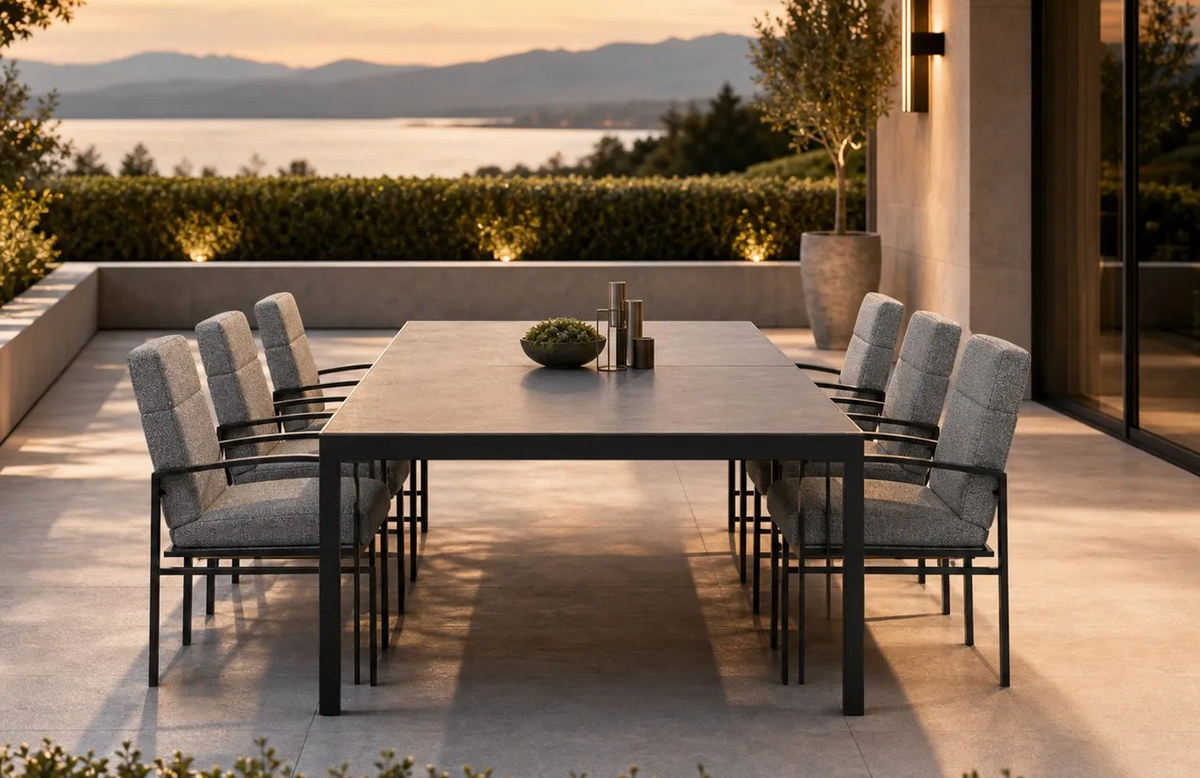
Repeatability across a floor
A hotel does not buy one chair, it buys the same chair many times over and expects the fortieth to arrive identical to the first. That is a production question, not a design one, and it is why the frames are made on our own lines rather than bought in.
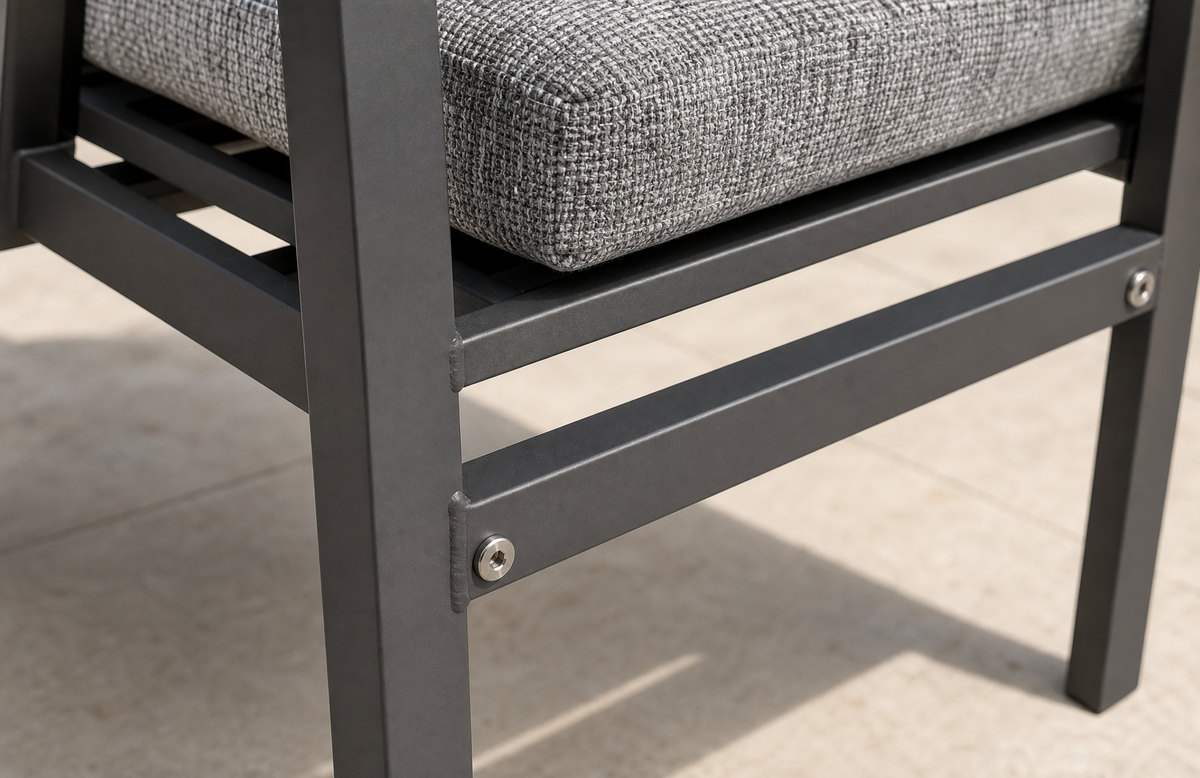
How it is built underneath
Welded square-section aluminium, a braced underframe and stainless fixings. The joints and the brace are what take the load when a hundred guests sit down and stand up on the same evening.
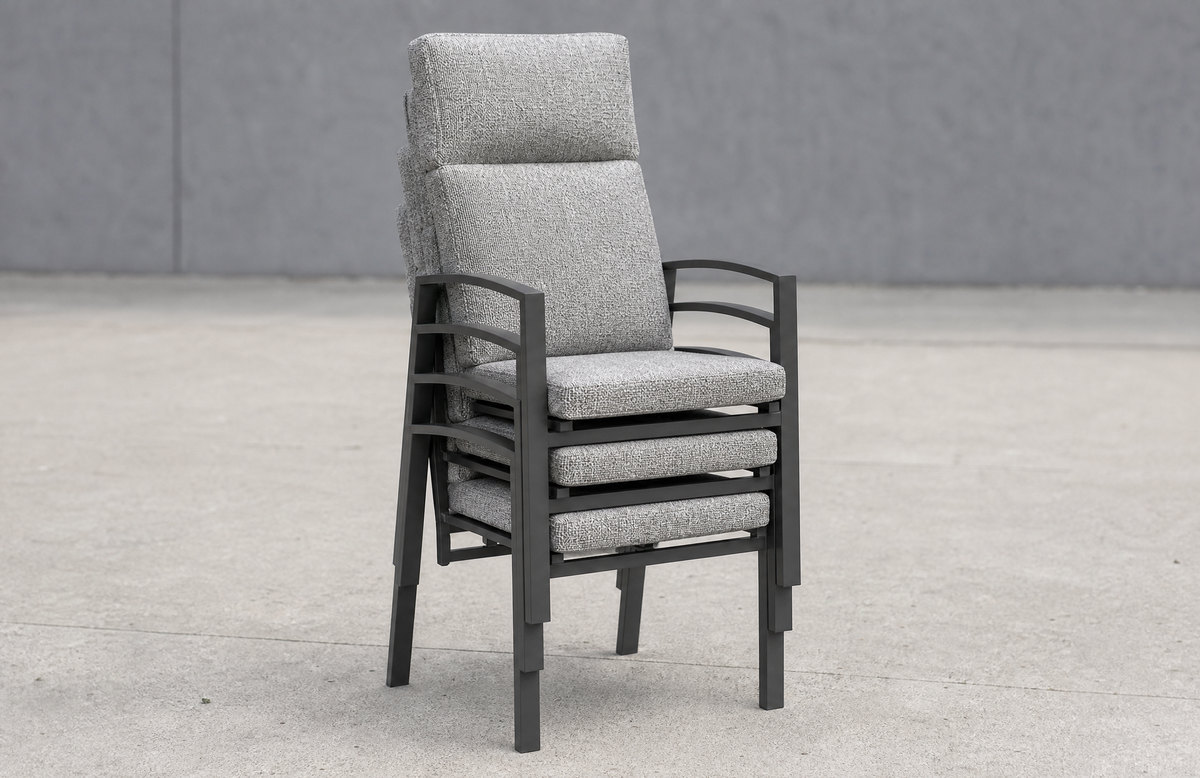
What happens at closing time
A terrace gets cleared and stored every night. Stacking and knock-down builds are what make that a five-minute job rather than a two-person lift for every chair.
What this collection covers
Four families of piece, all built on the same frame and finish specification, so a mixed programme still arrives looking like one order.
Contract seating
Armchairs and side chairs for hotel terraces, restaurant covers and resort decks, in stacked and knock-down builds.
Contract tables
Round and rectangular tops with slat, sunburst and solid finishes, sized to a covers plan rather than to a room.
Volume programmes
Repeatable production runs with a fixed specification, so a second order matches the first without a new sample stage.
Replacement and maintenance parts
Cushions, covers, fixings and feet quoted as separate line items, so a property can repair a unit rather than replace a set.
Buying for one terrace, or for a rollout?
The two orders look similar on a quotation and behave very differently in year two, so it is worth saying which one you are placing.
A single terrace or venue
One property, one scheme, an opening date to hit.
- Sample signed off once, then produced against it
- Piece mix set to the covers plan for that terrace
- Cartons and a loading plan for one container
- Spares held to the property rather than to a catalogue
A multi-site or framework rollout
The same specification released across several properties or phases.
- The finish and fabric are held as a fixed recipe
- Phases are scheduled so a late site does not hold an early one
- Part numbers stay stable for the life of the framework
- Reorders skip the sample stage and go straight to production
Where commercial outdoor furniture gets specified
Most of what we ship goes into hospitality and contract projects, where the furniture is cleaned daily, moved twice a day and expected to match across a whole floor.
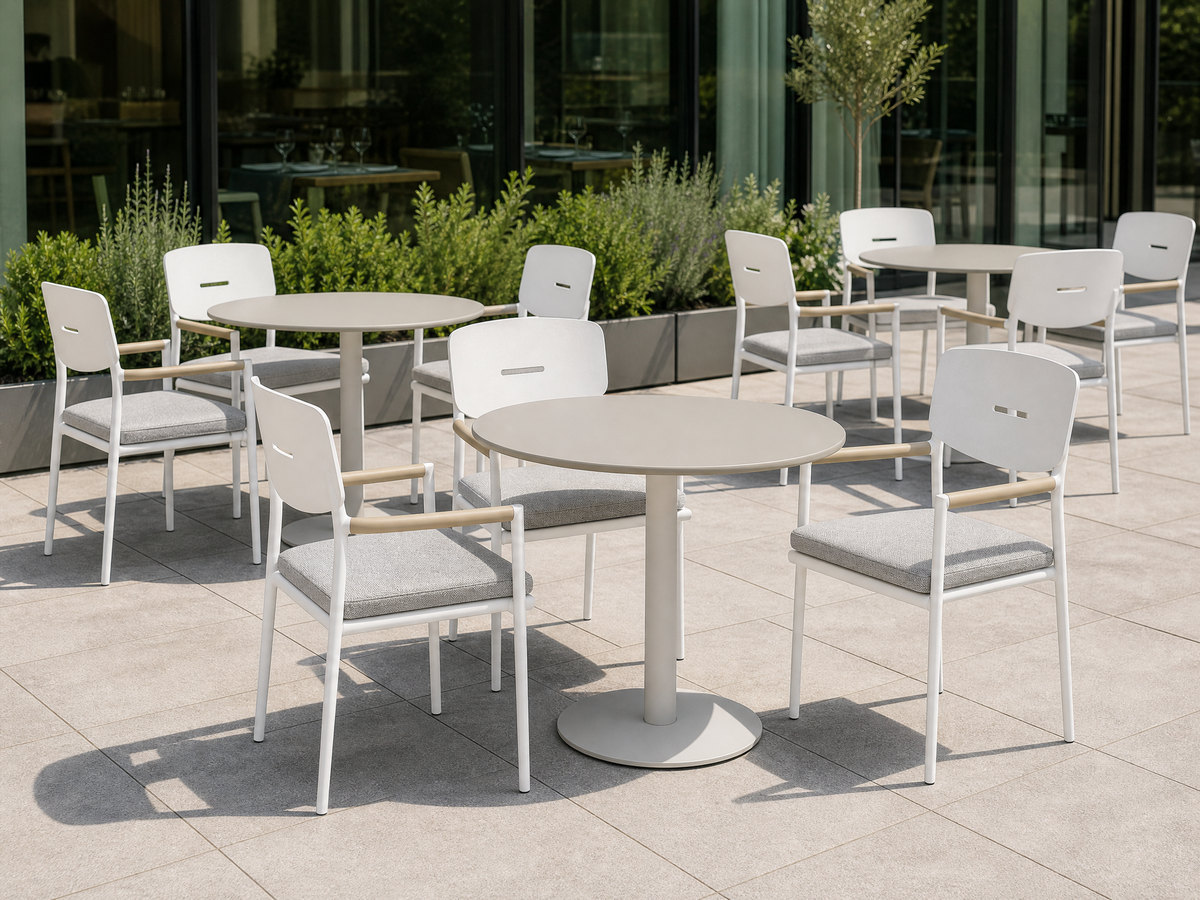
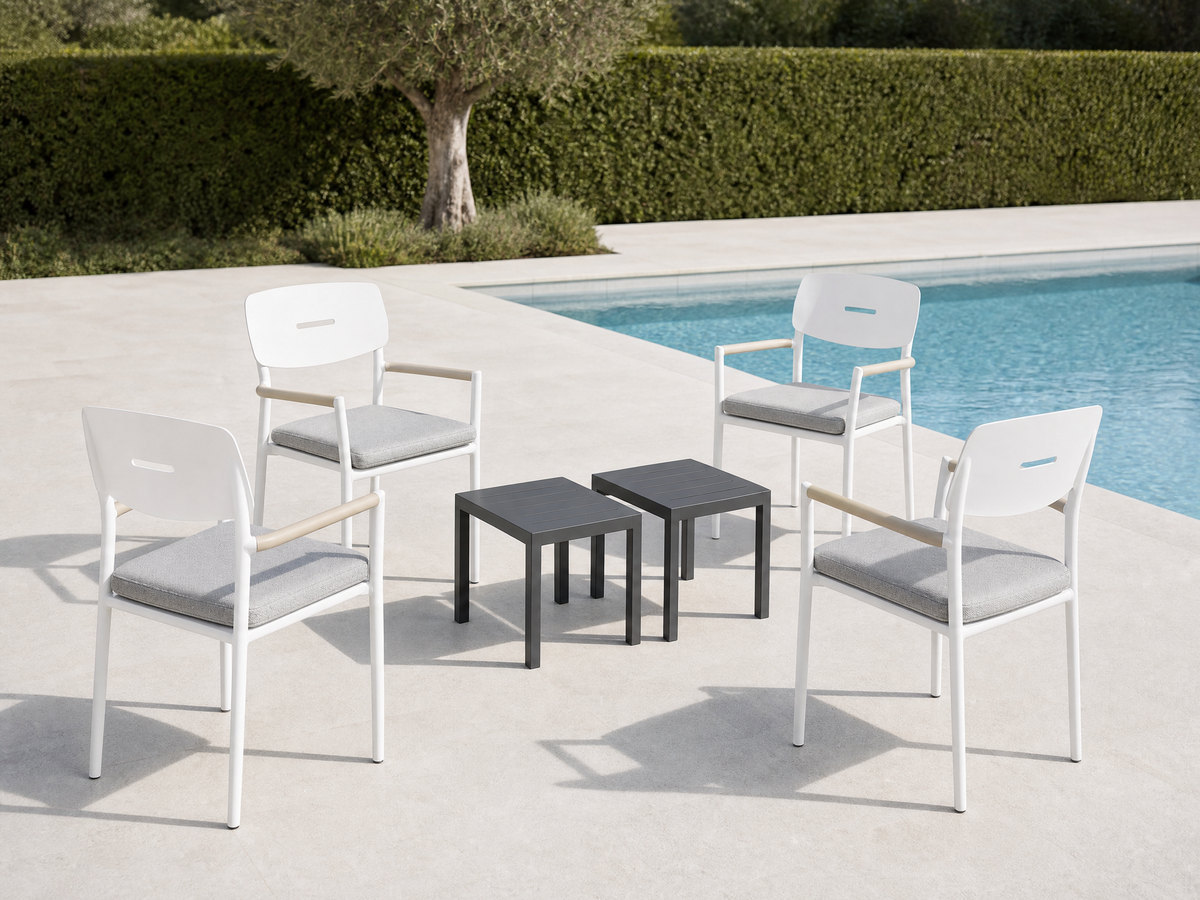
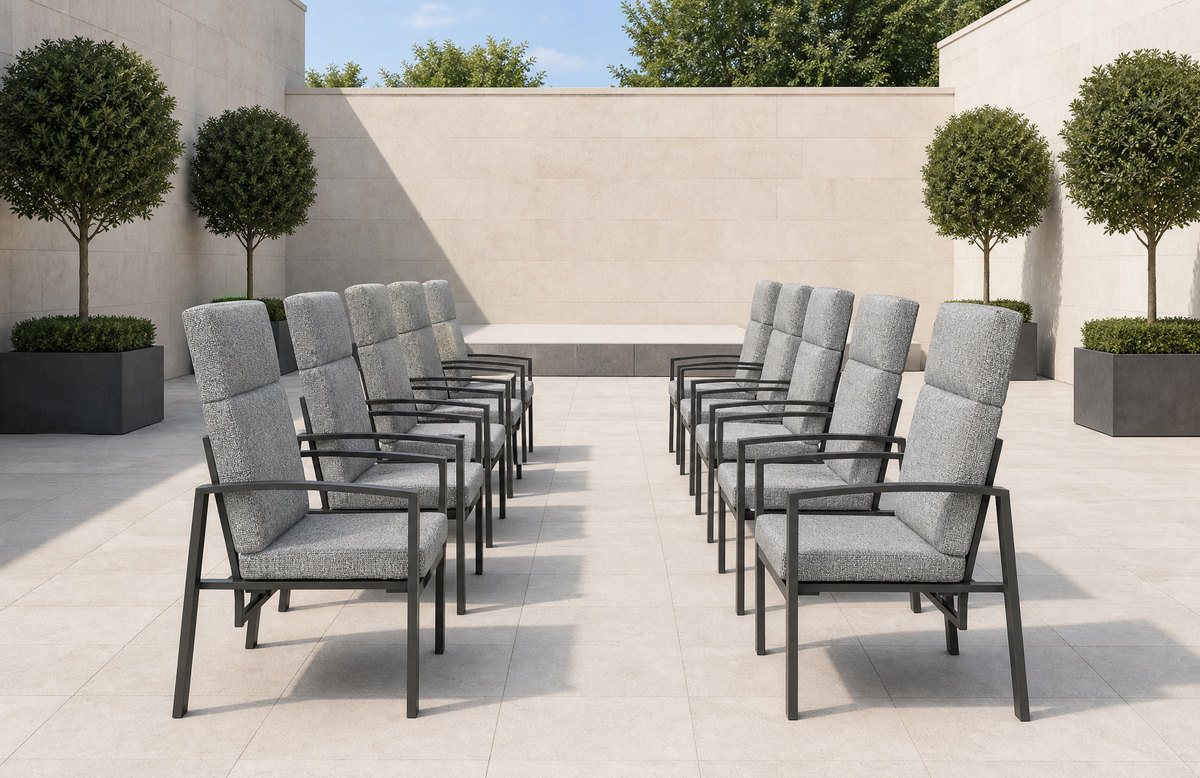
Built for contract supply
We supply hospitality procurement teams, restaurant groups, landscape contractors and outdoor furniture wholesalers with production, documentation and colour matching.
Made in our own workshop
Welding, powder coating, weaving and upholstery under one roof, so the fortieth chair matches the first.
Specification held as a recipe
Finish, fabric and part numbers recorded against the project, so a later phase or reorder is produced to the same instruction.
Checked before it ships
Incoming material checks, frame inspection and pre-shipment verification at our own facility.
Documented for export
Carton data, a loading plan for your container, HS code and the declaration documents on every order.
What separates contract grade from retail grade
Four differences that decide whether a terrace is still on its first set of furniture in year three, or on its second.
The frame is welded, not folded
Folded steel tube is cheaper because it needs no welding. A welded aluminium frame does not rust at a scratch and does not flex at the joint after a season of nightly clearing.
The unit can be repaired
A contract property damages individual units rather than whole sets. Cushions, covers, fixings and feet quoted as separate line items are what make a repair possible.
The surface wipes down
Restaurant service means a chair is cleaned between covers. Slat seats, removable cushions and smooth powder coat are specified for a one-pass wipe rather than for a photograph.
The specification is written down
Finish, fabric and part numbers recorded rather than remembered, so a reorder two years later arrives matching the floor it is going onto.
Stacking, knock-down and storage
Four ways a contract piece is built to be cleared, stored and shipped, and what each one costs you in space.
Stacking chairs
Nested one on another so a terrace clears in one pass. The high-back armchair in the range stacks 400 to a 40HQ, which also makes it the cheapest way to ship seating.
Knock-down chairs
The same chair supplied flat for sites with no storage. The same model loads 700 knock-down against 400 stacked, at two per carton and 0.1934 CBM per carton.
Table loading
Tables decide how much of a container is air. A 120 cm round table loads 330 to a 40HQ, and nesting or knock-down bases change that number before the top does.
Mixed containers
A seating programme and a table programme can travel together. The mix is quoted per mix, with carton data and declaration documents matched to each model.
Keeping a scheme identical across a floor
The failure that gets noticed in a hotel is not a broken chair. It is a chair that is a slightly different grey from the one beside it.
Finish held as a recipe
Frame colour, cord colour and cushion fabric are recorded against the project, so a phase two order is produced to the same instruction as phase one.
One sample, one standard
A finished sample is signed off before bulk production and kept as the reference. Nothing ships against a screen or a swatch book alone.
Stable part numbers
Components keep their numbers for the life of the range, so a facilities team can reorder a foot or a fixing without matching it by description.
Cushions the same batch
Replacement cushions are cut from the same fabric specification, which is the part of a scheme that fades first if a substitute is used.
Materials that survive daily cleaning
Four surfaces that come into contact with cleaning chemicals more often than with guests.
The powder coat
A baked matt powder coat takes mild soap and a rinse. Tell us what is used on the paving, because it lands on the frame too.
Slat seats and slotted backs
Open surfaces drain and wipe in one pass, and they dry between covers instead of holding water under a solid panel.
Removable covers
A cover that comes off can be washed and put back the same day, which is what keeps a terrace trading rather than short of seating.
Stainless hardware and glides
Fixings and floor glides that do not rust and do not mark a pale floor, on furniture that is moved twice a day.
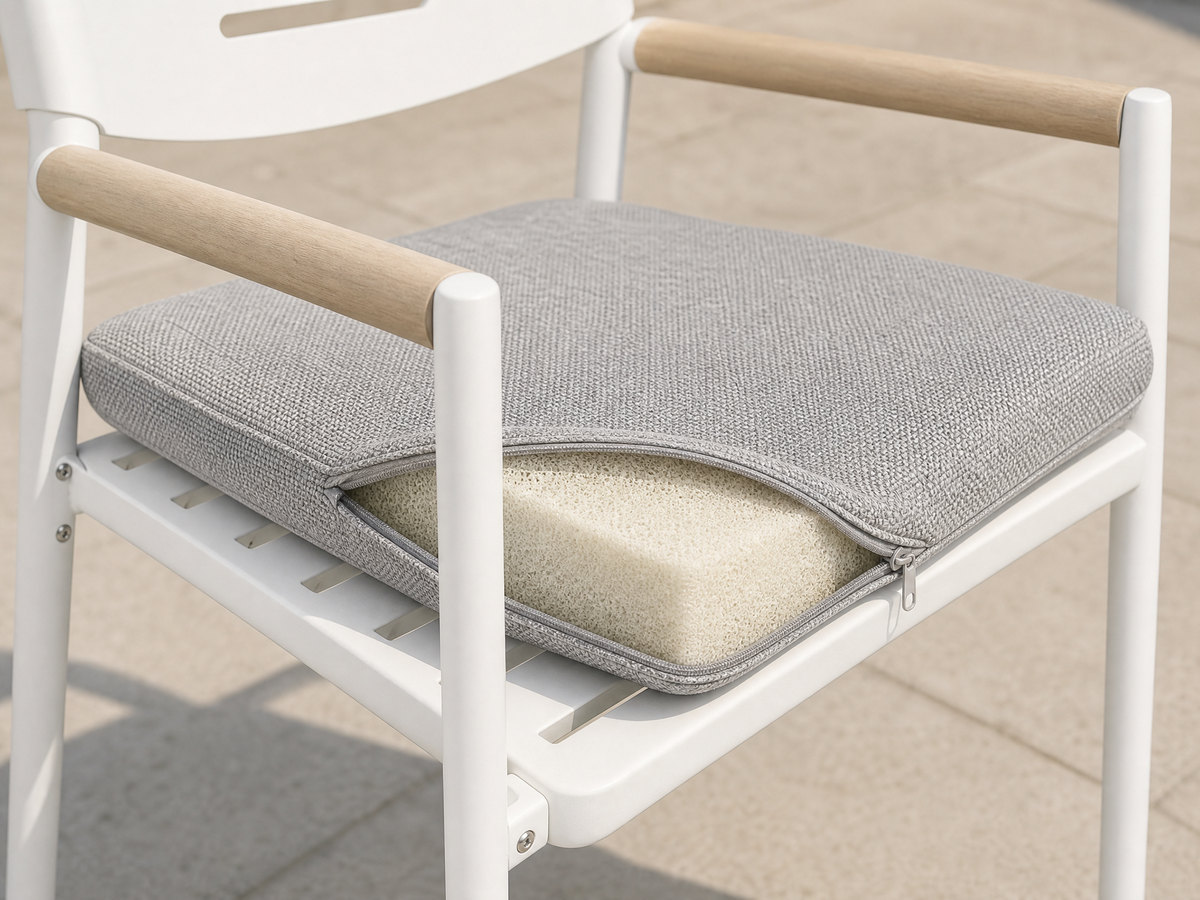
Built to be cleaned, stacked and repaired
A contract piece is bought for the routine it has to survive, not for the way it photographs. Ours is built so that a cover can be washed overnight, a chair can be stacked by one person, and a damaged unit can be replaced on its own against a stable part number.
- Slat seats and slotted backs that wipe down in one pass
- Removable covers over an open-cell foam that drains
- Welded aluminium frames with stainless hardware and glides
- Cushions, covers, fixings and feet quoted as separate lines
Commercial outdoor furniture specifications at a glance
What the contract specification covers as standard. Every line is a starting point rather than a limit, and anything here can be written into a project.
| Item | What is in the range | What decides it |
|---|---|---|
| Frame | Welded aluminium, square or round section | Section size, and whether the build is stacked or knock-down |
| Finish | Matt powder coat, charcoal and white | The facade and the paving it is seen against |
| Seat and back | Slat, slotted panel or upholstered | How fast the piece has to be cleaned between covers |
| Cushions | Open-cell foam with removable covers | Whether upholstery is left out or taken in at night |
| Hardware | Stainless fixings and floor glides | Whether the terrace is hosed down and how often pieces move |
| Loading | Stacked, knock-down or cartoned per piece | Storage available on site and the container you are working to |
| Parts | Cushions, covers, fixings and feet as line items | Whether the property maintains units or replaces sets |
| Documentation | Carton data, loading plan, HS code, declarations | The destination market and its clearance requirements |
What to check before you specify
Five things worth settling on paper. Each one is cheap to change before the order and awkward to change after it.
Measure the covers plan, not the terrace
A covers plan tells you how many seats are needed at peak and how many settings the tables have to make. The terrace dimensions come second.
Decide where the furniture goes at night
Stacking, knock-down or nothing at all. This decision changes the frame build and the loading number before it changes anything visible.
Match the surface to the cleaning routine
Tell us how the terrace is cleaned and with what. The seat surface, the cushion and the fixings all follow from that answer.
Write the specification down
Finish, fabric, part numbers and carton data recorded against the project. A rollout that is not written down drifts by phase two.
Order the spares with the programme
Cushions, covers and fixings are far easier to add to the first order than to match to it a year later, and they are what keep units in service.
Planning questions we ask before quoting
Six answers decide the build, the finish and the packing. None of them are technical, and they are quicker to answer now than to change later.
How many covers at peak, and how many settings?
It sets the chair count and the table count independently, which is usually where a contract quotation gets its first surprise.
Where does the furniture go at night?
Stacked in a store, left out, or taken down. It decides the frame build and the storage volume you need to find.
How is the terrace cleaned?
Hosed, swept, or wiped between covers. The cleaning routine is the best single guide to the surface specification.
Is this one site or a rollout?
A framework order is quoted differently, because the finish and fabric have to be held as a recipe rather than re-chosen per property.
What has to match?
An existing floor of furniture, a facade, a brand colour or a designer scheme. A photograph and a reference tell us more than a colour name.
What is the container and shipping plan?
Stacked, knock-down and cartoned pieces load very differently, so the mix is worth fixing before the quotation rather than after.
Common specifying mistakes
Six things that come up often enough to be worth naming, and what to do instead.
Specifying from a photograph
A photograph shows the shape and not the build. Section size, whether the frame is welded, and the loading number are all invisible in an image and all decisive in year two.
Forgetting the night-time routine
A terrace that has to be clear by midnight needs stacking or knock-down pieces. Discovering that after delivery means buying storage the property does not have.
Choosing cushions on colour alone
The fabric and the foam decide whether upholstery survives a season of cleaning. Colour is the easy part to change later.
Leaving the specification in an email
A rollout runs for years and changes hands. Finish, fabric and part numbers belong in the order record, not in a thread.
Not ordering spares
A damaged cushion should not take a seat out of service. Spares ordered with the programme cost less than a later match, and arrive in the same batch of fabric.
Leaving the packing to the forwarder
Stacked, knock-down and cartoned pieces load very differently. Ask for a loading plan with the quotation rather than after it.
What happens after year one
Contract furniture is judged on the second year, not the first. Four things decide how that goes.
Re-covering a cushion
Because the cover comes off, a tired cushion is re-covered rather than replaced, and the frame underneath never leaves the terrace.
Replacing a single unit
A chair that has been damaged is replaced on its own, against the same specification and part numbers, without reordering a set.
Touching up a frame
A scratch on a powder coat is a touch-up rather than a repaint, because there is no ferrous core underneath to spread.
Extending a floor
A new terrace or an extra phase is produced to the recorded recipe, so the two areas do not read as two different orders.
How a contract order runs
The same four steps whether you are furnishing one restaurant terrace or releasing a multi-site framework.
Brief and covers plan
Send the covers plan, the settings you need, the clearing routine and the colour scheme you are working to.
Sample and sign-off
A finished sample in your frame finish and fabric, kept as the reference that bulk production is measured against.
Production and QC
Frames welded and finished, weave fitted, cushions upholstered and inspected before packing.
Packing and export
Carton data, a loading plan for your container, HS code and the declaration documents.
What to order with a contract programme
The four lines that are far easier to add to the first order than to match to it a season or two later.
A spare cushion and cover set
Enough to keep a percentage of seats in service while the rest are cleaned or dried, cut from the same batch of fabric.
Fixings, glides and feet
Listed as part numbers so a maintenance team can reorder without going back through a new quotation.
Touch-up paint
For a property that will touch up frames after installation rather than returning a unit.
A written specification pack
Finish, fabric, part numbers and carton data on one sheet, so the scheme survives a change of facilities team or contractor.
Upkeep in a commercial setting
Four routines that keep a contract floor in service rather than in store.
Daily cleaning
Mild soap and a rinse on frames and surfaces. Solvent cleaners and abrasive pads take the sheen off a powder coat, and that is the usual reason a floor looks older than it is.
Rotating cushions
Rotating cushions between seats spreads wear, which matters most on the seats that are used at every service.
The start-of-season check
Fixings tightened and glides checked once a year. Stainless hardware does not rust, but furniture that is moved twice a day works loose.
Off-season storage
Cushions stored dry and off the floor, frames stacked where the build allows. Upholstery stored damp is what shortens its life.
Commercial outdoor furniture questions buyers ask
Eight answers that cover most of what comes up before a contract container is specified.
What does contract grade mean in practice?
It means the piece is built and documented for daily commercial use: a welded aluminium frame rather than folded tube, stainless fixings and glides, a surface that wipes down between covers, removable covers over draining foam, and components that carry stable part numbers so a single unit can be repaired.
What is the minimum order for a contract programme?
It depends on the piece, because it is driven by how the furniture loads. Chairs and tables are normally quoted as container programmes: the white slat-seat armchair loads 870 to a 40HQ, the high-back armchair loads 400 stacked or 700 knock-down, and the 120 cm round table loads 330. Tell us what you are furnishing and we will quote the smallest sensible programme.
Can you supply the same specification to several properties?
Yes. A framework order holds the finish, cord colour, cushion fabric and part numbers as a fixed recipe and then releases it in phases, so a late site does not hold an early one and the properties do not read as separate orders.
Can we reorder matching pieces later?
Yes, and that is the point of recording the specification. A reorder is produced against the same instruction and the same part numbers, so it does not need a new sample stage and does not arrive as a slightly different shade.
How are stacking and knock-down chairs packed?
Stacking chairs ship nested, which is the cheapest way to move seating. Knock-down chairs ship flat, two to a carton at 0.1934 CBM, which suits a site with no storage but adds assembly. The build is chosen against the storage you actually have.
Can frames and cushions be made in our colours?
Yes. Frame finish, cord colour, cushion fabric and table-top material are specified to a project brief, and a finished sample is produced and kept as the reference before bulk production starts.
Do you supply replacement cushions and parts?
Yes. Cushions, covers, fixings, glides and feet are quoted as separate line items so a property can maintain individual units rather than replace a set, and replacement cushions are cut from the same fabric specification as the original order.
What should I send for a quotation?
The covers plan and the number of settings, where the furniture is stored at night, how the terrace is cleaned, whether this is one site or a rollout, what has to match, and the container you are working to.
Planning a contract furniture programme?
Send us the covers plan, the clearing routine and the scheme you are working to, and we will come back with the specification, the loading plan and a delivered price.
Terms used on this page
Short definitions of the words that come up most often in a commercial outdoor furniture quotation.
Related pages
Where to go next, depending on the build and the finish you settle on.
Why choose Foris Hortus for commercial outdoor furniture
Contract work is judged on the second order rather than the first. Every piece here is built on a welded aluminium frame, specified piece by piece, and documented with part numbers, carton data and a loading plan, so a floor can be extended, a unit repaired and a cushion re-covered instead of a set replaced. That is the substance behind the experience, expertise, authoritativeness and trust that B2B buyers need before they commit to a container.
- Welded aluminium frames from our own workshop
- Part numbers and a written specification per project
- Stacked, knock-down and mixed-container programmes
- Loading plan and export documents with every order

Elevate Garden Living
- Phone
- *Title
- *Content