Cantilever Umbrellas
Offset shade without a pole through the table
A cantilever umbrella hangs its canopy from an arm instead of standing it on a pole in the middle. The upright sits at the edge of the group and the arm reaches out over the seating, so the table, the service path and the sightline across the terrace all stay clear.
That one change is why offset frames get specified for restaurant terraces, pool decks and rooftop bars: the shade moves to where the guests are, instead of the structure moving into the middle of them. The trade-off is a heavier base and a frame that has to be anchored properly, which is what most of this page is about.
- Upright set to one side
- Rotation and tilt options
- Free-standing or bolted bases
- OEM and ODM supply
Three parts decide how a cantilever behaves
Every offset umbrella is built around the same three assemblies. Ask about each one separately, because they fail for different reasons.
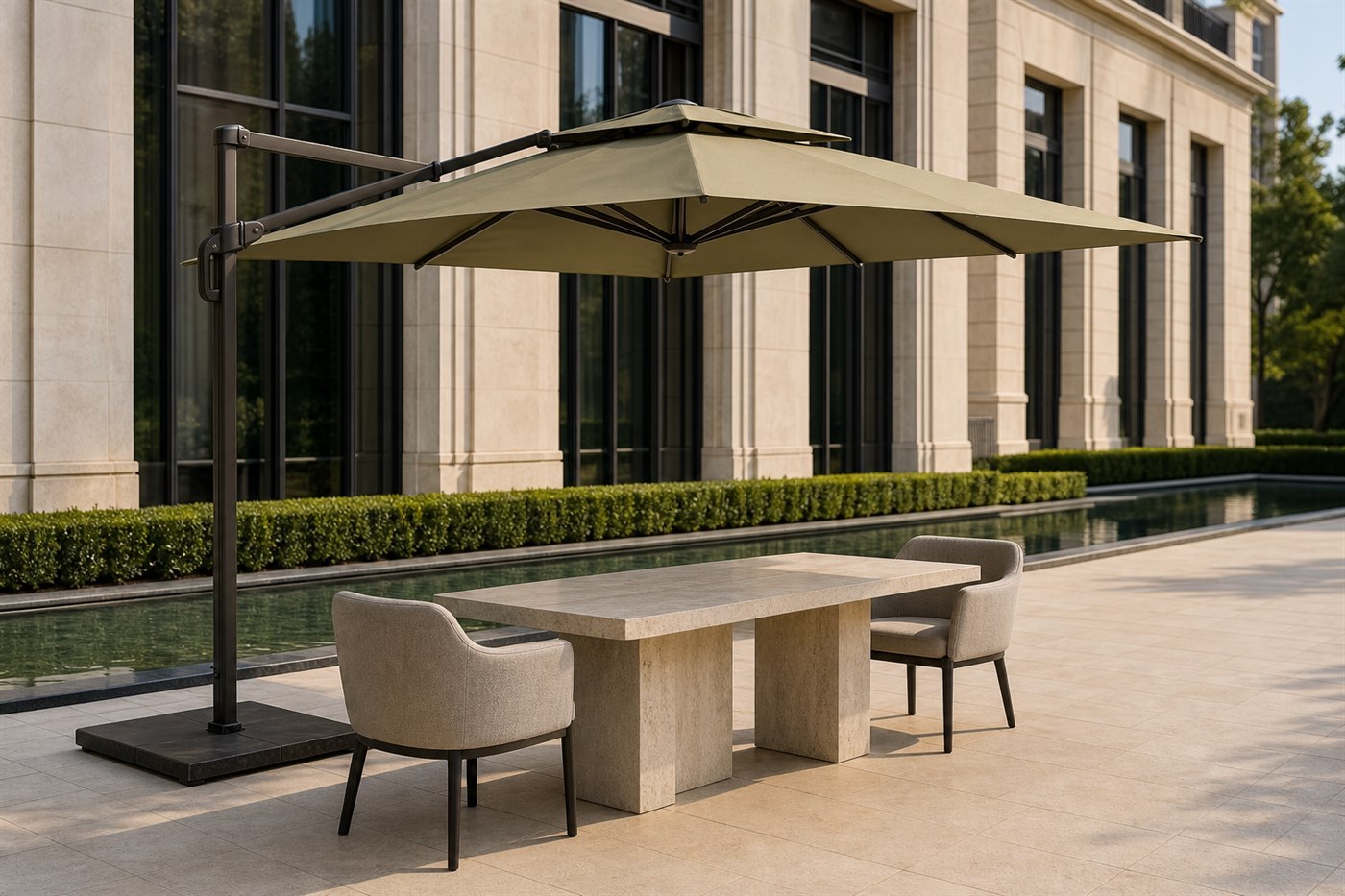
The offset arm
The arm carries the canopy out from the upright. Its length sets how far the shade reaches, and how much load the frame has to hold.
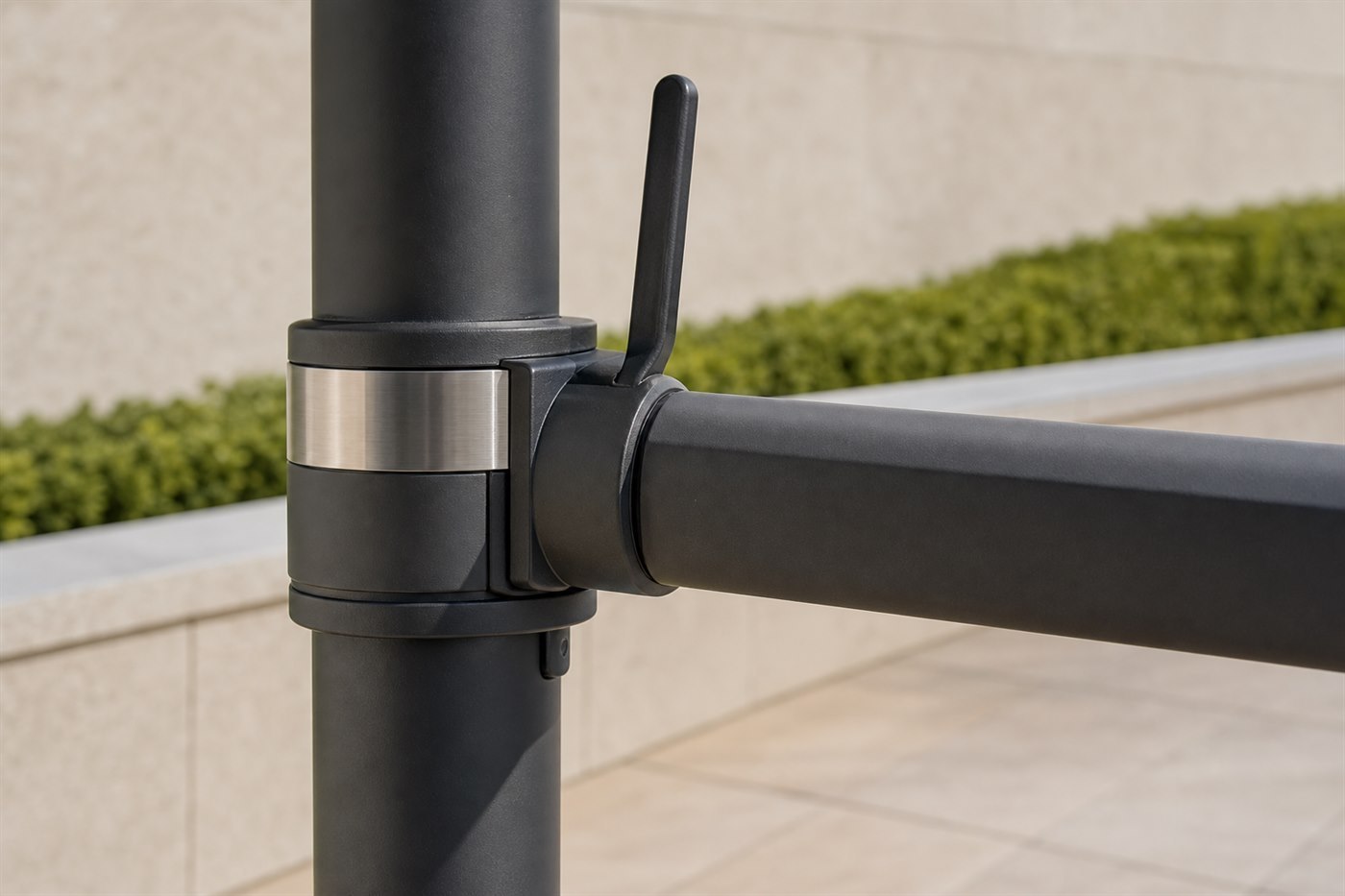
The rotation joint
A collar at the top of the upright lets the canopy swing round, and a lever sets the tilt. This is the part that decides whether the shade can follow the sun.
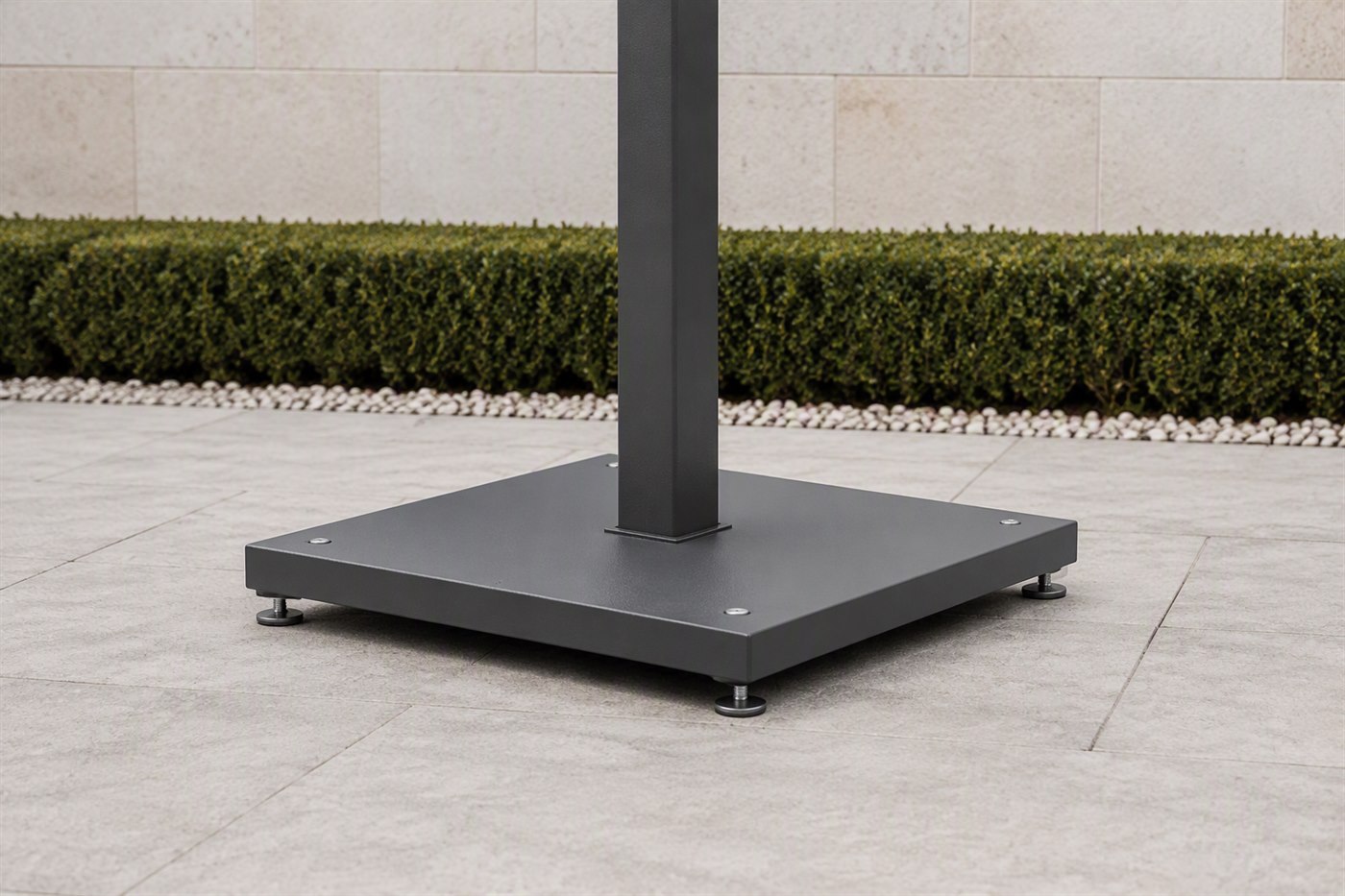
The base and counterweight
Because nothing stands under the canopy, the frame is held up by the base alone. Its weight and its fixing, not the canopy, decide how much wind the umbrella tolerates.
Cantilever or centre pole
Both hold a canopy. They differ in what they take out of the terrace and what they ask of the ground.
Choose cantilever when
The table has to stay completely clear, the shade needs to move across a group as the sun moves, the seating group is wider than one upright can cover, or the terrace is a pool deck or lounge area rather than a fixed dining row.
Choose a centre pole when
The setting is a fixed dining table and an upright through the middle is not in the way, the ground cannot take a heavy base or a bolted plate, or the umbrellas are folded away each night and moved often.
What actually changes
The cantilever asks more of the base and the fixing, and gives back an unobstructed table, wider coverage per frame and shade that can be moved through the day.
| Consideration | Cantilever | Centre pole |
|---|---|---|
| Space under the canopy | Completely clear, with no upright through the group | One upright through the middle of the table |
| Base requirement | Heavy: the base alone holds the frame up | Lighter: the pole shares the load with the base |
| Shade movement | Usually rotates and tilts to follow the sun | Fixed position, or tilts only |
| Best fit | Pool decks, lounges and wide seating groups | Fixed dining rows and tighter terraces |
Rotation, tilt and reach: what to ask for
These are the details that decide whether the umbrella covers what you are actually shading. Ask for them explicitly rather than reading them off a product photo.
Rotation
Ask how far the canopy swings round, and whether it locks in position or swings freely. On a terrace that runs all day, rotation is what lets one frame follow the sun.
Tilt
Ask how the tilt is set and whether it holds once set. A tilt that slips turns a shaded table into a sunlit one by mid-afternoon.
Reach
Ask how far the canopy sits from the upright. That distance, more than canopy size, decides whether the shade lands over the chairs or beside them.
Clearance
Ask the height under the canopy rim when it is tilted. Too low and guests duck; too high and the shade drifts off the table.
Where offset shade earns its cost
Four settings where the missing upright is not a detail, but the reason the layout works at all.
Pool and spa decks
Loungers sit in a row and the shade has to move with the sun rather than with the furniture.
Restaurant terraces
The service path stays clear, so staff are not walking around an upright all evening.
Hotel courtyards
A wide seating group can be covered by one frame instead of several small ones.
Rooftop and event decks
Frames can be swung clear between events instead of being taken down and stored.
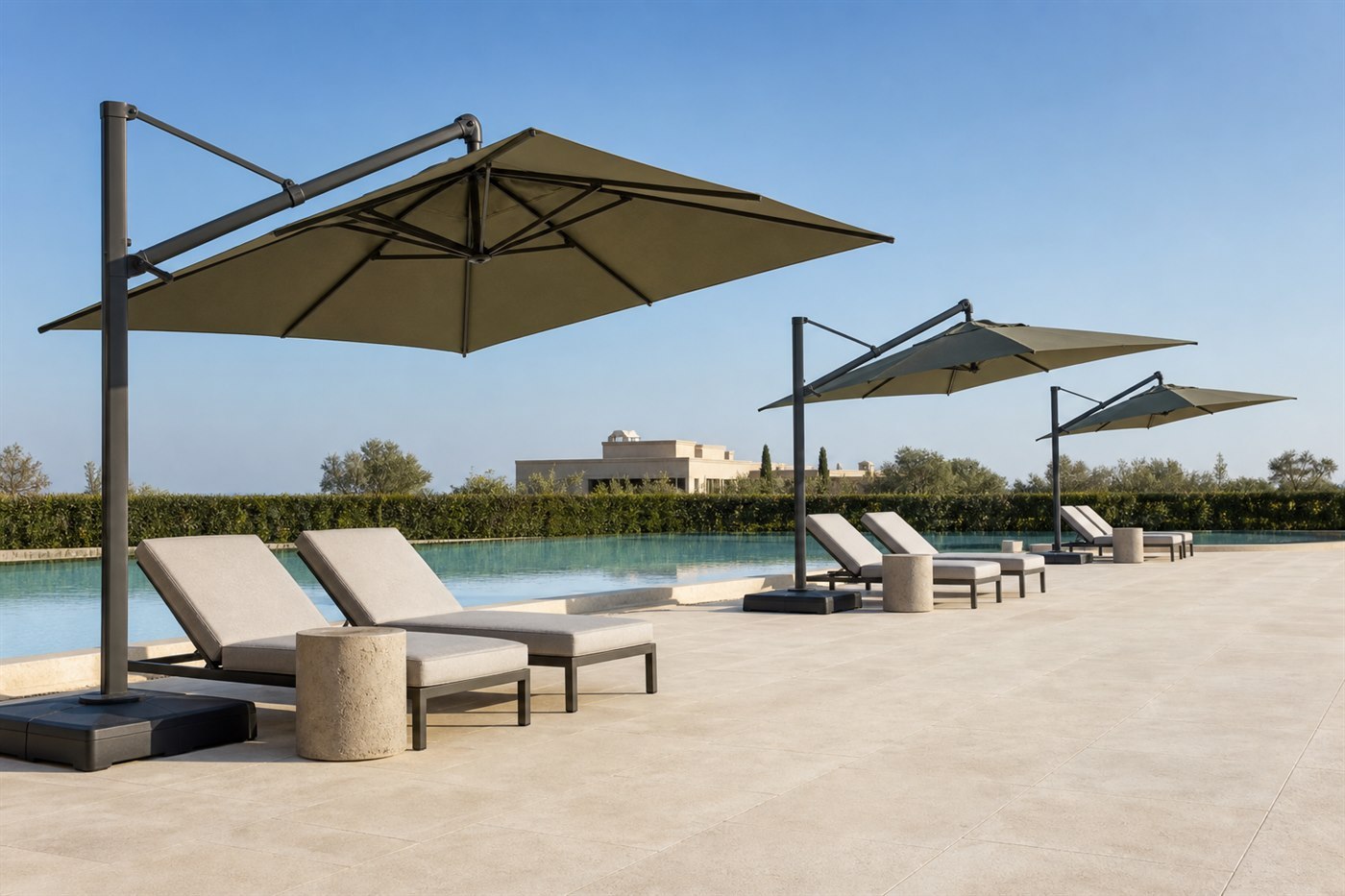
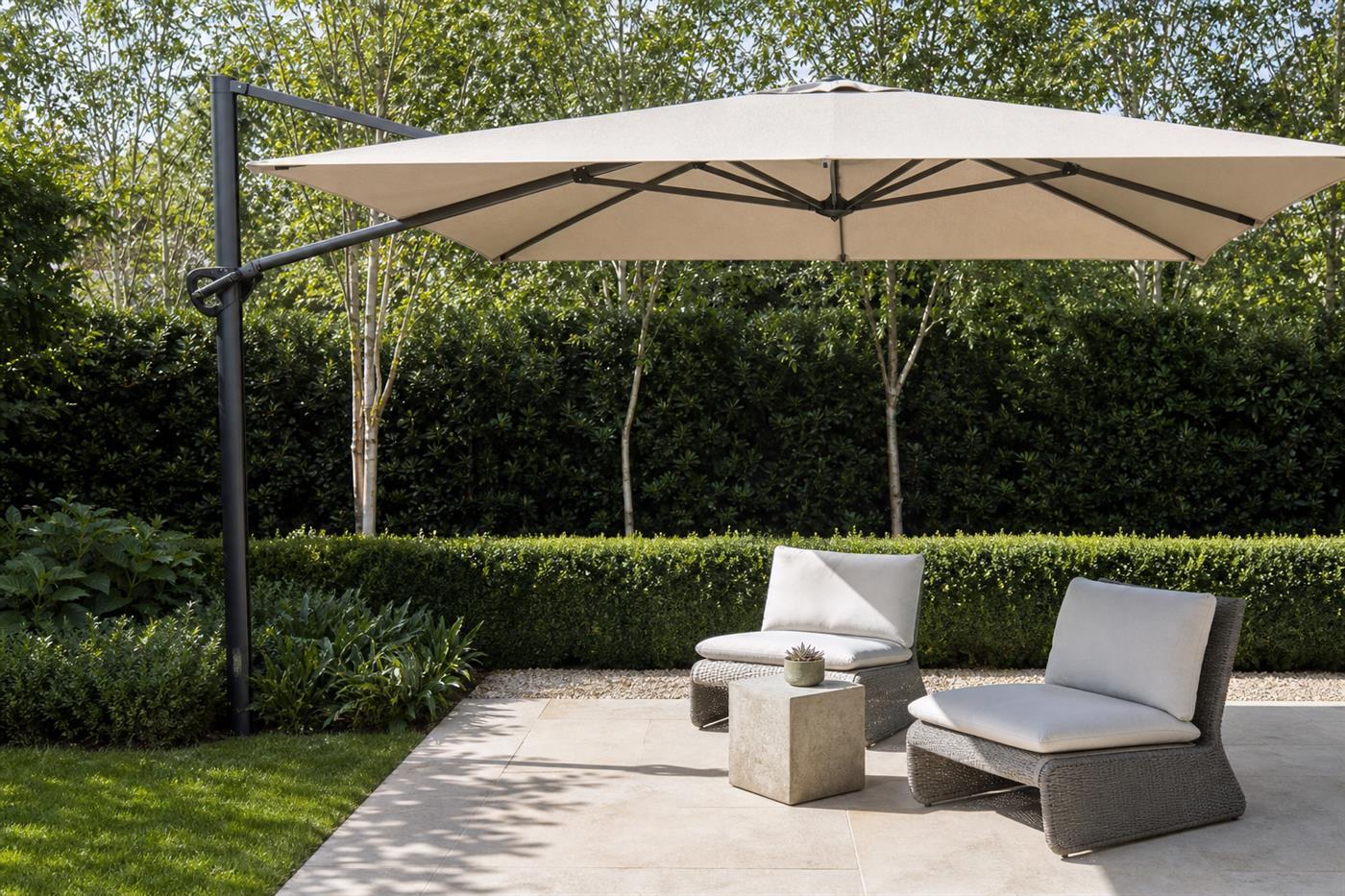
Canopy shapes and what decides the size
Shape is a layout decision before it is an aesthetic one, and size is set by the seating rather than by the catalogue.
Square and rectangular
Covers a rectangular table or a row of loungers with less overlap between neighbouring frames.
Round
Suits a single round table or a cluster of chairs, and reads the same from every angle on the terrace.
Mixing shapes
Mixing shapes on one site usually costs more in spares than it saves in layout. One shape across a terrace keeps the spare-parts list short.
Reach to the far edge
The distance from the upright to the furthest chair you need to shade. This comes first, because it sets the arm and the base.
Footprint of the group
The area to be shaded, plus an allowance for how low the sun gets at the hour the terrace is busiest.
Spacing between frames
Neighbouring canopies shade each other, so the gap between uprights is part of the sizing, not an afterthought.
Wind, base and anchoring
An offset frame has no upright standing on the ground under the canopy, so the whole structure is held by its base. On a rooftop or an exposed terrace, this is the part that decides whether the umbrella is still standing next season.
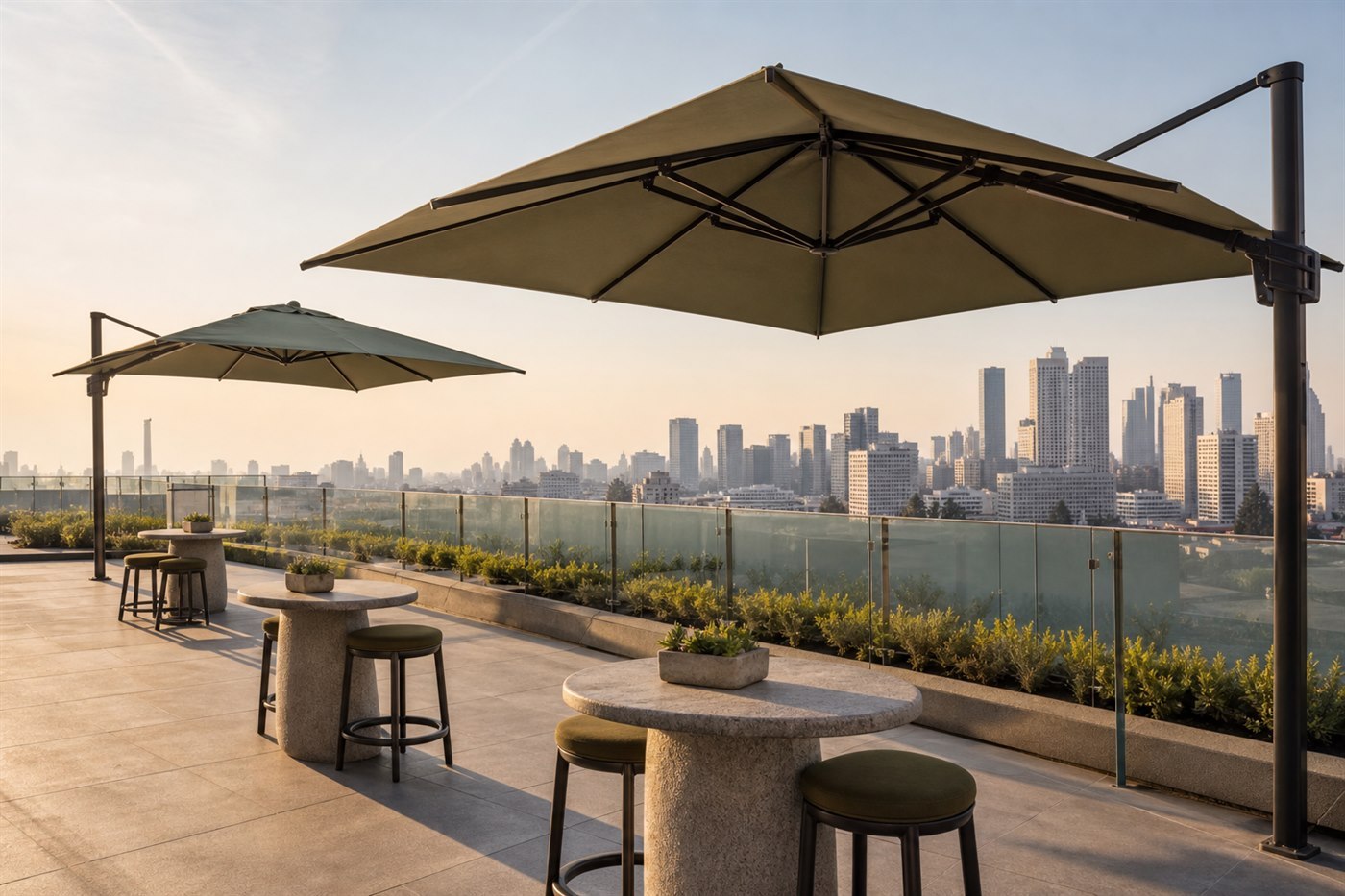
Base weight and footprint
A free-standing base has to carry the arm and the canopy on its own. Ask for the weight and the footprint before choosing a position on the deck.
Bolting or ballasting
Where the surface allows, bolting the plate down is the sturdiest arrangement and takes the least floor space. Where it does not, the frame depends on ballast alone.
Wind rating
Ask what wind speed the frame is rated for and at what point the canopy should be closed. A frame for a sheltered courtyard is not the frame for a rooftop.
Left open or closed overnight
Frames that stay open through the season need a heavier base and a higher rating than frames that are closed each night.
What to check before you specify
Five details that decide whether an offset frame still stands and still shades in year three.
Reach, not just canopy size
Check the distance from the upright to the far edge of the group you are shading. A large canopy on a short arm can still leave the chairs in the sun.
Rotation and tilt
Confirm how far the canopy rotates, how the tilt is set, and whether the tilt holds once it is set.
Base and fixing
Match the base to the surface, and confirm what load the deck or slab can actually carry.
Wind rating
Ask for the rated wind speed and the speed at which the canopy has to be closed.
Canopy fabric
Solution-dyed fabric holds colour, and the canopy has to be replaceable on its own rather than with the frame.
Planning questions we ask before quoting
Six answers decide the reach, the base and the frame. None of them are technical.
How wide is the group you are shading?
It sets the reach you need, and the reach sets the arm length, the base weight and the frame size.
Does the shade have to move during the day?
If it does, rotation and tilt stop being optional and become the features the whole specification turns on.
What can the ground take?
A bolted plate, a heavy free-standing base and a ballasted base suit different surfaces and different load limits.
Will the umbrellas stay out overnight?
Frames that stay out need a higher wind rating and a heavier base than frames that are closed each night.
Is the terrace exposed or sheltered?
A courtyard and a rooftop need different ratings for the same canopy size, so tell us which one it is.
How many frames, and in what shape?
Neighbouring canopies shade each other, so the spacing between uprights is part of the sizing rather than an afterthought.
Common specifying mistakes
Six things that are cheap to get right at quotation stage and expensive to correct once the terrace is built.
Sizing by canopy, not by reach
A large canopy on a short arm still leaves the chairs in the sun. The reach is what puts the shade where you want it.
A base chosen from the catalogue
On an offset frame the base is the structure. Choosing it before anyone has looked at the deck is how umbrellas go over.
Rotation treated as a luxury
On a terrace that runs all day, a frame that cannot turn is useful for about two hours of it.
A tilt that will not hold
A tilt that slips puts the shade somewhere else by mid-afternoon. Confirm how it is set and that it stays set.
Two canopies placed too close
Neighbouring frames shade each other, so a tightly packed row covers less than the same number of frames spread out.
One odd shape in the corner
Mixing canopy shapes on one site adds spares and confusion for very little gain in layout.
On-site installation in five steps
Offset frames go up in a different order from a centre pole umbrella, because the base has to be right before anything is loaded onto the arm.
- 1
Set out the positions and check the reach
Mark the upright positions first and check the reach over the seating, plus clearance from walls, glazing and planting.
- 2
Fix or place the base
Bolt the plate down where the surface allows; otherwise position and level a free-standing or ballasted base.
- 3
Assemble the upright and the arm
Stand the pole, fit the arm and check the joint before the canopy goes on.
- 4
Fit and open the canopy
Fit the canopy to the ribs, then open it and run rotation and tilt through their full range.
- 5
Check it in real wind
Check the frame on a breezy day rather than a still one, and confirm the wind speed at which it should be closed.
Care, storage and the moving parts
An offset frame has one more set of moving parts than a centre pole umbrella, and they are the parts that decide how long it lasts.
Cleaning the canopy
Canopy fabric is cleaned on the frame or off it, so check what the maker recommends before the first season.
The joint and the arm
The rotation collar and the tilt lever are the moving parts. Keep them free of grit and check them at the start of each season.
Closing overnight
On an exposed terrace, closing the canopy overnight takes the standing load off the arm and the base.
Off-season
Frames that come in for winter should be stored with the canopy off and dry, so the fabric is never folded away damp.
What a complete order includes
Worth checking line by line against a quotation, because on an offset frame the base and the rating are easy to leave vague.
Frames
To the arm length and upright height specified, with the opening mechanism confirmed.
Canopy fabric
In the colour, weave and shape chosen, and replaceable on its own.
Base and fixings
Matched to the surface on site and to the load it can carry, not chosen from a catalogue page.
Rotation and tilt specification
Stated on the quotation rather than assumed from a photograph of the frame.
Wind rating
With the wind speed at which the canopy should be closed written down.
Spares
On a terrace that runs every day, a replacement canopy or spare ribs so one damaged frame does not mean a dark table.
A combined spare-parts list
One list covering frame, canopy and base, so a single order keeps a mixed terrace running.
Customisation and ordering
Offset frames are quoted around the terrace rather than around a standard size, so the reach and the fixing are the first things we settle.
- Canopy size and shapeSquare, rectangular and round, sized to the seating group.
- Fabric colour and brandingSolution-dyed canopies, print or logo on request.
- Arm and upright lengthReach and clearance set to the terrace rather than to a standard frame.
- Base and mountingFree-standing, ballasted or bolted, chosen against the surface on site.
Tell us the width of the seating group, the surface it stands on and whether the umbrellas stay out overnight, and we will narrow the specification to the two or three frames that actually fit.
Common questions about cantilever umbrellas
The questions buyers ask most often before they specify offset shade.
Does a cantilever umbrella need a heavier base?
Yes. Nothing stands on the ground under an offset canopy, so the base alone holds the frame up. Its weight and its fixing are what keep the umbrella standing in wind.
Can it be left out all year?
Ask what wind rating the frame is built to and at what speed the canopy should be closed. A sheltered courtyard and an exposed rooftop need different answers for the same canopy size.
How do I know the shade will land where I want it?
Check the reach from the upright to the far edge of the seating group, and the height of the canopy rim when it is tilted. Canopy size on its own does not tell you either.
Is rotation worth specifying?
On a terrace that runs all day, yes: a frame that cannot turn only shades the same spot for part of it. Where the group is fixed and the sun is predictable, it matters less.
Can the canopy be replaced on its own?
Worth confirming before you order, along with whether spare ribs are available. It decides whether a torn canopy means a new canopy or a new umbrella.
What should I send to get a quotation?
The width of the seating group, what the ground can take, whether the umbrellas stay out overnight, and how many frames you need. With those we come back with the reach, the base and a delivered price.
Terms used on this page
Short definitions of the words that come up most often in a cantilever quotation.
Related umbrella pages
Where to go next, depending on the frame and the fixing you settle on.
Specifying offset shade for a terrace?
Send us the width of the seating group, the surface it stands on and whether the umbrellas stay out overnight, and we will come back with the reach, the base and a delivered price. Start a quotation request.

Elevate Garden Living
- Phone
- *Title
- *Content