LED Outdoor Umbrellas
Outdoor umbrellas with lights built in
An LED outdoor umbrella carries its light in the frame instead of asking you to run cables across a terrace. The strips or pucks sit inside the ribs or the hub, run from a small solar panel on the canopy or a rechargeable pack in the pole, and switch on with the same handle you use to crank the canopy open.
That is the whole point for a commercial terrace: the shade you already paid for keeps earning after sunset, with no extra posts, no trailing leads and nothing for a guest to trip over.
- Solar or mains power
- IP-rated light modules
- Replaceable LED strips
- OEM and ODM supply
Where the light actually sits on an umbrella
Three placements cover almost every lit umbrella, and each one lights a terrace differently.
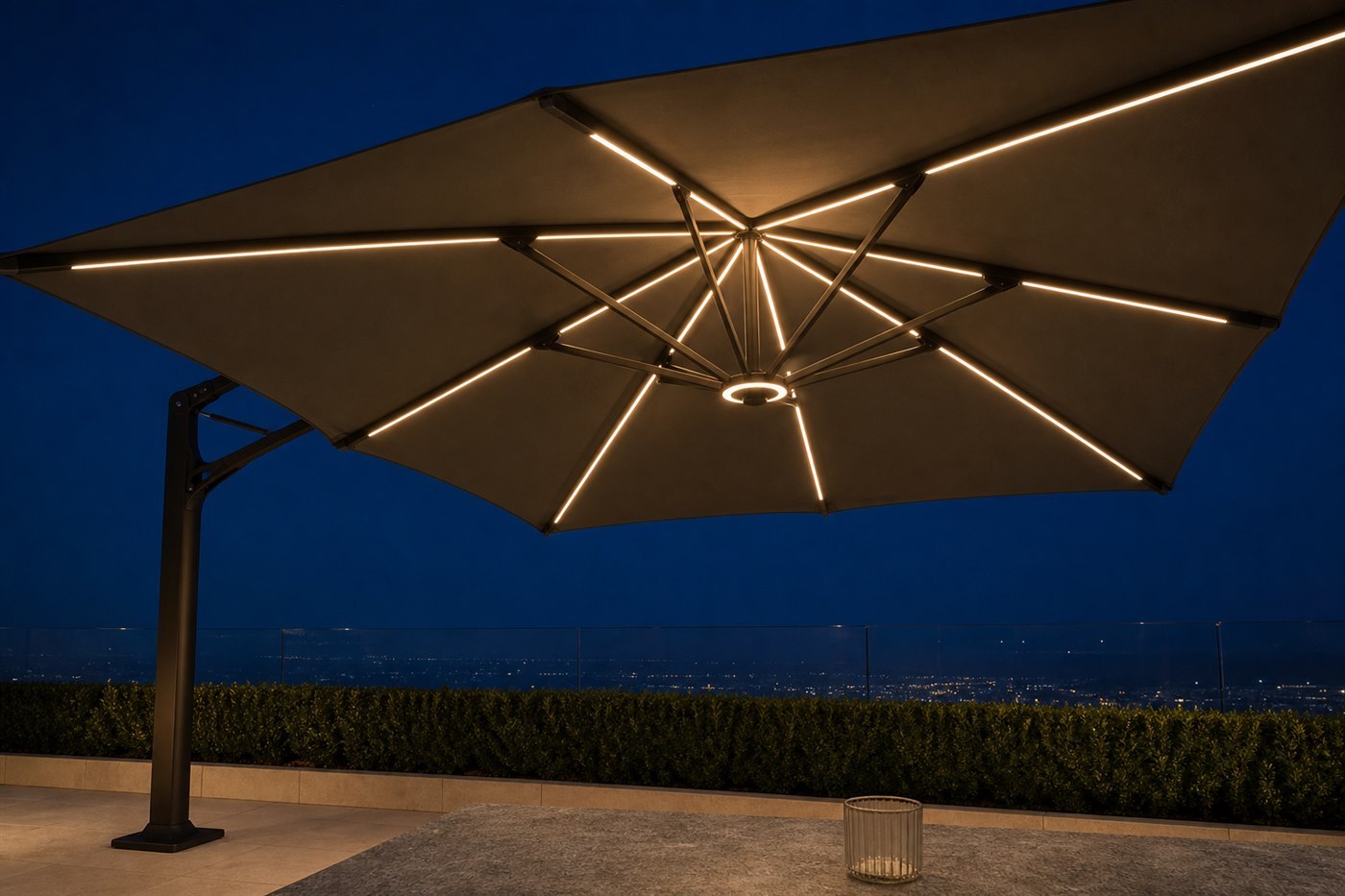
Rib-mounted strips
Strips are recessed along the underside of every rib, so the light traces the canopy outline and spreads across everything beneath it.
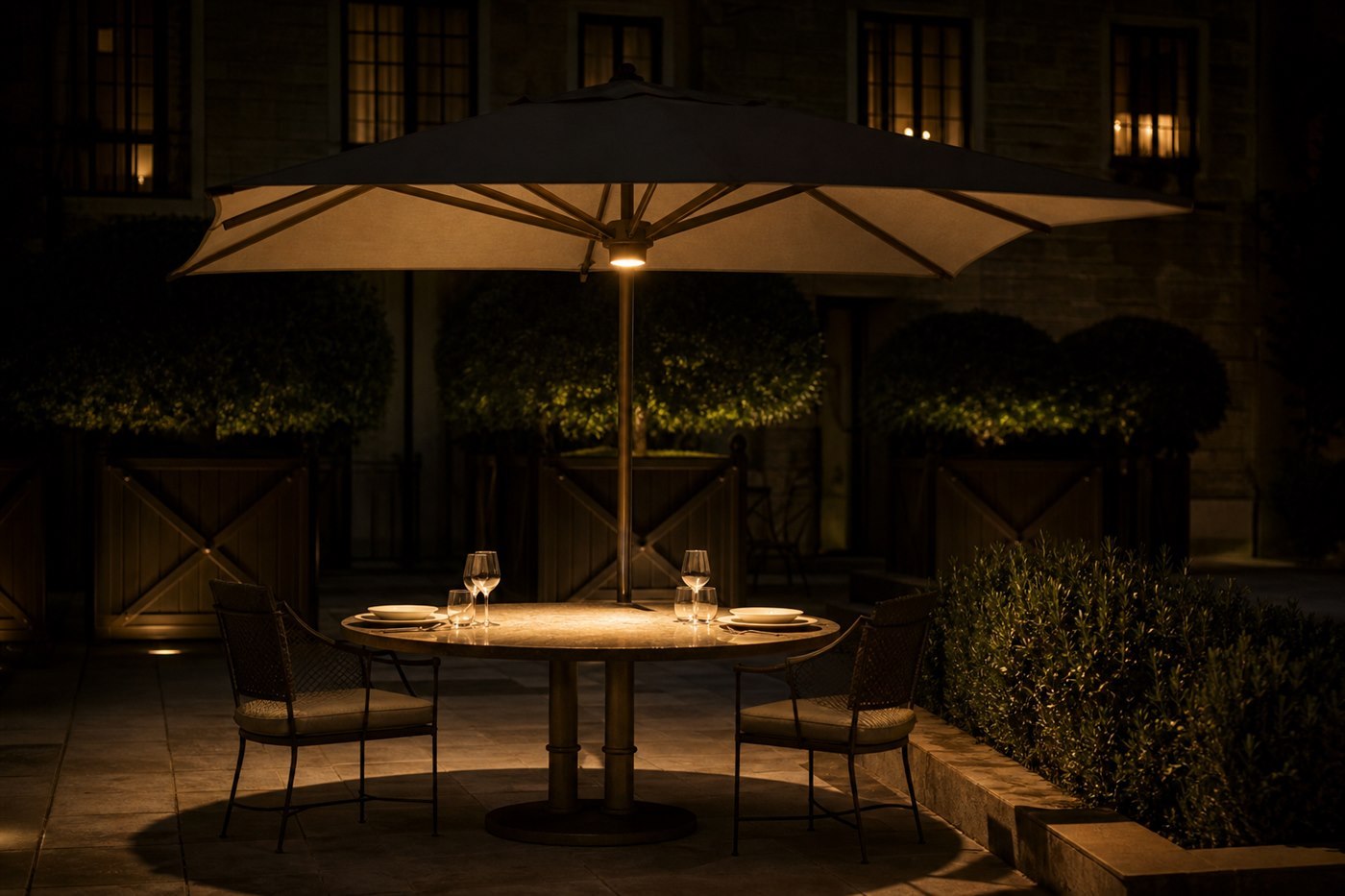
Hub lamp
One lamp at the centre of the canopy throws a single pool of light straight down, which lands on the table and little else.
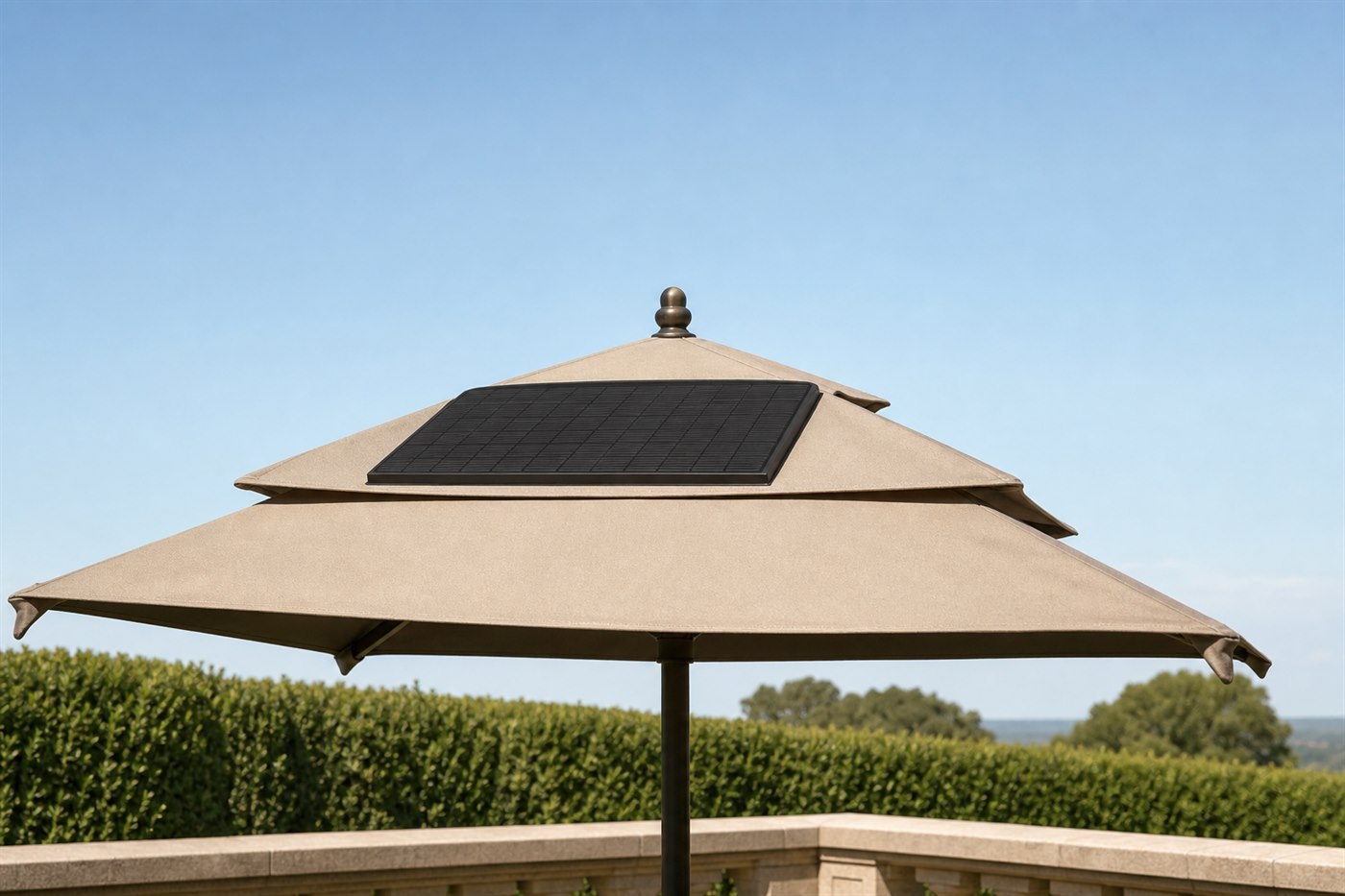
Solar panel on the canopy
A slim panel sits flat across the crown of the canopy and charges the pack that feeds the lights, with no cable to the building.




Choose the frame first, then the light
The lighting is quoted as an option on the frame, so the frame decides how the terrace works in daylight and where the light can go.
Cantilever
The pole stands to one side and the canopy is carried out over the seating, so nothing interrupts the table underneath. The usual choice where guests need a clear view across the terrace.
Centre pole
One pole through the middle of the setting. The simplest and most rigid arrangement, and the natural fit for a fixed dining table.
Side pole
A straight pole beside the table rather than through it. Keeps the table clear without the cantilever arm, for a terrace where the canopy stays in one position.
Where a lit umbrella pays for itself
Four settings where the lighting is not decoration, but the reason the space still earns after dark.
Hotel courtyards
Guests stay for a second drink when the table is still lit and the terrace still reads as open.
Restaurant terraces
Extends the second seating without stringing temporary lighting across the tables.
Pool decks
Low, local light over the loungers instead of floodlighting the whole deck.
Rooftop bars
No cable runs to design around, so the deck stays flexible for events.
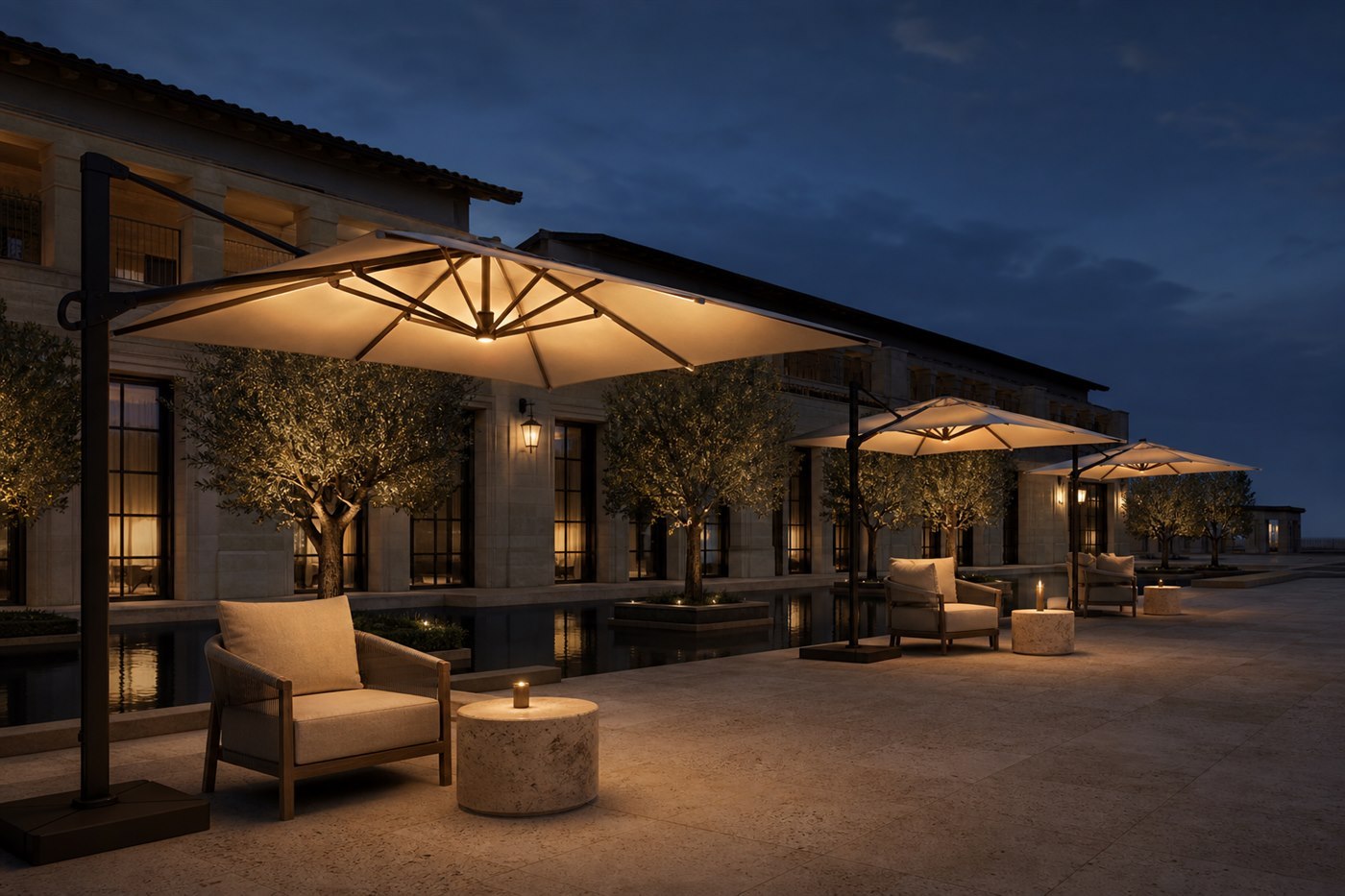
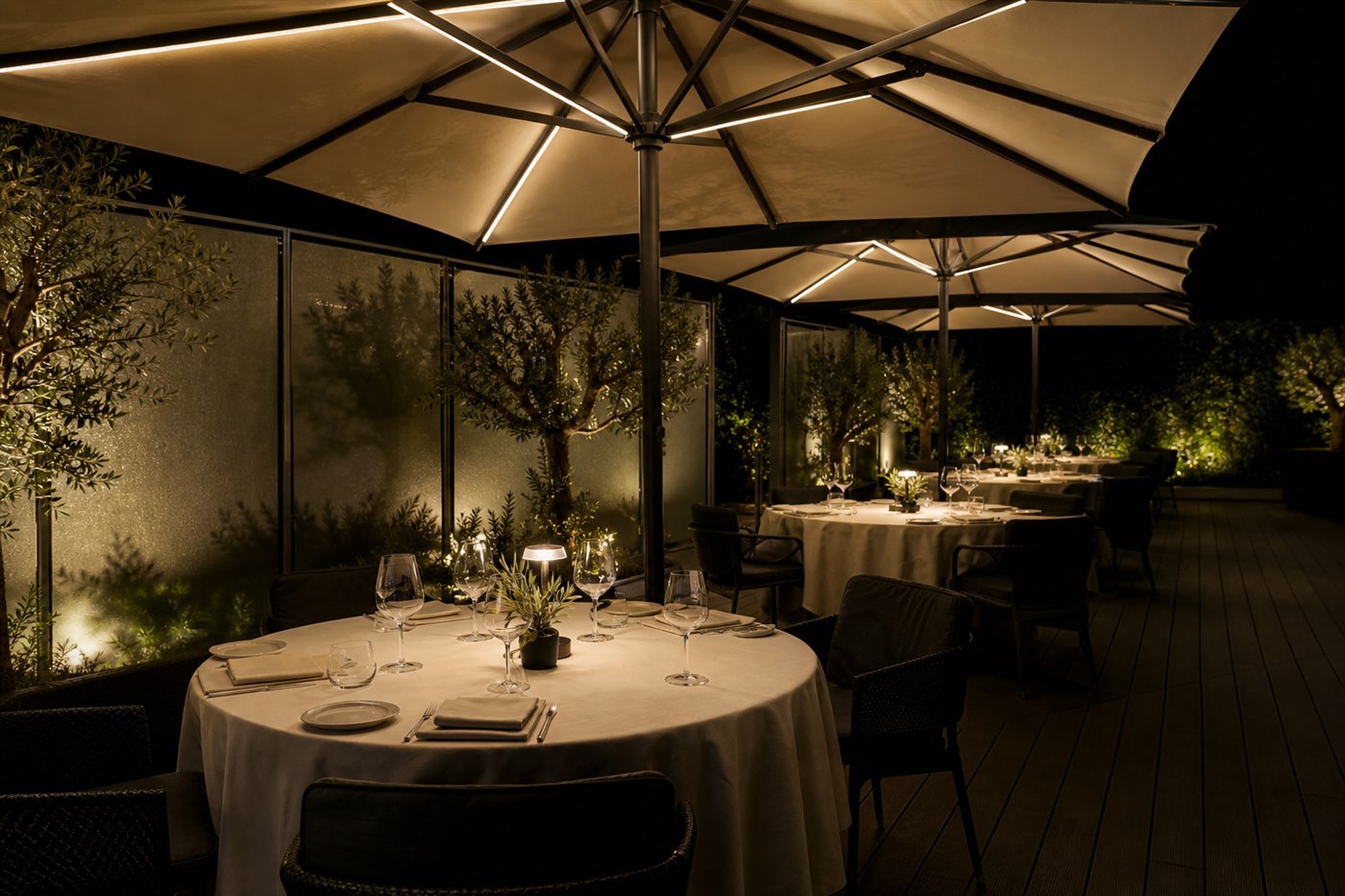
Solar or wired: which power source to choose
The frame is the same either way. What changes is where the electricity comes from, and what that costs you to install.
Solar and rechargeable
- Panel sits on top of the canopy; no cabling to the building.
- Fits terraces where you cannot trench or add circuits.
- Runtime depends on how much daylight the canopy actually gets, so check shading before you commit.
- Rechargeable packs can be charged indoors and swapped at the start of the season.
Mains powered
- Steady output all evening regardless of the weather that day.
- Better where the umbrella stays in one place year round.
- Needs a circuit and a discreet cable route up the pole.
- Worth it for a fixed terrace with a predictable closing time.
| Consideration | Solar on the canopy | Mains powered |
|---|---|---|
| Installation | No cabling to the building and no trench to dig | Needs a circuit and a discreet route up the pole |
| Output | Depends on how much daylight the canopy actually gets | Steady all evening whatever the weather that day |
| Best fit | Terraces where you cannot trench or add circuits | Fixed terraces that run late, year round |
| Main limitation | Not suitable for a canopy that sits in shade for most of the day | Installation cost, and a cable that has to be concealed |
How a solar lit umbrella works
Nothing in the sequence is complicated, but knowing it tells you which part to ask about when a terrace underperforms.
- 1
Daylight charges the panel
The panel laid across the crown of the canopy collects daylight through the day and feeds it down to the pack.
- 2
The pack stores the charge
A pack in the pole or under the canopy holds that charge until you need it. Its capacity, not the panel, sets how long the lights run.
- 3
You switch on at the handle
The lights run from the same cranking handle or a switch at the pole. There is no separate control box to wire in.
- 4
Output falls as the pack drains
The light dims through the evening, which is why the runtime at full brightness is the honest figure to ask for.
- 5
The pack recharges or is swapped
Rechargeable packs can be charged indoors and swapped, so even a shaded terrace can run the same frame.
What to check before you specify
Five details that decide whether a lit umbrella still works in year three, not just on the day it arrives.
Light placement
Rib-mounted strips light the outline of the canopy; a hub lamp concentrates light on the table. For hospitality, rib-mounted usually reads better across a terrace.
Power
Solar panel on the canopy, or a rechargeable pack in the pole. Ask for the runtime at full brightness, not the maximum figure.
Weather rating
Ask for the IP rating of the light modules and the battery, and confirm the frame rating separately. They are not the same thing.
Serviceability
Check that the strips or pucks are replaceable, and whether the battery can be swapped without taking the canopy off.
Canopy fabric
The same rating rules as any outdoor umbrella: solution-dyed fabric holds colour, and the fabric has to be replaceable on its own.
Warm white or neutral white
It is the one lighting choice guests notice without being able to name, and it is fixed when the order is placed.
Warm white
Reads as hospitality rather than work light. The safer choice where guests sit under the umbrella for a whole evening, and the closer match to the lamps and candles elsewhere on the terrace.
Neutral white
Reads brighter and more even. Better where the light has to do a job rather than set a mood, such as checking a pool deck or a service area before closing.
Planning questions we ask before quoting
Six answers decide the frame, the power source and the base. None of them are technical.
What time does the terrace close?
A terrace that runs late needs steady output all evening, which points at mains power. One that is used at weekends or in high season can usually run on solar.
Can you trench or add a circuit?
If you cannot, the solar panel on the canopy removes the whole electrical question and the installation cost that goes with it.
How many covers sit under each umbrella?
It sets the canopy size, and the canopy size sets how far one lamp has to throw light across the table.
Do the umbrellas stay out all year?
Umbrellas that stay out need a heavier base and a higher wind rating than ones that are folded away each night.
Is the deck paved, decked or planted?
It decides whether the base is weighted or bolted down, and how the pole and any cable are fixed to the surface.
Does the same look have to run across sites?
Ordering the same frame with and without lights keeps one spare-parts list across a multi-site rollout.
Common specifying mistakes
Six things that are cheap to get right at quotation stage and expensive to correct once the terrace is built.
Lighting left out of the frame order
If the frames are ordered without the lighting option, matching lit umbrellas have to be added later as a second, separate order.
Solar specified on a shaded terrace
A canopy that sits in shade for most of the day will not keep a pack charged, however good the panel is. Check the shading before choosing.
Runtime taken at the maximum figure
The maximum is not the number guests will see. Ask for runtime at full brightness and plan the closing time around that.
A base chosen before the surface
Weighted, bolted and water-filled bases suit different surfaces. Choose the fixing after someone has looked at the deck.
No spare parts on a year-round terrace
On a terrace that runs every night, one spare light module and one spare pack avoids a dark table waiting on a shipment.
Weather rating assumed to cover both parts
Light modules and frames are rated separately. Confirming only one of them leaves the other unverified.
Bases, mounting and wind
A lit umbrella is still an umbrella. The base and the fixing decide whether it survives a gusty terrace.
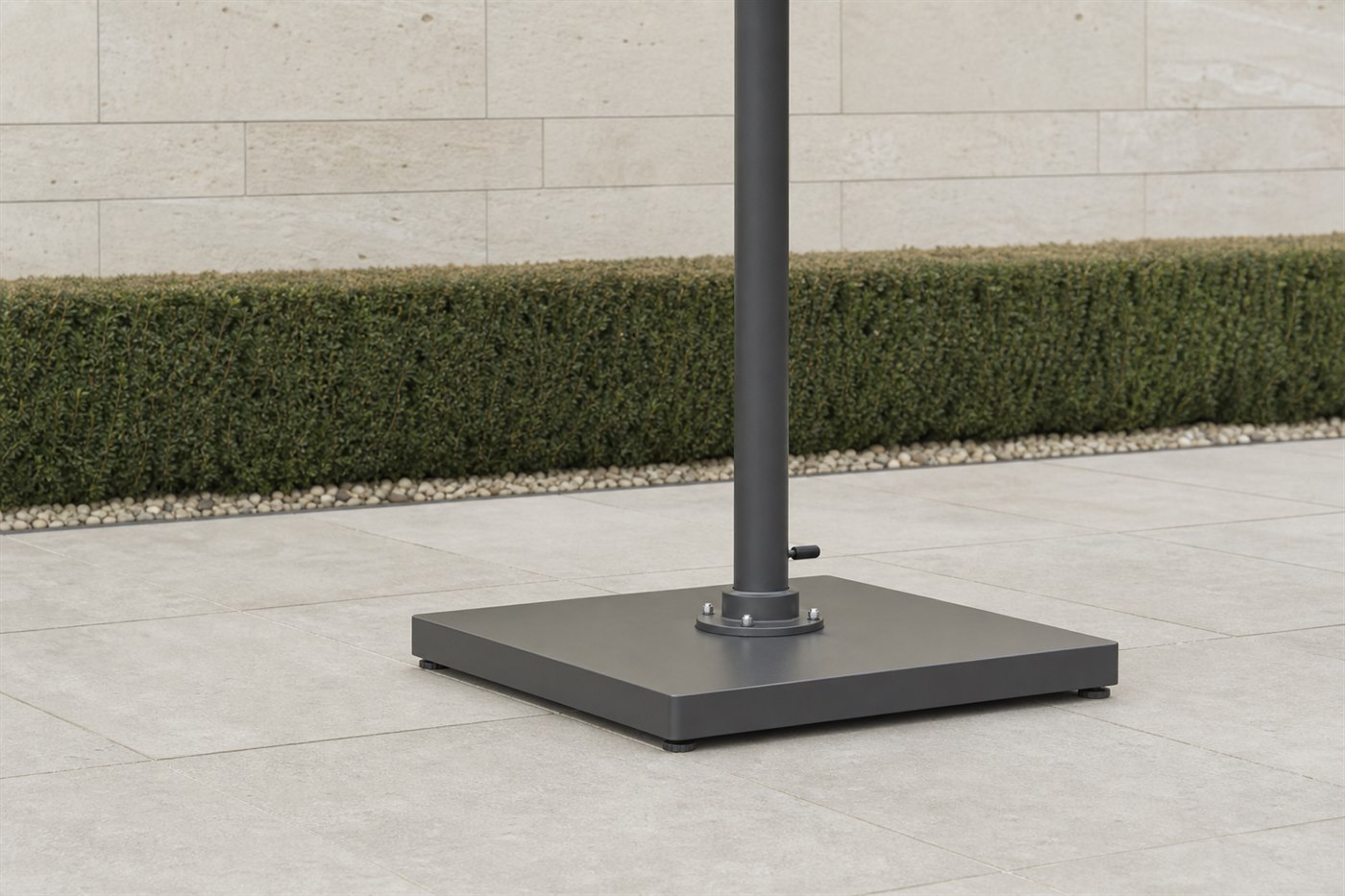
Weighted and resin bases
Free-standing bases that need no fixing, for paved or decked terraces where nothing can be drilled.
Bolted mounting
A plate fixed down to a slab or a deck. The sturdiest option, and the one that takes the least space under the table.
Water-filled bases
A heavier base that can be emptied when it has to be moved. Useful where a permanent base is not wanted.
Wind and storage
Ask what wind rating the frame is built to, and whether the canopy is meant to come down each night or stay up through the season.
On-site installation in five steps
The sequence is the same whether the umbrella is lit or not, with one extra step at the end.
- 1
Set out the positions
Mark where each umbrella will stand, check the reach over the tables, and allow clearance from walls, planting and glazing.
- 2
Fix the base
Bolt the plate down, or place and level a weighted base, depending on what the surface allows.
- 3
Stand and open the frame
Assemble the pole and canopy, then open the frame and check it before any lighting is connected.
- 4
Fit and connect the lighting
Fit the strips or the hub lamp, route the cable down the pole on a mains umbrella, and seat the pack on a solar one.
- 5
Test at full brightness
Run the lights at full brightness and time them on site, rather than accepting the figure on the specification sheet.
Maintenance and storage
Lighting adds two wear items to an ordinary umbrella. Both are cheap to plan for and expensive to discover late.
Replaceable light modules
Confirm before you order that the strips or pucks can be replaced on their own rather than as a whole canopy.
Battery access
Ask whether the battery can be swapped inside the pole without taking the canopy off. That one detail decides how long the umbrella stays useful.
Cleaning
Canopy fabric and light modules are not cleaned the same way, so check what the maker recommends for each before the first season.
Off-season
Rechargeable packs can be charged indoors and swapped at the start of the season rather than left to drain on the terrace.
Customisation and ordering
Umbrellas on this page are quoted with the lighting as an option, so you can order the same frame with or without lights and keep one spare-parts list across a project.
- Canopy size and shapeRound, square and rectangular, including large commercial spans.
- Fabric colour and brandingSolution-dyed canopies, print or logo on request.
- LightingSolar or rechargeable, rib-mounted strips or hub lamps, warm or neutral white.
- Base and mountingWeighted, resin, water-filled, or bolted to a slab or deck.
Tell us the site, the hours the terrace runs and whether the umbrellas stay out all year, and we will narrow the specification to the two or three options that actually fit.
What a complete lit umbrella order includes
Worth checking line by line against a quotation, because lighting is easy to leave out and expensive to add later.
Frames
To the canopy size and pole type specified, with the opening mechanism confirmed.
Canopy fabric
In the colour and weave chosen, and replaceable on its own.
The lighting kit
Rib-mounted strips or a hub lamp, in the colour temperature and output chosen.
The power source
Panel or pack, with the runtime at full brightness stated on the quotation rather than in a brochure.
Bases and fixings
Matched to the surface on site rather than chosen from a catalogue page.
Spare light modules
On a terrace that runs year round, at least one spare strip or puck for each size in use.
A combined spare-parts list
One list covering the frame and the lighting, so a single order keeps a mixed terrace running.
Common questions about LED umbrellas
The questions buyers ask most often before they specify lighting on a terrace.
Do I need an electrician for a solar LED umbrella?
No. The panel sits on top of the canopy and there is no cabling to the building, which is why solar suits terraces where you cannot trench or add circuits.
Rib-mounted strips or a single hub lamp?
Rib-mounted strips light the outline of the canopy and usually read better across a whole terrace. A hub lamp concentrates the light in one pool on the table underneath it.
What weather rating should I ask for?
Ask for the IP rating of the light modules and the battery, and confirm the frame rating separately. The light rating and the frame rating are not the same thing.
Can the LED parts be replaced later?
Worth checking before you order: whether the strips or pucks are replaceable, and whether the battery can be swapped without taking the canopy off. Rechargeable packs can be charged indoors and swapped at the start of the season.
How much daylight does a solar panel need?
Runtime depends on how much daylight the canopy actually gets, so look at the shading over the terrace before you commit. A canopy that sits in shade for most of the day is not a solar candidate.
What should I send to get a quotation?
The canopy sizes, the quantity, whether the terrace can be wired, the hours it runs and the site conditions. With those we come back with the frame options, the lighting options and a delivered price.
Terms used on this page
Short definitions of the words that come up most often in a lit umbrella quotation.
Related umbrella pages
Where to go next, depending on the frame and the fixing you settle on.
Specifying lit umbrellas for a project?
Send us the canopy sizes, the quantity and the site conditions, and we will come back with the frame options, the lighting options and a delivered price. Start a quotation request.

Elevate Garden Living
- Phone
- *Title
- *Content