Outdoor Lounge Furniture
Outdoor lounge furniture built to be sat in, and left outside
Lounge furniture is bought for a different job from a sofa set. A sectional that turns a corner, a chair deep enough to settle into and a daybed beside a pool are relaxation pieces: they are sat in for longer, in looser positions, and they are the furniture a terrace is remembered for.
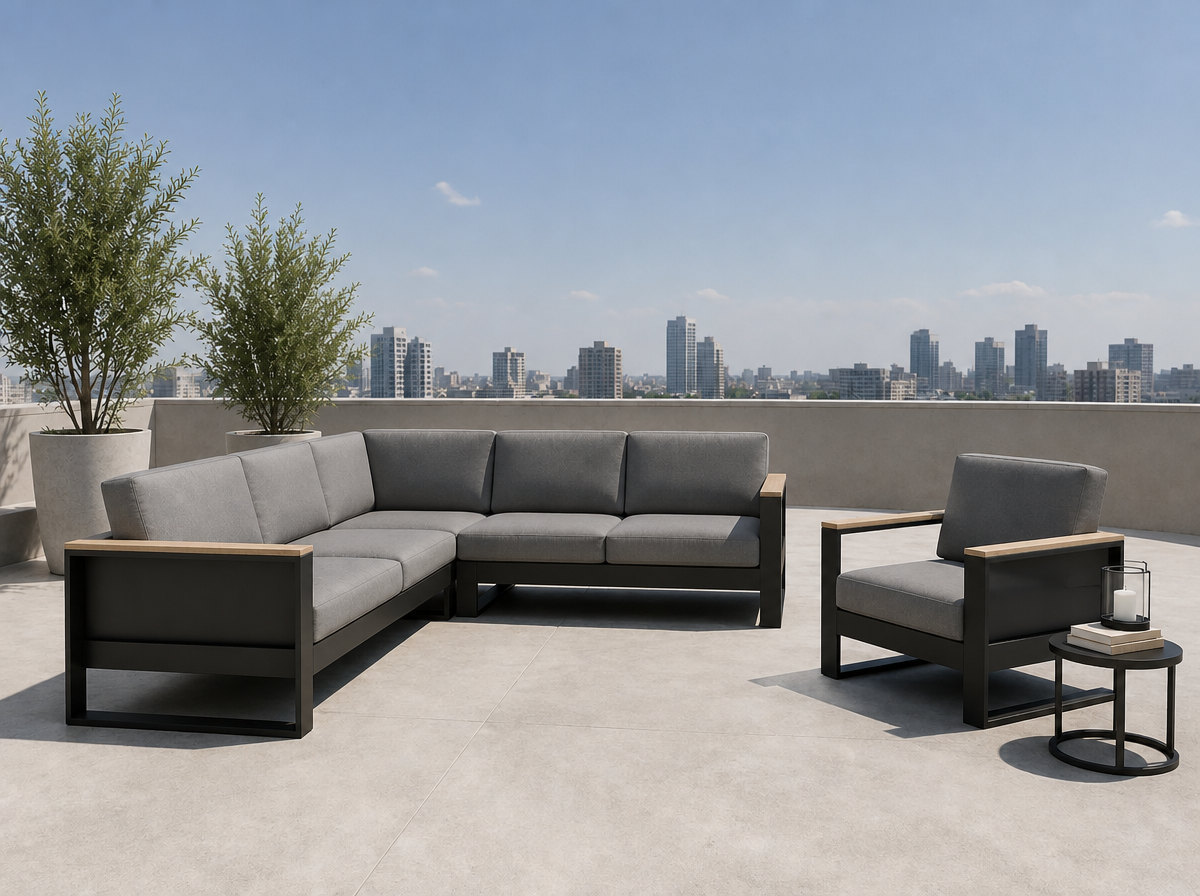
We build them on welded aluminium frames in square or round section, finished in a matt powder coat with solid wood or wood-look arm caps, then upholstered with open-cell quick-dry foam in covers that come off. Frames, cord and cushions are made in our own workshop in Zhejiang and packed for export with the cartons, the container loading plan and the HS code already documented.
- Welded aluminium frames, square or round section
- Quick-dry cushions with removable covers
- Sectionals, deep chairs and daybeds
- OEM, ODM and container programmes
Three things that separate lounge furniture from a sofa set
All three are settled by the frame and the cushion rather than by the fabric, which is why they are worth deciding before colour comes up.
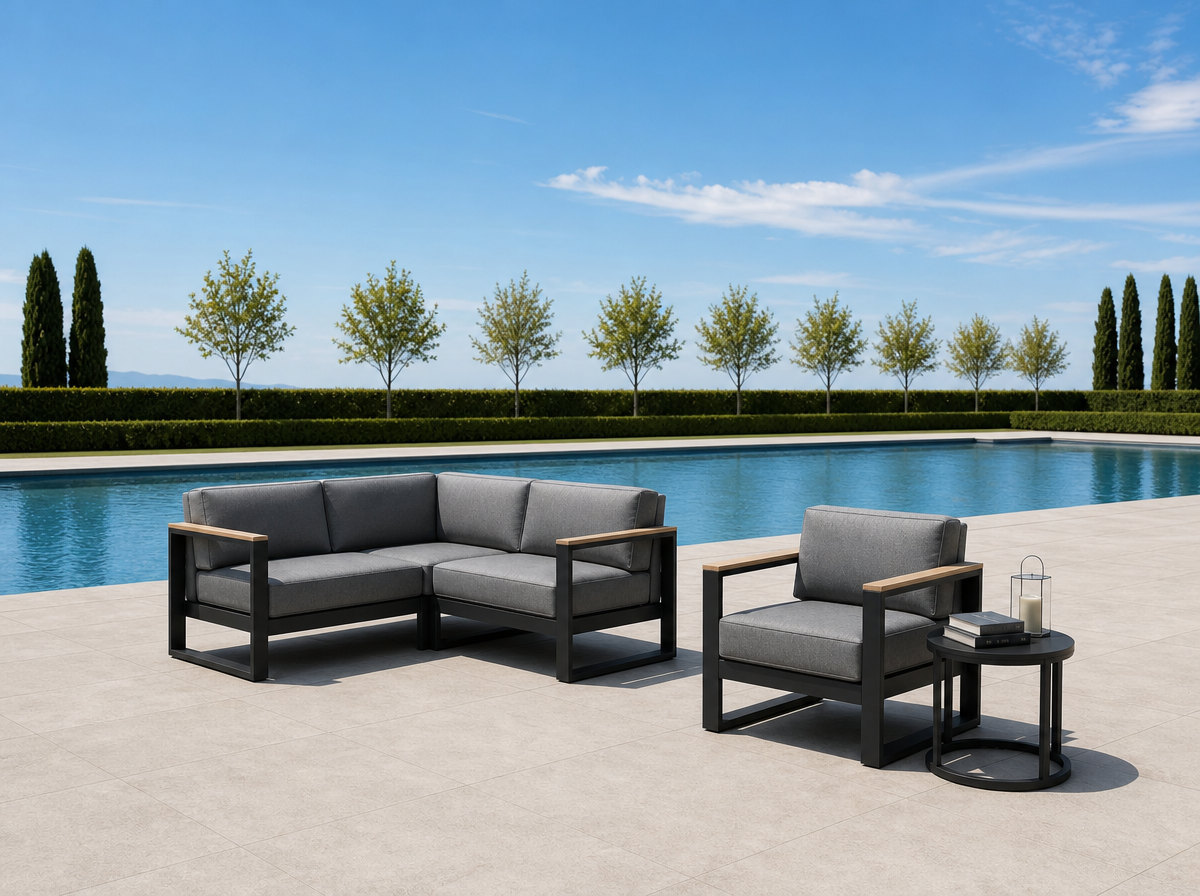
Seat depth and recline
A lounge piece is built to be settled into rather than perched on, so the seat is deeper and the back is set further back. That geometry is what decides how long anybody actually stays sitting.
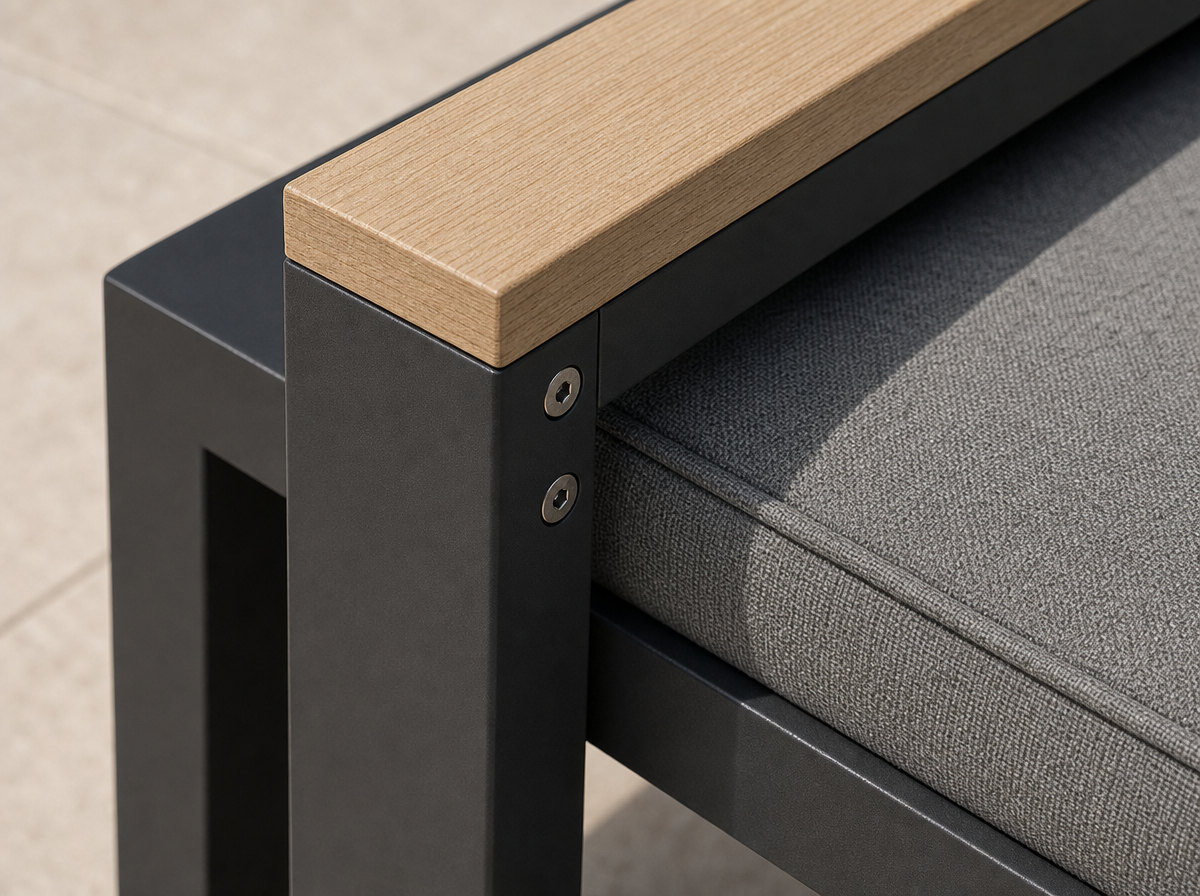
The frame and the arm cap
Square-section welded aluminium in a matt powder coat, finished with a solid wood or wood-look cap along the arm. The cap is the part your hand rests on, so it is specified in a material rather than implied by a colour.
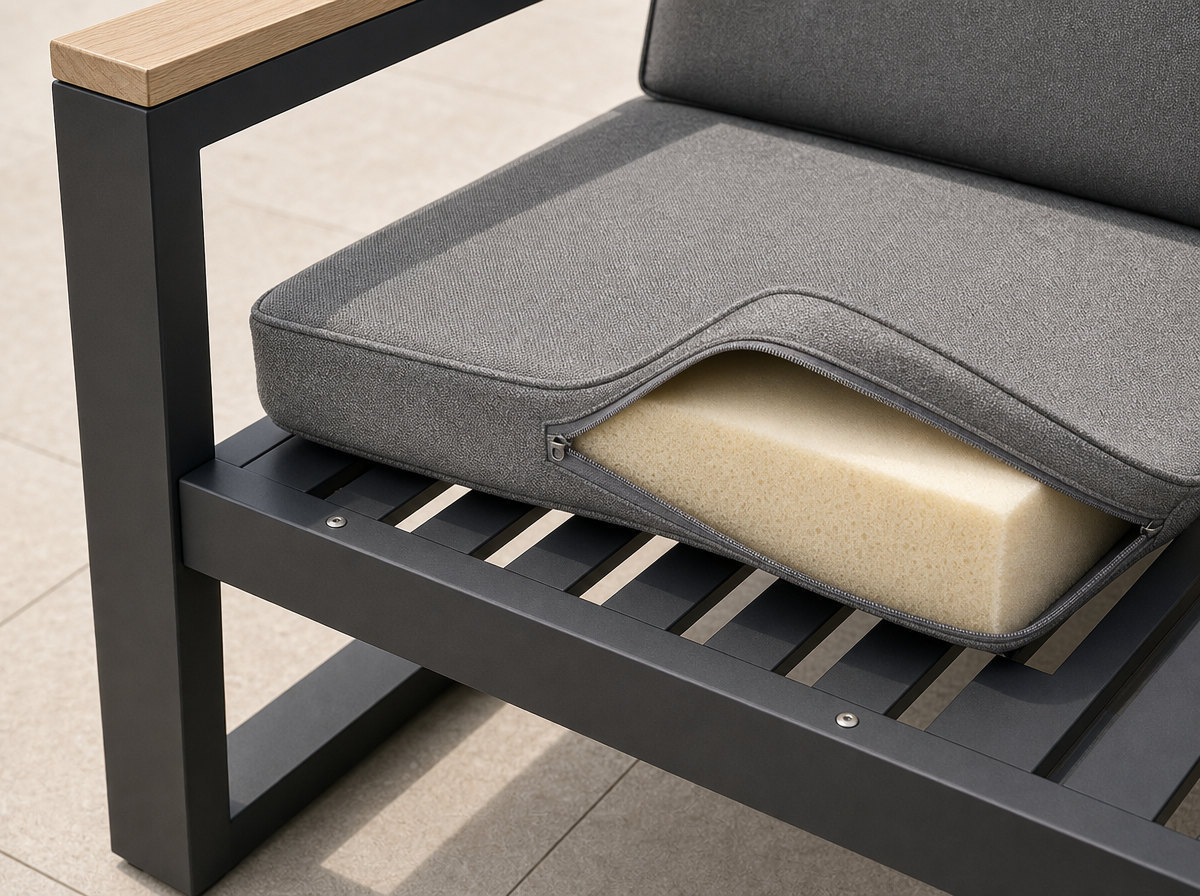
The cushion, and what sits under it
Open-cell foam in a removable cover, resting on a slatted platform rather than a solid deck, so water drains away instead of pooling under the cushion and working back up through the foam.
What this collection covers
Four families of piece, all built on the same frame and cushion specification, so a terrace can mix them without looking assembled from different suppliers.
Sectionals and corner lounges
Groups that turn a corner with the deck, in a straight L or a shallow curve, with the corner piece carrying the extra seating.
Deep lounge chairs
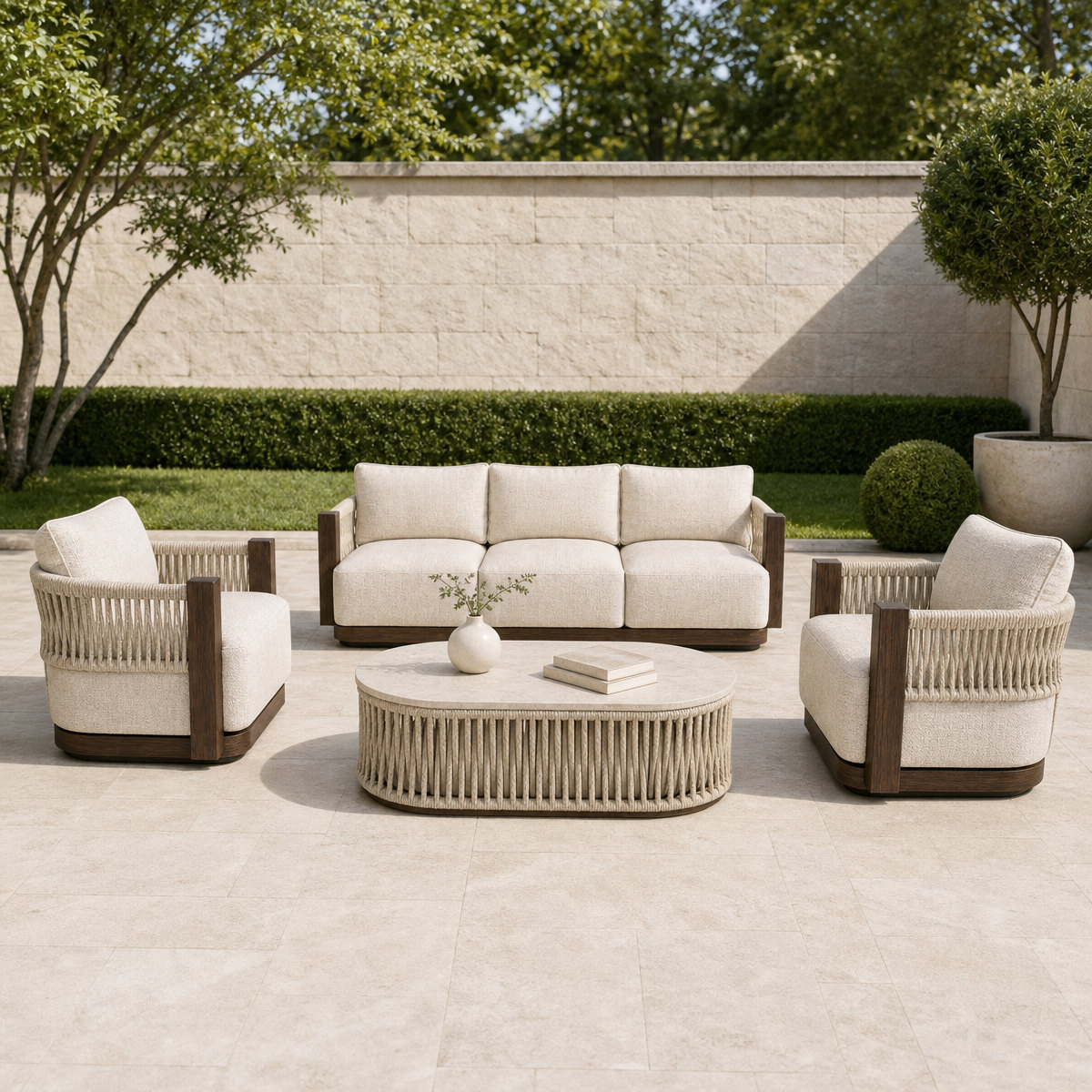
Single chairs with a deeper seat than a dining chair, in aluminium with wood or with a corded cradle shell, for a corner of a terrace.
Daybeds and chaises
Long relaxation pieces for a pool deck or a garden room, sized for one or two people lying back rather than a group sitting up.
Footstools, side and low tables
The pieces that carry a lounge: loose footstools, round side tables and low tables in wood, slatted or corded finishes.
Sectional lounge or loose pieces?
This is the decision that changes the frame rather than the finish, so it is worth taking before anything else on the page.
A sectional lounge
The pieces join into one arrangement that turns a corner with the deck.
- Carries six to eight covers on a short footprint
- Best where the deck edge already defines the seating
- Corner and return pieces are quoted separately
- Keeps a view open because the seating faces along it
Loose lounge pieces
Separate chairs, footstools and tables that can be moved by one person.
- Re-arranged for events, seasons and cleaning
- Single pieces added or replaced at any time
- Suits roof terraces and decks with no single long edge
- Best where the seating has to face two different ways
Where outdoor lounge furniture gets specified
Most of what we ship goes into hospitality and contract projects, where a lounge has to survive daily cleaning and be replaceable piece by piece if one part is ever damaged.
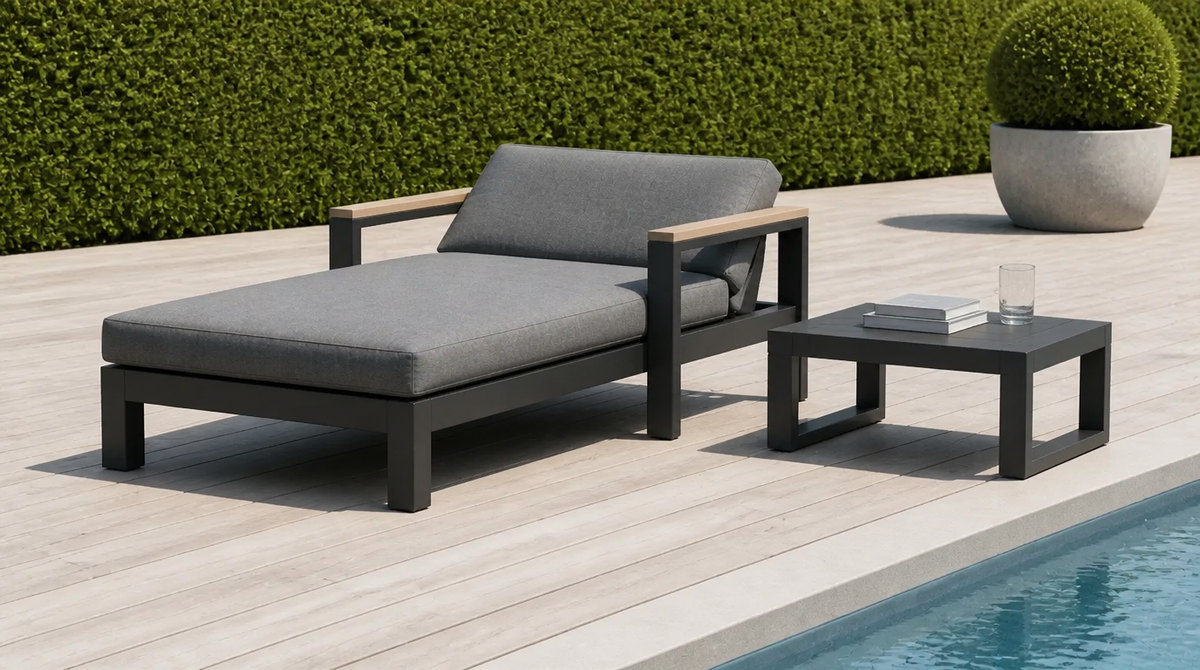
Built for contract outdoor lounging
We supply hospitality procurement teams, landscape contractors and outdoor furniture wholesalers with production, engineering data and colour matching.
Made in our own workshop
Welding, powder coating, cord work and upholstery under one roof, so a repeat order matches the first one.
Frame, cord and fabric matched to a scheme
Frame finish, cord colour and cushion fabric specified to the project, with a finished sample before bulk production.
Checked before it ships
Incoming material checks, frame inspection and pre-shipment verification at our own facility.
Documented for export
Cartons, a loading plan for your container, HS code and the declaration documents on every order.
Four lounge pieces and what each one does
A lounge group is assembled from pieces that do different jobs. Knowing which job each one does is what stops a group ending up with too many seats and nowhere to put a drink.
The corner or return piece
Joins two runs of seating at an angle. On a sectional it carries the extra covers, and it is the piece that decides whether the group turns a corner or opens out.
The deep lounge chair
One person, longer dwell time. It sits lower and deeper than a dining chair, and it is usually paired with a footstool so the seat can be stretched out.
The daybed
A long relaxation piece taking a single cushion along its length, sized for one or two people lying back rather than a group sitting up.
The footstool
Loose, low and easy to move. It adds a cover without adding to the footprint, and it doubles as a side table when a tray is put on it.
Seat depth, height and recline
Four measurements decide whether a lounge piece is comfortable or merely low. All four are set in the frame, so they are worth fixing before the finish.
Seat height
Lower than a dining chair, so the feet reach the floor without a step down when standing up. The taller the guests, the more this one matters.
Seat depth
Deeper than a dining seat, so the back of the knees is not pinched and a cushion can sit behind. Too deep, and shorter guests end up perched on the front edge.
Back angle
Set further back than an upright chair, with a rake that supports a relaxed position. Adjustable-backrest pieces are in the range where the group also has to work sitting up.
Arm height and the side table
Arms sit level with the low table so a drink can be reached from the seat. A round side table at the same height is easier to use than a table set lower.
What keeps a lounge usable through a season
Four construction details decide whether a lounge group is still in use in October or under a cover from the first wet week.
The cushions drain
Open-cell foam lets water pass through instead of holding it. A closed-cell filling stays wet for days, and that is what turns a cushion sour.
The covers come off
Removable covers can be washed, and re-covered later, so the frame keeps its value after the fabric is tired.
The platform drains too
A slatted seat platform lets water fall through instead of trapping it under the cushion, which is where mould starts on a solid deck.
The fixings match the frame
Stainless hardware and floor glides, so a joint does not bleed a rust mark down a pale powder coat over a season.
Frame, cord and table-top finishes
Finish is the part of a specification buyers most often want to revisit. It is worth settling it against a real sample rather than a screen.
Powder-coated frames
Matt charcoal and mid grey are the finishes specified most often, in square or round section, and a frame can be matched to a facade or a joinery colour from a sample.
Cord and cradle panels
Cords are run over the frame and tensioned line by line rather than glued on, which is what keeps a cradle shell even across its width.
Solid wood and wood-look caps
Solid teak and wood-look aluminium arm caps are both in the range, and the choice changes how warm the group reads against the architecture.
Table tops
Wood, slatted, corded and stone tops are all available. The top is usually the first part of a lounge to be settled, because it sets the tone for the upholstery.
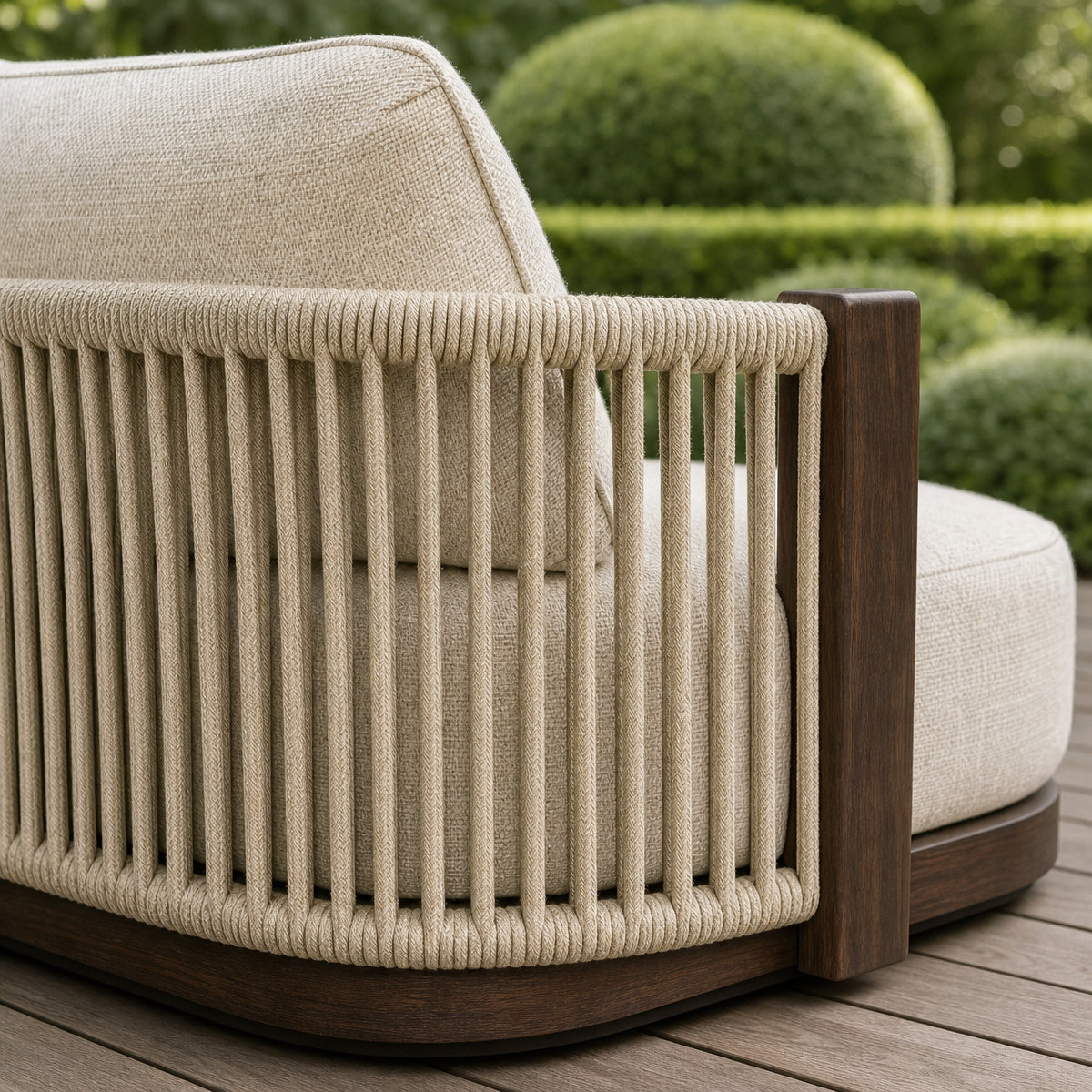
The cord is tensioned, not glued on
A corded shell is the detail that separates a lounge built for a resort from one built for a season. Ours is run line by line around the frame and tensioned as it goes, so the panel stays even across its width and does not sag after a summer in the sun.
- Cords tensioned by hand, not glued to a backing panel
- Welded aluminium frames rather than folded tube
- Slatted seat platforms that drain under the cushion
- Every piece quoted separately so a group can be extended
Outdoor lounge furniture specifications at a glance
What the range covers as standard. Every line below is a starting point rather than a limit, and anything here can be specified to a project.
| Item | What is in the range | What decides it |
|---|---|---|
| Frame | Welded aluminium in square or round section | Section size, and whether the group is a sectional or loose pieces |
| Finish | Matt powder coat, charcoal and mid grey | The facade, joinery or deck it has to sit against |
| Arm caps | Solid teak or wood-look aluminium | How warm the group should read, and how much handling the arms get |
| Cushions | Open-cell foam with removable covers | Whether the lounge stays out all year or comes in for the wet season |
| Seat platform | Slatted aluminium, draining | Whether the deck is hosed down or swept |
| Shells | Corded cradle, solid panel or open frame | How much the seating should read as upholstery rather than frame |
| Table tops | Wood, slatted, corded, stone | The tone of the surrounding paving and joinery |
| Configuration | Sectionals, corner groups, deep chairs, daybeds, footstools | The shape of the deck and the way the group has to face |
| Packing | Cartons and a container loading plan | Container size and the mix of pieces in the order |
What to check before you specify
Five things worth settling on paper. Each one is cheap to change before the order and awkward to change after it.
Measure the seating line and the walk-through
A lounge group needs its own footprint plus a path behind it. On a deck with a parapet or a planting bed, that path is usually the thing that gets forgotten.
Decide sectional or loose first
A sectional turns a corner and holds a view open. Loose pieces let the arrangement change. The decision changes the frame, not only the layout.
Match the cushion to the cleaning routine
A deck hosed down daily and a balcony that is swept both work. The cushion and platform specification should follow the routine rather than the other way round.
Choose the finish against something real
Send a facade photograph, a joinery sample or a paint code. A finish picked from a screen is the most common thing to change at sample stage.
Work out where the cushions go
If upholstery comes in over winter, decide where it is stored before the lounge arrives rather than after. A lounge holds more cushion volume than a dining set.
Planning questions we ask before quoting
Six answers decide the configuration, the frame and the packing. None of them are technical, and they are quicker to answer now than to change later.
How many people, and how long do they stay seated?
A terrace used for a coffee and one used for an evening call for different seat depths and different numbers of covers.
Does the group turn a corner or stay in a line?
A sectional and a run of loose pieces can hold the same number of people with very different footprints.
Which way should the seating face?
A view, a fireplace, a screen or the building. It decides whether the group runs along the deck edge or turns back into it.
Is the deck hosed down or swept?
The cleaning routine is the best single guide to the cushion, the platform and the hardware specification.
What has to match?
A facade, a joinery colour, a paving tone or an existing shade structure. A photograph tells us more than a colour name.
Is there a container plan?
Lounge pieces are bulky. Piece mix decides how much of a container a group actually fills, so it is worth fixing before the quotation.
Common specifying mistakes
Six things that come up often enough to be worth naming, and what to do instead.
Sizing a sectional from a photograph
A corner group photographed on a resort deck looks smaller than it is. Set the pieces out at their real dimensions before committing to the layout.
Treating a lounge as a sofa set
A deeper seat is the point of lounge furniture. If the depth is specified from sofa-set measurements, the group ends up being sat on rather than sat in.
Choosing cushions on colour alone
The fabric and the foam decide whether a lounge survives a season. Colour is the easy part to change later, so do not let it drive the order.
Forgetting the side table
A lounge group of five or more people needs somewhere to put a drink. It is easier to add with the first order than to match to a set delivered a year earlier.
Assuming all aluminium frames are the same
Section size, and whether the frame is welded or folded, separates a contract piece from a retail one. Neither is visible in a photograph.
Leaving the packing to the forwarder
Lounge frames are bulky and cushion volume is deceptive. Ask for a loading plan with the quotation rather than after it.
Poolside and coastal sites: what changes
A lounge beside water lives in a harder environment than one on a sheltered terrace. Four things change in the specification, and none of them show up in a render.
Everything has to drain
Splash and rain arrive from below as well as above. Slatted platforms and open-cell foam let water through instead of holding it against the frame.
Salt air and the hardware
Coastal air attacks fixings before it attacks a powder coat. Stainless hardware is not an upgrade at a pool or a seafront, it is the specification.
Wind and loose cushions
An exposed deck loses loose seat cushions in a gust. On open sites, specify pieces whose cushions are heavy enough to stay put or can be stored quickly.
Cleaning chemicals and the finish
Pool decks get cleaned with more than water. Tell us what is used on the surface, because it also lands on the frame and the cord.
How a lounge order runs
The same four steps whether you are furnishing one villa terrace or rolling out a resort.
Brief and layout
Send the deck, the number of covers you need and the colour scheme you are working to.
Sample
A finished sample in your frame finish, cord colour and cushion fabric, before any bulk production starts.
Production and QC
Frames welded and finished, cord tensioned, cushions upholstered, with inspection before packing.
Packing and export
Cartons, a loading plan for your container, HS code and the declaration documents.
What to order with a lounge
The four lines that are far easier to add to a first order than to match to it a season later.
Footstools
They add a cover without adding to the footprint, and they turn a deep chair into something that can be stretched out in.
Side and low tables
A lounge needs somewhere to put a drink. Round side tables at arm height and one low table per group is the usual starting point.
A spare cushion set
A second cover set keeps a terrace in use while the first is being cleaned, which matters more in hospitality than in a private garden.
A documented spare-parts list
Fixings, feet and cord quantities listed as part numbers, so a maintenance team can reorder without going back through a new quotation.
Care and storage through the year
An aluminium frame is built to outlast several sets of upholstery. These four routines decide whether it gets the chance to.
Frames and cord
Mild soap and a rinse. Solvent cleaners and abrasive pads take the sheen off a powder coat and can fray a corded shell, and that is the usual reason a lounge looks tired.
The cushions
Take the covers off and wash them to the label, and dry the foam through before the covers go back on. A cover put back over damp foam stays damp.
The hardware
Check the fixings at the start of the season. Stainless hardware does not rust, but a sectional that is moved often can work its joints loose.
Out of season
Store cushions and footstool pads dry and off the floor. Frames can stay outside; upholstery stored damp is what shortens its life.
Outdoor lounge furniture questions buyers ask
Eight answers that cover most of what comes up before a container of outdoor lounging is specified.
What is the difference between your sofa sets and your lounge furniture?
A sofa set is a seating group organised around a cover count: a three-seat sofa, chairs and a table. Lounge furniture is the relaxation side of the same frame and cushion specification, which means deeper seats, sectionals that turn a corner, daybeds, footstools and the low tables that carry them.
What is a daybed used for?
It is a long relaxation piece for one or two people lying back, so it suits a pool deck, a garden room or a quiet end of a terrace. It takes a single cushion along its length rather than separate seats.
Can a sectional be split into separate pieces?
Yes. Sectionals are built from separate pieces joined into one arrangement, so a corner group can be broken into a shorter run and chairs, and rearranged without buying anything new. Corner and return pieces are quoted separately.
Which cushions can stay outside?
The fabric and the open-cell foam are chosen for outdoor use, and the covers come off for cleaning. Even so, a lounge holds more cushion volume than a dining set, so upholstery should be stored dry when a terrace is out of season.
Can frames and cushions be made in our colours?
Yes. Frame finish, cord colour, cushion fabric and table-top material are specified to a project brief, and a finished sample is produced before bulk production starts.
How is a lounge set packed for shipping?
Frames and cushions are cartoned separately, and the piece mix is planned against your container because lounge frames are bulky and cushion volume is easy to underestimate. A loading plan, carton data and the HS code come with the order.
Do you supply hospitality projects?
Most of what we ship goes into hospitality and contract work, including resort pool decks, hotel roof terraces and restaurant garden rooms. A project order is quoted the same way as a single group, with the sample stage included.
What should I send for a quotation?
The deck and its dimensions, how many people it has to seat, whether the group turns a corner or stays in a line, which way the seating should face, your colour scheme, and whether you are working to a container plan.
Planning an outdoor lounge area?
Send us the deck, the number of covers and the scheme you are working to, and we will come back with the pieces that fit, the packing plan and a delivered price.
Terms used on this page
Short definitions of the words that come up most often in an outdoor lounge quotation.
Related pages
Where to go next, depending on the configuration and the finish you settle on.
Why choose Foris Hortus outdoor lounge furniture
Every piece in this collection is built on a welded aluminium frame with a draining seat platform and quick-dry upholstery, and specified piece by piece, so a lounge can be extended, repaired or re-covered rather than replaced. That is the substance behind the experience, expertise, authoritativeness and trust that B2B buyers need before they commit to a container.
- Welded aluminium frames from our own workshop
- Pieces quoted separately for extension and repair
- Frame, cord and cushion matched to the project
- Loading plan and export documents with every order

Elevate Garden Living
- Phone
- *Title
- *Content