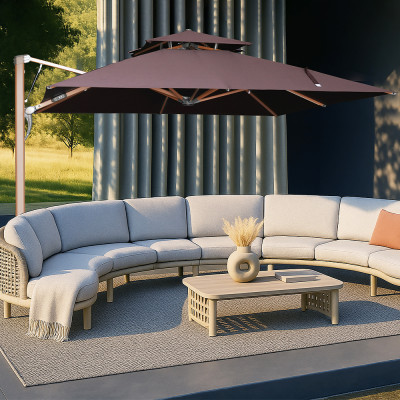
Planning Outdoor Shade for Hotels and Resorts: A Step-by-Step Specification Guide
Outdoor shade at a hotel or resort gets decided twice. The first time is on the architect's drawing, while the deck, the pool and the terrace are still lines on paper. The second time is two seasons later, when guests abandon the west-facing terrace at three in the afternoon and the operations team is ordering replacements for canopies that did not survive the first storm. This guide is about getting the first decision right, so the second one never arrives. It walks owners, operators, design studios and contractors through a planning sequence - site survey, zone map, structure match, wind discipline, brand consistency and a deployment checklist - that turns "buy some umbrellas" into a specification you can hand to a supplier.
Start with the site, not the catalogue
There is a temptation to open a supplier's catalogue before anyone has looked at the actual site. Resist it. Four site facts decide almost every shading choice that follows, and none of them show up in a product photo.
1. The sun path across a full day
A terrace is not one space from dawn to dusk. Breakfast service faces east light, lunch sits under an overhead or southern sun, and dinner terraces take a low western sun that is the harshest of the three. The shade that covers the lunch service will not cover the dinner service, so a plan has to say where the sun is at each service period, not just "the patio needs shade."
2. Prevailing wind and coastal exposure
Resorts near the sea live with salt air and sudden gusts that a city courtyard never sees. Wind is the single biggest cause of early umbrella failure, and it is decided by the location, not the budget. A coastal site needs vented canopies, heavier bases and a close-in-storm routine built into the operating manual from day one.
3. What you are allowed to anchor to
A ground-level pool deck can take an in-ground socket. A rooftop or a finished timber deck usually cannot be drilled at all, which forces a freestanding, weight-bearing solution and rules out anything that needs a footing. This single constraint changes the shortlist more than any style preference.
4. How long "good enough" has to last
A private garden umbrella is a seasonal purchase. A resort umbrella is a piece of operating equipment expected to look new in year three. The planning question is not "what is cheapest now" but "what still looks right after two summers of UV, salt and guest handling."
Map your zones before you count umbrellas
The most common mistake is buying a uniform set of umbrellas and dropping them everywhere. A pool deck, a dining terrace, a rooftop lounge and an arrival courtyard are four different problems. Map the property into zones first, then spec each one.
| Zone | Typical use | What the shade must do | Structure that fits |
|---|---|---|---|
| Pool deck | Loungers, all-day sun | Move with the sun, cover many stations, survive wind and chlorine | Cantilever umbrellas on heavy bases |
| Restaurant / cafe terrace | Dining, reconfigured for events | Clear space under the canopy, no centre pole in the table | Cantilever or centre-pole umbrellas |
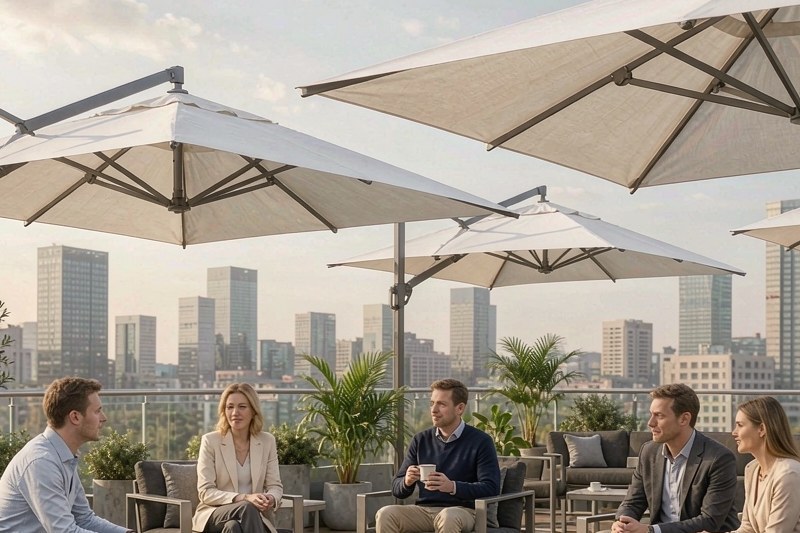
| Rooftop / sky lounge | Weight-limited, wind-exposed | Low profile, wind-rated, no in-ground fixing | Wind-rated freestanding cantilever |
| Arrival / lobby courtyard | First impression, branding | Look designed, hold up to daily use | Large centre-pole or pergola with umbrellas beneath |
| Event lawn | Temporary, variable layout | Deploy and retrieve, no permanent fixings | Freestanding cantilevers on mobile bases |
Our pool-deck capacity guide works out how many loungers and umbrellas a given deck actually holds, which is the number the procurement order should start from.
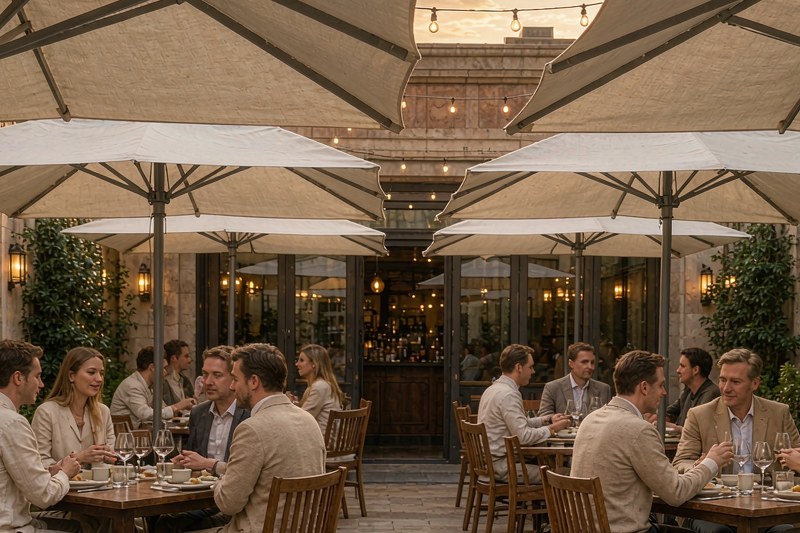
Match the structure to the zone
Once the zones are drawn, the structure choice is mostly mechanical. Use the zone's job, not the showroom favourite.
Cantilever umbrellas for pool and dining
The cantilever pushes the canopy out on a side arm so nothing blocks the seats or the table underneath. That is exactly what a pool deck and a dining terrace need: shade over people, not a pole in the middle of the conversation. Our cantilever vs offset vs market comparison sets out when the offset arm beats a centre pole, and the cantilever umbrella range shows the builds suited to pool and dining decks.

Centre-pole umbrellas for statement and branding
Where the job is a designed first impression - an arrival court or a signature lounge - a large centre-pole or roman umbrella reads as architecture and carries a printed brand mark cleanly. It is less flexible than a cantilever but more of a statement.
Pergola where the shade is permanent
For zones that will never move, a pergola defines a real outdoor room and carries lighting and heaters. Many resorts pair a pergola with movable umbrellas underneath, getting both the structure and the flexibility in one drawing. The commercial outdoor furniture range covers the seating and tables that sit underneath.
Large commercial umbrellas for big decks
Wide decks that seat dozens need canopy coverage a standard parasol cannot reach. A large commercial or giant umbrella covers a broad footprint from a single base, which simplifies both the layout and the maintenance count. See the large commercial umbrella range for the sizes and bases involved.
Wind, coast and weight discipline
This is where resort shading plans succeed or quietly fail. Three rules keep a deployment intact through a second season.
- Spec vented canopies. A wind vent releases pressure instead of catching it. On a coastal or rooftop site it is the difference between a unit that flaps and a unit that stays.
- Calculate the base, do not guess it. The base is the part buyers under-spec. Our base selection guide maps canopy size and site exposure to the weight each base actually needs.
- Write the close-in-storm routine into the operating manual. No commercial umbrella should be left open in a named-wind event. A one-line SOP protects more inventory than any upgrade.
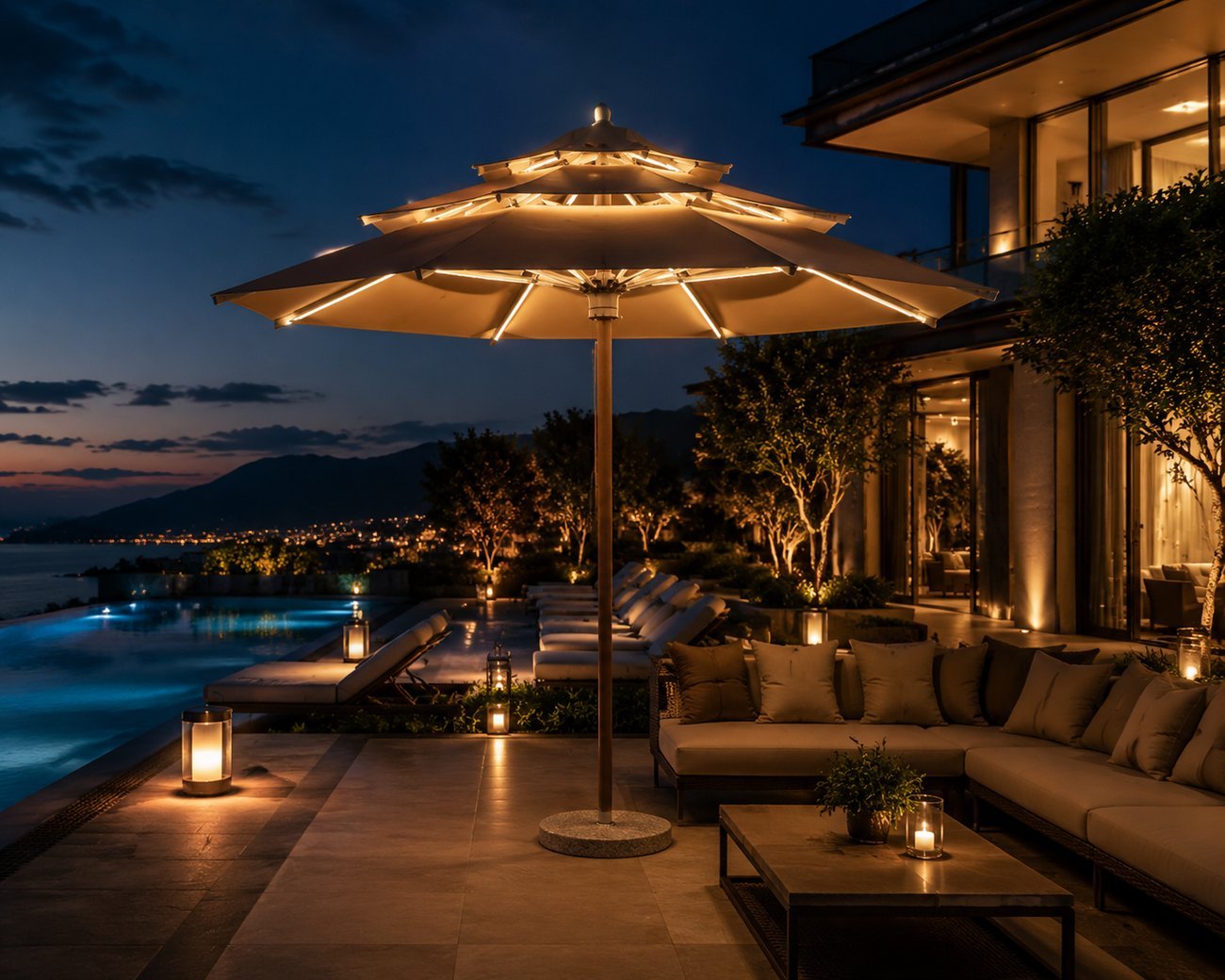
Rooftops and finished decks add a fourth rule: weight discipline. Freestanding units must carry their own stability, so the structure and the base are specified together, never as an afterthought.
Keep the brand consistent
A resort that buys shade from three suppliers over two years ends up with three slightly different creams, two logo placements and a terrace that reads as patchwork. Treat canopy colour, logo placement and frame finish as brand assets from the first order. A single custom programme - one colourway, one logo position, one frame finish across every zone - is what makes a property look designed rather than assembled. Our corporate parasol and printing guide covers how hotels and restaurants brand their shade without breaking the warranty. For a hospitality property, start from our hospitality shading solutions so the shade plan and the furniture plan are specified as one programme.
A deployment checklist
- Site survey done: sun path per service period, prevailing wind, coastal exposure, anchoring constraints.
- Zones mapped with the table above; umbrella count taken from the pool-deck capacity guide or an equivalent area calculation.
- Wind rating and base weight confirmed per zone against the base guide.
- Brand spec locked: canopy colourway, logo position, frame finish, one supplier programme where possible.
- Maintenance and close-in-storm routine written before opening, referencing the care guide.
- Spare-canopy and spare-rib strategy agreed so year-three fading does not mean a full replacement.
Common planning mistakes
- Buying shade after the layout is fixed. If the deck is poured and the anchoring points were never planned, the best umbrella cannot be placed where the sun actually is.
- One umbrella for every zone. A pool deck needs cantilevers; an arrival court needs a statement. Forcing one model everywhere leaves one zone under-served.
- Under-rating the wind. A lightweight market umbrella that suits a backyard will not survive a resort wind season, and replacement mid-season is far costlier than specifying correctly once.
- Treating brand as decoration. Colour and logo decided per order, not per property, produce the patchwork look guests notice.
- No spare strategy. Canopies fade in year three; without an agreed replacement programme, a single faded unit drags down the whole terrace.
Each of these is easier to avoid when the plan is set before opening. The successful cases show how delivered resort and hotel shade programmes were actually specified, zone by zone.
Reference brands: what the high-end shade market looks like
When you plan shade for a premium property, it helps to know the names that define the category, because the specification you write will be measured against them. A few references worth keeping in view:
- TUUCI - a US name known for marine-grade cantilever umbrellas built for coastal resorts; the usual benchmark for structures that survive salt and wind.
- Glatz - a Swiss maker of high-end shade fabric and umbrellas, often the reference point for refined European aesthetics.
- MakMax / Taiyo - tensile-membrane and large-span structures behind the biggest resort roofs and public spaces.
- Jardinico and Scolar - designer-grade outdoor shade and furniture favoured by architects on luxury terraces.
Foris Hortus sits in this landscape on the manufacturing side: a maker of commercial-grade cantilever, centre-pole, roman and large umbrellas that builds to the same structural and fabric standards these brands are known for, then supplies brands, distributors, contractors and design projects through OEM and ODM. For a hospitality project that means you can specify one coordinated programme - a single colourway, a single logo position, a single frame finish across every zone - and receive it as one consistent supply rather than a patchwork of retail buys. See our hospitality shading solutions for how a full-property programme is put together.
Plan your shade with Foris Hortus
We are a B2B manufacturer of commercial-grade cantilever, centre-pole, roman and large umbrellas for hotels, resorts, distributors and design projects. Open the High-End Umbrella Customization Manual for materials, wind ratings and branding options, or send us your site plan and zone counts for a quotation on request.