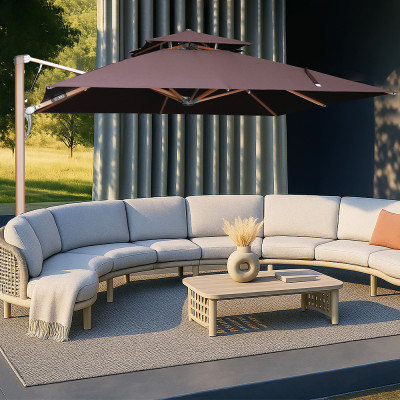
Cantilever Umbrella vs Offset Umbrella vs Market Umbrella: Choosing the Best Shade for Your Space
Choosing the perfect patio umbrella can transform your outdoor space into a comfortable and stylish oasis, protecting you from the sun's harsh rays and even light rain. But with so many types available, how do you decide which one is right for your home? Let's explore the key differences and benefits of cantilever umbrellas, offset umbrellas, and market umbrellas to help you make an informed decision.
As someone looking to enhance my outdoor living area, I know that understanding the nuances of different patio umbrella styles is crucial. This guide from Foris Hortus will walk you through the design, functionality, and ideal uses for each type, ensuring you pick the best shade solution for your furniture arrangement, space, and personal preferences.
Key Takeaways
- Market Umbrellas: These are the classic "center pole" umbrellas. They are best suited for passing through the center hole of a dining table, which provides additional support. They are generally more budget-friendly and have a smaller footprint, making them ideal for traditional dining sets and smaller, well-defined spaces.
- Cantilever & Offset Umbrellas: These terms are often used interchangeably to describe umbrellas with a side-mounted pole and a boom that extends the canopy over the desired area. The key advantage is providing a large, unobstructed shade area, perfect for covering lounge furniture, conversation sets, or dining tables without an umbrella hole.
- Space & Flexibility: A market umbrella's central pole can obstruct views and limit furniture arrangement possibilities. A Cantilever Umbrella offers superior flexibility. Its 360-degree rotation and advanced tilting functions allow you to adjust the shade throughout the day without moving the heavy base.
- Stability is Crucial: Cantilever umbrellas require significantly heavier and larger bases than market umbrellas of the same canopy size due to their offset design. Always use the manufacturer-recommended base weight to ensure safety, especially in windy conditions.
- Material Matters: The longevity and durability of your umbrella depend heavily on its frame and fabric. Aluminum frames offer a great balance of strength, lightweight properties, and rust resistance. For fabrics, look for high-performance materials like Sunbrella or Olefin, which provide excellent UV protection, colorfastness, and resistance to mold and mildew. Vented canopies are a must-have feature for improved stability in the wind.
Understanding the Core: Cantilever Umbrella vs Offset Umbrella vs Market Umbrella: Differences & Picks
When you start shopping for a patio umbrella, you'll immediately encounter three main categories: the market umbrella, the cantilever umbrella, and the offset umbrella. While cantilever and offset are often the same, the fundamental difference lies in the pole's position. This single design variation drastically changes how the umbrella functions, the space it requires, and the areas it can shade, making it the most critical factor in your decision-making process. Let's break down these core types to understand which one aligns with your vision for the perfect outdoor retreat.
Market Umbrellas: The Traditional Choice
The market umbrella is the most recognized style, characterized by a straight pole positioned directly in the center of the canopy. This classic design has been a staple in outdoor settings for centuries, from bustling European marketplaces to serene backyard patios. Its straightforward structure makes it a popular and often cost-effective choice for many homeowners.
Design and Footprint
The market umbrella, also known as a center pole umbrella, features a simple, time-tested design. Its pole is located directly beneath the center of the canopy, providing a balanced and stable structure. This straightforward construction means it generally has a smaller physical footprint compared to a cantilever umbrella, as the base is directly under the shade area. Market umbrellas come in various pole materials, including classic hardwood for a traditional aesthetic, and modern aluminum for lightweight durability. The canopy itself is available in multiple shapes, such as octagon (the most common), square, or rectangle, to suit different table shapes and preferences. This design makes them an intuitive and easy-to-manage shade solution.
Ideal Use Cases
Market umbrellas excel in specific scenarios due to their central pole design. Their primary and most effective use is in conjunction with an outdoor dining table that has a pre-drilled umbrella hole. In this setup, the table itself provides significant additional stability, bracing the pole against wind and movement. This makes them a perfect choice for:
- Dining Sets: They provide targeted shade directly over a dining table, creating a comfortable and intimate eating environment.
- Small Patios and Balconies: For areas where space is at a premium, a market umbrella's contained footprint is a major advantage. It can be placed between two lounge chairs or in a corner without demanding a large, open area for the base.
- Symmetrical Layouts: They work best in layouts that are centered and balanced, such as a bistro set on a small deck or a pair of chairs overlooking a garden.
- Commercial Settings: They are a favorite for cafes and restaurants with outdoor seating, as they can be uniformly placed at each table to create a classic, cohesive look.
While versatile, the central pole is also the market umbrella's main limitation, as it can obstruct conversation and limit how you arrange furniture if not used with a dedicated table.
Cantilever and Offset Umbrellas: Modern Flexibility
Cantilever and offset umbrellas represent a modern evolution in shade design. The terms are often used interchangeably, as both refer to a style where the support pole is positioned to the side, rather than in the middle. An arm extends from the main mast, allowing the canopy to hang or "cantilever" over a space. This clever engineering is a game-changer for outdoor furniture arrangements, offering a level of versatility that traditional market umbrellas cannot match.
Side-Mounted Pole and Unobstructed Space
The defining feature of a cantilever or offset umbrella is its side-post construction. The support mast is anchored in a heavy base and stands completely to the side, outside of the shaded area. From this mast, a hinged or articulated arm extends outwards, suspending the canopy over your desired location.
The primary benefit of this design is immediately obvious: it creates a completely open and unobstructed area under the canopy. With no pole in the center, you have total freedom in how you arrange your furniture. This makes a Cantilever Umbrella perfect for:
- Large conversation sets and outdoor sectionals.
- Dining tables that do not have an umbrella hole.
- Poolside lounge chairs or daybeds.
- Children's play areas or hot tubs.
This design allows for clear lines of sight and easy conversation, making your outdoor space feel more open and social.
Adjustability and Dynamic Shading
Beyond just offering clear space, high-quality cantilever umbrellas are marvels of engineering, built for dynamic and effortless shade adjustment. Many models from Foris Hortus include a suite of features that allow you to precisely control your shade as the sun moves across the sky.
- 360-Degree Rotation: A crucial feature is the ability to rotate the entire mast and canopy a full 360 degrees. This is typically controlled by a foot pedal or a handle at the base. It allows you to swing the shade from a dining area to an adjacent lounging area without ever moving the heavy base.
- Tilting Mechanisms: Cantilever umbrellas offer advanced tilting capabilities. They can often tilt vertically along the arm and sometimes even horizontally (side-to-side). This "infinite tilt" functionality ensures you can block low-angle sun during the early morning or late afternoon, maximizing your comfort throughout the day.
- Crank Lifts and Easy Operation: Despite their large size, modern cantilever umbrellas are designed for easy use. A crank mechanism allows you to smoothly open and close the large canopy, and other controls for rotation and tilting are designed to be user-friendly.
This combination of unobstructed space and superior adjustability makes the cantilever umbrella an incredibly versatile and functional, albeit more premium, choice for comprehensive shade management.
Cantilever Umbrella vs Offset Umbrella vs Market Umbrella: Sizing and Placement for Optimal Shade
Choosing the correct size and shape for your patio umbrella is just as important as selecting the style. An umbrella that is too small will fail to provide adequate shade, leaving your guests shuffling their chairs to stay out of the sun. Conversely, an umbrella that is too large can overwhelm a small space, making it feel cramped and unbalanced. Proper sizing and placement are key to creating a functional and aesthetically pleasing outdoor environment.
Determining the Right Size for Your Space
The fundamental rule of thumb for sizing a patio umbrella is that the canopy should extend over your seating area by at least 2 feet on each side to ensure ample shade coverage. This creates a comfortable buffer as the sun moves.
Measuring for Dining Areas
For a dining table, the goal is to shade the entire table and the seated guests. A good rule of thumb is to choose an umbrella canopy that is about 4 to 5 feet larger than the diameter of your table. This will provide roughly a 2-foot overhang on all sides.
Here is a quick guide for sizing a market or cantilever umbrella for a dining table:
| Table Diameter/Width | Seating Capacity | Recommended Umbrella Size |
|---|---|---|
| Up to 36 inches | 2-4 People | 6 ft to 8 ft |
| 38 to 48 inches | 4-6 People | 9 ft to 11 ft |
| 54 to 60 inches | 6-8 People | 11 ft or larger |
To measure, first place your chairs around the table where they would normally be when occupied. Then, measure the full diameter of this entire arrangement, from the back of one chair to the back of the opposite chair. Your umbrella should be at least this large, if not slightly larger.
Measuring for Lounging and Open Areas
For lounge areas with sectionals, deep seating, or chaise lounges, the measurement process is a bit different. Here, you are defining a "zone" that needs shade. This is where a large cantilever umbrella truly shines, as it can be positioned to cover these larger, more irregularly shaped areas.
- Arrange Your Furniture: Position your lounge furniture exactly as you intend to use it.
- Measure the Zone: Measure the length and width of the entire furniture grouping to determine the total square footage you need to cover.
- Select the Size: Choose a large rectangular or square cantilever umbrella that matches or slightly exceeds these dimensions. For example, a 10'x13' rectangular umbrella is excellent for shading a long outdoor sofa and coffee table grouping. An 11-foot or 13-foot square umbrella can comfortably cover a large U-shaped sectional.
For these larger spaces, it is always better to err on the side of a larger canopy to ensure functional, all-day shade.
Matching Umbrella Shape to Your Furniture Layout
The shape of your umbrella's canopy—typically round (or octagonal), square, or rectangular—plays a significant role in both the aesthetics and the functional coverage of your outdoor space. The right shape complements your furniture and maximizes shade efficiency.
Round, Square, and Rectangular Canopies
Round/Octagonal Umbrellas: This is the most classic and common shape. Round umbrellas provide a very natural and evenly distributed circle of shade, making them perfect for round or square dining tables and circular conversation sets. Their symmetrical shape creates a cozy, inviting atmosphere. An octagonal canopy, which appears round, is also noted for being more stable in windy conditions compared to a perfectly round one.
Square Umbrellas: Offering a clean, modern aesthetic, square umbrellas are highly efficient at providing shade. A square canopy provides significantly more coverage—some estimates suggest up to 30% more—than a round umbrella of the same primary dimension. They are excellent for shading square dining tables, fitting neatly into corners, or being placed side-by-side to cover a larger area without leaving awkward gaps.
Rectangular Umbrellas: The obvious choice for long, rectangular, or oval dining tables. A rectangular canopy ensures that guests at both ends of the table are shaded, which is a common problem when using a round umbrella with a long table. They are also exceptionally effective for covering long outdoor sofas or a row of chaise lounges.
Considering Furniture Arrangement for Cantilever Umbrella vs Offset Umbrella vs Market Umbrella
How you arrange your furniture is the ultimate guide to choosing the right umbrella.
For Market Umbrellas: The arrangement is predetermined by the central pole. You are essentially building your layout around the umbrella. It works perfectly when the umbrella is centered in a dining table, creating a well-defined and shaded focal point.
For Cantilever and Offset Umbrellas: These offer complete freedom. The "match the shape" principle is a great starting point: use a rectangular umbrella for a sectional sofa and a large square or round umbrella for a modular conversation pit. Because the pole is to the side, you can position it at the corner of a deck or behind a sofa, allowing the canopy to extend over the entire area without any obstruction. This flexibility allows a single cantilever umbrella to potentially shade multiple zones—like a dining set and a nearby lounge area—simply by rotating the canopy.

Durability and Features: Making Your Cantilever Umbrella vs Offset Umbrella vs Market Umbrella Last
An outdoor umbrella is an investment in your comfort and the longevity of your outdoor furniture. To ensure it withstands the elements and provides reliable shade for years to come, it's crucial to pay close attention to the materials used in its construction. The frame and the canopy fabric are the two most critical components determining an umbrella's durability, wind resistance, and overall performance.
Frame Materials: Wood, Aluminum, and Fiberglass
The frame is the backbone of your patio umbrella, providing the structural integrity needed to support the canopy and resist wind. The three most common materials—wood, aluminum, and fiberglass—each offer a distinct set of advantages and disadvantages.
Pros and Cons of Each Material
To help you decide, here is a comparison of the three main frame materials:
| Material | Pros | Cons | Best For |
|---|---|---|---|
| Wood | - Classic, high-end, and natural aesthetic. - Complements traditional or rustic outdoor decor. - Sturdy and heavy, providing good stability. |
- Prone to weathering, fading, and rot if not properly maintained. - Can be susceptible to insect damage. - Less flexible and can snap in very high winds. - Typically more expensive. |
Aesthetically driven spaces with classic decor, in areas with moderate wind conditions. |
| Aluminum | - Lightweight, yet strong and durable. - Highly resistant to rust and corrosion, especially when powder-coated. - Low maintenance and affordable. - Available in various finishes to match any style. |
- Can bend or dent under extreme impact or very high wind gusts. - Lighter weight may require a heavier base for stability. |
Most residential and commercial applications; it offers the best balance of durability, low maintenance, and value. |
| Fiberglass | - Extremely flexible and durable; ribs can bend and flex in high winds without breaking. - Lightweight and completely resistant to rust and rot. - Considered the most wind-resistant option. |
- Typically the most expensive frame material. - Can be combined with an aluminum pole for optimal performance. |
Windy environments, coastal areas with salt air, and for anyone prioritizing maximum longevity and wind performance. |
For most users, a high-quality, powder-coated aluminum frame offers the ideal combination of strength, longevity, and affordability. For those in particularly windy regions, investing in an umbrella with fiberglass ribs is a wise choice for its superior flexibility and resilience.
Wind Resistance Considerations for Cantilever Umbrella vs Offset Umbrella vs Market Umbrella
An umbrella's ability to handle wind is a critical safety and durability factor. Both design and material play a role.
- Market Umbrellas: When secured through a sturdy patio table, a market umbrella benefits from two points of stability (the base and the table), making it inherently stable. However, a freestanding market umbrella is more vulnerable to tipping.
- Cantilever Umbrellas: Due to their offset design, cantilevers act like a sail and catch more wind, making them more susceptible to lift. This is why they require significantly heavier bases. However, high-end cantilever models are engineered for wind resistance with features like heavy-duty frames, flexible fiberglass ribs, and robust rotation/locking mechanisms.
- Key Feature for Wind Resistance: Vented Canopies. Regardless of the umbrella type, the single most important feature for wind resistance is a vented or double-vented canopy. These vents allow wind to pass through the top of the canopy, which reduces upward pressure and significantly improves stability by preventing the umbrella from being lifted out of its base.
Canopy Fabrics: UV Protection and Weather Resistance
The canopy is your primary shield against the elements. Its ability to block harmful UV rays, resist fading, and repel water is determined by the type of fabric it's made from. Investing in a high-quality fabric not only provides better protection but also ensures your umbrella maintains its vibrant color and structural integrity for many seasons.
Key Fabric Types like Sunbrella and Olefin
Not all fabrics are created equal. Here is a breakdown of the most common materials used for patio umbrella canopies, from premium to budget-friendly.
- Solution-Dyed Acrylic (e.g., Sunbrella): This is the gold standard for outdoor fabrics. In the solution-dyeing process, color pigment is added to the acrylic fibers before they are spun into yarn. This means the color is locked in, making the fabric exceptionally resistant to fading from UV exposure. Sunbrella fabric is renowned for its durability, stain resistance, mold/mildew resistance, and for providing a UPF (Ultraviolet Protection Factor) rating of 50+, which blocks over 98% of harmful UV rays. While it is the most expensive option, its longevity often makes it the best long-term value.
- Olefin (Polypropylene): Olefin is another excellent synthetic fiber that offers a great balance of performance and cost. It is also solution-dyed, giving it strong colorfastness and UV resistance. Olefin is highly stain, mold, and mildew resistant and dries quickly. It is a durable and popular mid-range choice that performs very well in most outdoor conditions.
- Polyester: This is a common and budget-friendly option. Standard polyester can be prone to fading more quickly than solution-dyed acrylics or olefins. However, higher-quality, solution-dyed polyesters offer much-improved fade resistance and durability at a lower cost than premium acrylics. When considering polyester, look for a heavier fabric weight and specifications on its UV protective coating.
Understanding UPF Rating: The Ultraviolet Protection Factor (UPF) measures how effectively a fabric blocks UV radiation. A fabric with a UPF of 50 allows only 1/50th (or 2%) of UV rays to pass through. For maximum skin protection, always look for an umbrella canopy with a stated UPF rating of 50+.
Vented Canopies for Stability and Airflow
A vented canopy, sometimes called a double-canopy or dual-top, is a critical feature for any patio umbrella, especially in windy locations. It consists of one or more openings near the top of the canopy that are covered by an overlapping layer of fabric.
Benefits of a Vented Canopy:
- Wind Resistance: The primary function of a vent is to allow wind to pass through the canopy rather than getting trapped underneath it. This "pressure-release valve" effect drastically reduces the upward lift force, preventing the umbrella from flipping inside out or being knocked over.
- Improved Airflow: On hot, still days, heat can get trapped under a solid canopy, creating a stuffy, uncomfortable environment. Vents allow this hot air to escape, promoting better air circulation and keeping the shaded area cooler and more pleasant.
- Enhanced Durability: By reducing the stress that wind puts on the ribs and frame, a vented design contributes to the overall longevity of the umbrella's structure.
Given these significant advantages in stability and comfort, a vented canopy should be considered a non-negotiable feature when choosing a quality market, cantilever, or offset umbrella.
Essential Features: Lift, Tilt, and Rotation Mechanisms
Beyond the core structure, the mechanisms that allow you to open, close, and adjust your umbrella are what you will interact with every day. The ease of use and functionality of these lift, tilt, and rotation systems can significantly impact your overall satisfaction with your shade solution. Different umbrella styles and price points offer various mechanisms, each with its own operational feel.
Crank, Pulley, and Manual Lifts
The "lift" is the mechanism used to open and close the umbrella's canopy. There are three primary types:
- Crank Lift: This is the most common and user-friendly mechanism, especially for larger market and cantilever umbrellas. It features a handle on the pole that you simply turn clockwise to open the canopy and counter-clockwise to close it. The internal cord system does the heavy lifting, making it an effortless, smooth operation suitable for almost anyone.
- Pulley Lift: Often found on large commercial market umbrellas, this system uses a rope and pulley. You pull the rope to raise the canopy and then secure it in place with a pin that goes through the pole. While simple and durable with fewer complex parts to break, it can require more physical strength to operate compared to a crank, and the hanging rope can be less sightly.
- Manual (Push-up) Lift: This is the simplest system, typically found on smaller, more basic umbrellas. It functions just like a personal rain umbrella—you manually push the canopy's hub up the pole until it locks into place. While reliable and cost-effective, it is not practical for large, heavy canopies and is rarely found on umbrellas over 7.5 feet in diameter.
For most residential uses, a crank lift provides the best combination of convenience and ease of operation.
Tilting and Rotation for Dynamic Shade
The ability to adjust the angle of your canopy is essential for blocking the sun as it moves throughout the day. Cantilever umbrellas offer the most advanced options, but market umbrellas also have various tilting mechanisms.
- Push-Button Tilt: This is a common and straightforward tilt mechanism on market umbrellas. A button is located on the pole, usually high up near the canopy joint. Pushing the button unlocks the joint, allowing you to manually angle the canopy to one side.
- Collar Tilt: A more convenient option, the collar tilt features a ring or "collar" located on the pole above the crank handle. To tilt, you simply twist the collar. This allows you to adjust the angle without having to reach up high, making it much easier to operate.
- Auto-Tilt (or Crank-Tilt): This is arguably the easiest tilt mechanism for market umbrellas. After the canopy is fully opened with the crank, continuing to turn the crank handle will automatically engage the tilt function.
- Rotation: This feature is the signature advantage of cantilever umbrellas. High-quality models, like those from Foris Hortus, feature a base mechanism that allows for a full 360-degree rotation of the canopy. This means you can shade multiple distinct areas—a dining table for lunch, then a poolside lounge area in the afternoon—all without ever moving the heavy base, providing truly dynamic and versatile shade coverage.
Stability Solutions: Bases for Your Cantilever Umbrella vs Offset Umbrella vs Market Umbrella
An umbrella is only as good as its base. A properly weighted and styled base is not just a matter of convenience; it is a critical safety component that ensures your umbrella remains securely anchored and upright, even when the wind picks up. The base you need is determined by the size and style of your umbrella, with cantilever models requiring significantly more weight than their center-pole counterparts due to differences in physics and weight distribution.
Choosing the Right Base Weight and Style
The primary rule for choosing a base is: the larger the umbrella, the heavier the base needs to be. For cantilever umbrellas, this rule is amplified due to the offset center of gravity. Failing to use a sufficiently heavy base is the most common reason for umbrella failure and can lead to damage or injury.
Weighted Bases for Freestanding Umbrellas
Freestanding umbrellas—any umbrella not supported by a table—rely solely on their base for stability. A common guideline is to have a base that weighs at least 10 pounds for every foot of the umbrella's canopy diameter. However, this is just a starting point, and more weight is always better, especially in windy areas.
For Market Umbrellas (Freestanding):
- Up to 7.5 ft canopy: Minimum 50 lb base
- 9 ft canopy: Minimum 75 lb base
- 11 ft canopy or larger: 100+ lb base
For Cantilever/Offset Umbrellas: Because the entire weight of the canopy is offset from the pole, the base needs to be substantially heavier to act as an effective counterbalance.
- 9-10 ft canopy: 180 - 220+ lb base
- 11-13 ft canopy: 240 - 400+ lb base
Always follow the manufacturer's specific recommendations for base weight, as they have engineered the umbrella and base to work together safely.
Table-Mounted vs. Freestanding Bases
The way you use your umbrella dictates the type of base you'll need.
- Table-Mounted Support: When a market umbrella's pole passes through a hole in a sturdy dining table, the table itself adds a significant amount of stability. This allows you to use a lighter base than you would for a freestanding umbrella of the same size. The base's main job in this scenario is to prevent the bottom of the pole from kicking out. Even with a table, a base is still required for safety and stability.
- Freestanding Bases: These are required for all cantilever umbrellas and any market umbrella not used with a table. They must be heavy enough to support the entire structure on their own. Freestanding bases are typically larger and heavier, designed to provide the sole source of support. For very large umbrellas or in commercial settings, permanent mounting solutions are often preferred over freestanding bases.
Stationary and Mobile Base Options
Modern umbrella bases come in a variety of materials and designs, offering both permanent (stationary) and moveable (mobile) solutions. Your choice will depend on whether you need the flexibility to reposition your shade or want the ultimate "set it and forget it" stability.
Concrete Slabs, Steel Plates, and Roller Bases
- Fillable Bases: These are typically made of durable plastic (HDPE) and are designed to be filled with water or sand. They are lightweight when empty, making them easier to transport and store. Sand is denser and provides more weight than water, making it the preferred fill material for maximum stability. These are a very common and versatile option, especially for cantilever umbrellas, which often come with a cross-frame designed to hold four separate fillable plates.
- Solid Bases (Concrete, Steel, Cast Iron): These bases are heavy from the start. Concrete bases offer excellent stability at a reasonable cost, while steel plates provide a heavy, low-profile option that looks sleek and modern. Cast iron bases often feature decorative, traditional designs. While extremely stable, their major drawback is that they are very difficult to move.
- Roller Bases (Wheeled Bases): For those who want the best of both worlds—heavy stability and mobility—a roller base is an excellent choice. These heavy bases are equipped with wheels (often lockable) that allow you to reposition your umbrella as the sun moves or when you need to clear the space. They are particularly useful for large freestanding umbrellas that would otherwise be too heavy to move.
In-Ground and Deck Mounts
For the ultimate in stability and a clean, unobtrusive look, permanent mounting options are the superior choice. They eliminate the large footprint of a heavy freestanding base, freeing up valuable patio space.
- In-Ground Mounts: This option involves setting a mounting sleeve into the ground with concrete. It provides an incredibly secure and permanent anchor point for your umbrella. When the umbrella is removed, a cover can be placed over the mount to make it flush with the ground, maintaining a clean look. This is an ideal solution for poolside areas, expansive lawns, or any location where you have a dedicated spot for your umbrella.
- Deck Mounts: If your outdoor space is a wooden or composite deck, a deck mount is the way to go. This hardware involves bolting a mounting plate directly to the surface of the deck, often with reinforcement underneath between the joists. This creates a very strong and stable connection that integrates the umbrella securely into your deck's structure, providing peace of mind in windy conditions without the clutter of a large base.
These permanent solutions require more initial installation effort but offer unparalleled stability and a more professional, integrated aesthetic.
Frequently Asked Questions (FAQ)
1. What is the main difference between a cantilever umbrella and an offset umbrella? While the terms are often used interchangeably, and both refer to side-post umbrellas, there can be subtle technical differences. An offset umbrella might be considered one with a simple arched pole, while a cantilever umbrella can have a more complex articulated arm. However, in the modern market, both terms generally describe umbrellas with a side-mounted pole that offer unobstructed shade and advanced features like rotation and tilting. When shopping, focus on the specific features like 360-degree rotation, tilt range, and lift mechanism rather than the name alone.
2. Can I use a market umbrella without a table? Yes, you can use a market umbrella without a table, which is known as a "freestanding" setup. However, it is crucial that you use a much heavier base than you would if the umbrella were supported by a table. A table provides significant additional stability, so without it, all the support must come from the base. Always consult the manufacturer's weight recommendations for freestanding use to prevent the umbrella from tipping over.
3. Are cantilever umbrellas good in the wind? High-quality cantilever umbrellas are designed to be wind-resistant, but they are more susceptible to wind than a table-secured market umbrella due to their large canopy and offset design. To ensure stability, look for cantilever umbrellas with a heavy-duty frame (aluminum or fiberglass), a double-vented canopy, and always use the manufacturer-recommended base weight, which can be 200 lbs or more. It is always recommended to close any patio umbrella in high-wind conditions to prevent damage.
4. What canopy fabric offers the best UV protection and longevity? Solution-dyed acrylic fabric, with Sunbrella being the most well-known brand, is widely considered the best choice. It offers a UPF rating of 50+, meaning it blocks over 98% of harmful UV rays. Its color is locked into the fibers, making it extremely resistant to fading, and it's also highly resistant to water, mold, and mildew. While more expensive upfront, its exceptional durability provides the best long-term value.
5. How do I choose the right size umbrella for my 6-person dining table? For a dining table that seats six people (typically 48 to 60 inches in diameter), you should opt for an umbrella with a canopy that is 9 to 11 feet wide. The general rule is to have the umbrella extend at least 2 feet beyond the edge of the table on all sides to ensure everyone seated is comfortably in the shade, even as the sun moves.
6. Is a wheeled (roller) base a good idea? A wheeled base is an excellent option if you need both stability and mobility. For large umbrellas that require very heavy bases, wheels allow you to easily move the shade around your patio to track the sun or to clear the space for other activities. Look for bases with locking wheels to ensure they stay securely in place once positioned. They combine the security of a heavy base with the convenience of portability.
Conclusion: Your Perfect Shade Awaits
Ultimately, the best choice among a cantilever umbrella, an offset umbrella, or a market umbrella depends entirely on your specific needs, the layout of your outdoor space, and your desired level of flexibility. A classic market umbrella is an excellent, budget-friendly choice for shading a dining table with a center hole, especially in smaller, defined areas. For those with large, open-plan patios, sprawling sectional sofas, or poolside lounging zones, the unobstructed coverage and dynamic adjustability of a Cantilever Umbrella from Foris Hortus offer unparalleled function and style.
By carefully considering the critical factors of size, shape, materials, and stability solutions, you can confidently select a patio umbrella that not only protects you from the elements but also serves as a lasting enhancement to your outdoor living experience. Investing in a high-quality umbrella is a commitment to creating a comfortable, stylish, and welcoming oasis right in your own backyard. We encourage you to explore the new collections and exclusive offers at Foris Hortus to find the perfect, high-performance shade solution that will bring you joy for many seasons to come.