Wind Resistant Commercial Umbrellas: Vent, Frame and Base Compared
Wind resistance is the specification most often settled by assumption. A buyer hears heavy duty, reads a canopy size and assumes the frame will hold. In practice the wind rating of a commercial umbrella is the product of five separate engineering choices, and you can compare any two umbrellas by reading five numbers. This guide sets out what those numbers are, what a published rating should say, and how wind performance changes with exposure.

What actually makes a commercial umbrella wind resistant?
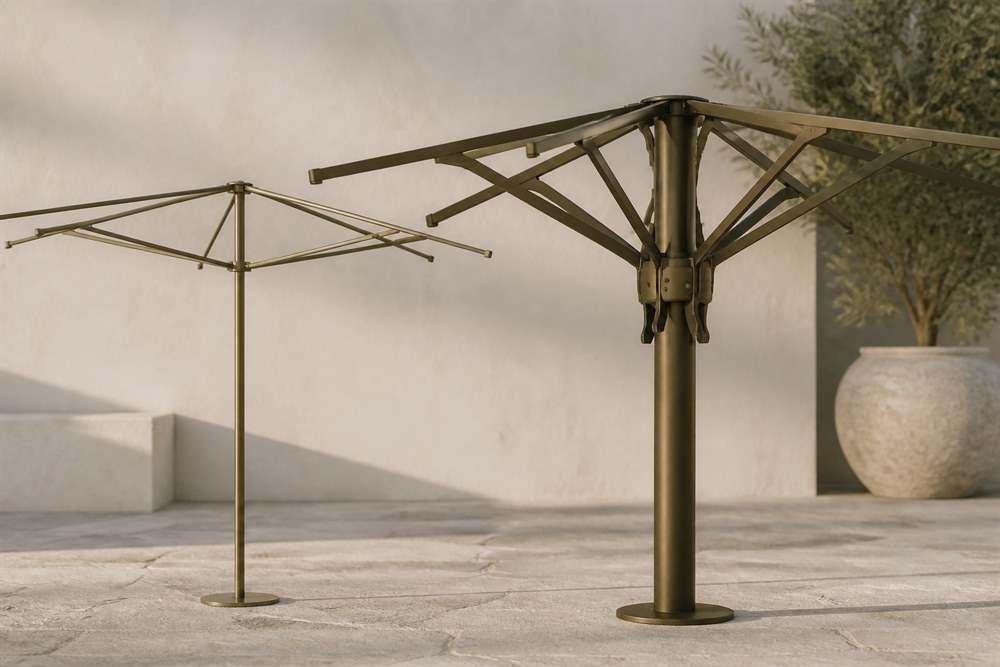
There is no single wind resistant component. An umbrella resists wind because five things work together, and if any one of them is undersized the whole assembly becomes the weak point. This is why two umbrellas with the same canopy diameter can behave completely differently on the same exposed site.
| Factor | What to ask for | Why it decides performance |
|---|---|---|
| Pole diameter and wall thickness | Published diameter and wall thickness in mm | Sets the bending stiffness the whole frame relies on |
| Rib section and material | Rib profile plus aluminium or fibreglass | Flexes under a gust instead of snapping |
| Canopy fabric weight and coating | Fabric weight in gsm plus the coating type | Determines how much pressure the canopy holds before it lifts |
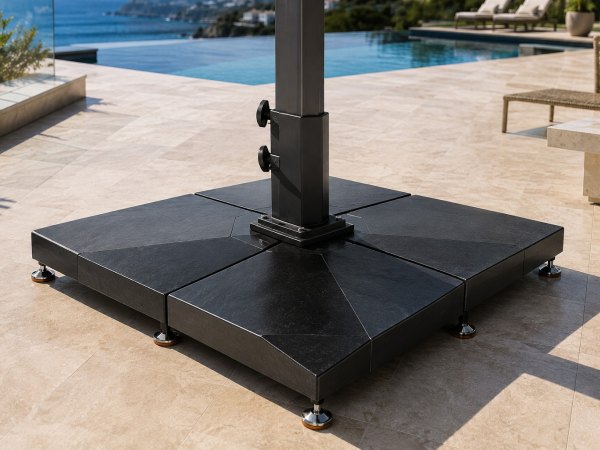
| Base mass | Minimum base weight for the canopy size | The only thing actually resisting overturn |
| Frame connections | Welded or bolted, and the fitting material | The joint is where fatigue usually starts |
Read those five against the site exposure and you have a wind specification. A supplier who cannot answer all five precisely has not engineered the product, whatever the brochure says.
Double vented, single vented and unvented canopies compared
The vent is the mechanism that stops an umbrella inverting, and it is the single most visible sign that a canopy was designed for wind rather than for appearance. A vent lets air out of the top of the canopy so pressure equalises instead of building underneath and lifting the whole structure.
| Canopy vent | How it works | Wind performance | Best suited to |
|---|---|---|---|
| Double vented | Two vents, usually on opposite faces | Best inversion resistance, air passes through freely | Exposed sites, coastal terraces, high-wind locations |
| Single vented | One vent at the apex | Meaningful improvement over unvented, less than double | Sheltered urban terraces, courtyard dining |
| Unvented | Closed canopy, pressure builds underneath | Lifts and inverts in a strong gust | Low-wind regions, occasional-use residential shade |
The rule is straightforward: the more exposed the site, the more vents. Our guide to double vented canopy wind resistance covers the mechanism in detail, including why pressure equalisation matters more than any single material choice.
How wind rating changes with umbrella size
A published wind rating is always given for a specific configuration. A rating quoted without its canopy size and base mass is not a rating, because the same frame behaves very differently over a larger canopy.
| Canopy size | Typical safe operating wind | Minimum base weight | Read as |
|---|---|---|---|
| 2.3 m (9 ft) round | Up to 35 - 40 km/h | 60 - 90 kg | Sheltered urban terrace |
| 2.7 m (10 ft) round | Up to 30 - 35 km/h | 90 - 120 kg | Open courtyard, light coastal |
| 3 x 3 m square cantilever | Up to 30 - 35 km/h | 180 - 260 kg | Hotel pool deck |
| 3 x 4 m rectangular cantilever | Up to 25 - 30 km/h | 260 - 400 kg | Exposed terrace, seafront |
Note the direction of travel. Bigger canopy means more sail area means a lower safe wind threshold, and it means a heavier base. A buyer who wants a bigger umbrella and the same wind performance is asking for a stronger frame, not a bigger one.
Why site exposure changes the rating
The published rating assumes a typical site. Real sites are not typical, and three conditions routinely require an adjustment.
Coastal and seafront exposure
Salt spray and near-constant wind work on the frame and the mechanism at the same time as the load. Specify a marine-grade finish, stainless fixings and a double vented canopy, and add an exposure allowance to the base weight.
Rooftop and exposed terrace
A roof deck has no surrounding building to break the wind, and the umbrella may sit above a parapet that catches the gust. Treat it as an exposed site and confirm whether the roof permits anchoring, because an unanchored rooftop umbrella needs a heavier base than a ground-level one.
Wind funnel between buildings
A terrace between two towers funnels the wind rather than blocking it, and a narrow gap can produce gusts stronger than the open site next door. This is the condition most often missed in a site survey, because it only shows when the building is finished.
What to ask for in a wind rating quotation
A rating is only useful if it comes with its conditions. Ask for these five things in writing, and treat a supplier who cannot supply them as telling you something.
- The test standard the rating is measured against, for example EN 13561 or ASTM F2612.
- The canopy size the rating applies to, because it does not transfer to a larger canopy.
- The minimum base mass for that rating, because the rating assumes it.
- The number and position of vents in the canopy.
- The frame specification, covering pole diameter, wall thickness, rib profile and fixings.
For the coastal and exposed case specifically, our guide to commercial patio umbrellas for high wind coastal areas sets out the full checklist, and the commercial umbrella base weight guide covers how to size and source the base that the rating depends on.
Frequently Asked Questions (FAQ)
1. Is a heavier umbrella more wind resistant?
Not automatically. A rigid, heavy frame can be more brittle and snap under a sudden gust, while a strong powder-coated aluminium pole combined with flexible fibreglass ribs absorbs the same gust without breaking. What actually resists wind is the base mass, the rib flexibility, the vent count and the canopy fabric, working together. A heavier frame that is rigid is not an advantage.
2. What wind speed should I close a commercial umbrella?
Follow the published rating for that configuration, and treat it as the point to close rather than the point to be comfortable. For a 2.3 m market umbrella on a properly weighted base that is typically 35 to 40 km/h. The safe operating figure assumes the stated base mass, so an under-weighted base lowers the number in practice regardless of what the label says.
3. Does a double vented canopy really stop an umbrella flipping inside out?
Vents are the main mechanical defence against inversion, because they let air through the canopy so pressure equalises instead of lifting it. They are not a guarantee. The base weight still has to be right, and a vented canopy on an under-weighted base will still be at risk. The vent removes the most common failure mode; it does not remove the requirement for a correctly specified base.
4. Is a wind rating worth paying for?
It is worth asking for, and worth checking the standard behind it. A rating with a named test standard and a stated base mass tells you the product was measured. A rating without those tells you nothing, because it may simply be describing the canopy size. The real question to put to a supplier is not whether they have a rating but whether they will state the conditions attached to it.
5. How do I choose an umbrella for a windy coastal hotel?
Start with the base mass for the exposure, then work up to the frame. Specify a double vented canopy, a marine-grade powder-coated aluminium frame, stainless fixings and a published wind rating with its standard named. Add an exposure allowance to the base, because the published rating assumes a typical site rather than a seafront one.
Get a wind-rated umbrella specification from Foris Hortus
We manufacture commercial-grade cantilever, centre-pole and large umbrellas engineered to published wind ratings, with the base specification included. Tell us your site exposure and canopy sizes and we will return the frame, fabric and base specification. See our hospitality shading solutions.