Wind Ratings on Commercial Parasols: How to Read the Test Report Behind the Number
"How windy is too windy for a patio umbrella?" is one of the most repeated questions in this category. It sounds like it wants a single number. It does not. Two suppliers can quote the same wind speed and mean entirely different things: one figure describes the conditions a frame was engineered to work in, the other records the point at which a sample finally failed in a wind tunnel. Both appear as one number on a specification sheet, and nothing on the page tells a procurement team which one it is reading. On a sheltered courtyard the difference is academic. On a coastal deck, a rooftop bar or a poolside terrace it becomes a public-safety question, because the rating only holds when the canopy, the ballast, the anchoring method and the closing procedure match the test conditions.
This guide is about reading the evidence behind the number. It treats a wind rating as a claim with four conditions attached, shows what a usable report must contain, and gives a buyer wording that can be pasted into a request for quotation so that every supplier answers the same question. The wider supplier-approval checklist is covered separately in the commercial umbrella procurement guide.
1. Two numbers that look identical and are not
A wind rating is not a property of a parasol on its own. It is a property of a tested configuration. Change the canopy, the base, the substrate or the operating rule, and the same frame produces a different result. Four assumptions do most of the damage in a comparison.
| Assumption behind the number | What to ask | Why it changes the answer |
|---|---|---|
| Canopy fitted or bare frame | Was the production canopy installed and open during the test? | A bare frame sheds load that a fitted canopy catches. The two figures are not comparable. |
| Design limit or failure point | Is the speed a designed safe-use limit, or the speed at which the sample failed? | A test-to-failure number is a ceiling, not a working limit. |
| Sustained or gust, open or closed | Is the figure sustained wind with the canopy in the open position? | Gust figures and closed-position figures describe different events. The number buyers actually operate against is the open-position safe-use limit. |
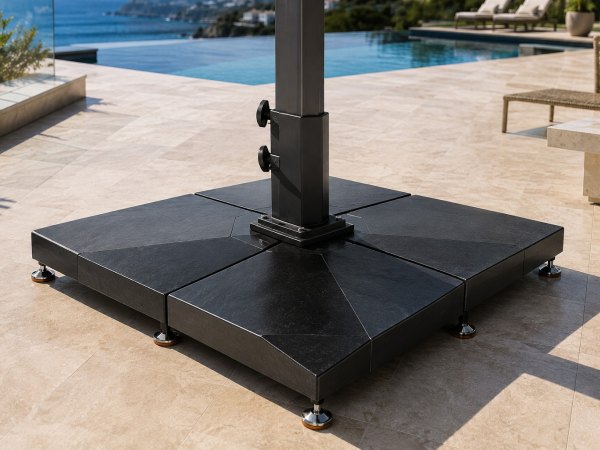
| Which base, which substrate | What ballast and mounting produced this rating? | A portable base on smooth decking and a bolted in-ground sleeve produce different system limits. |
Industry coverage of commercial shade has started to make the second distinction explicit: an engineered rating means the structure was designed to withstand the stated conditions, while a wind-tunnel figure can simply be the point at which the parasol fails. Neither is wrong. They answer different questions, and a tender that accepts both in one column invites the wrong comparison. A rating quoted without the base and mounting method is a frame rating, not a system rating.
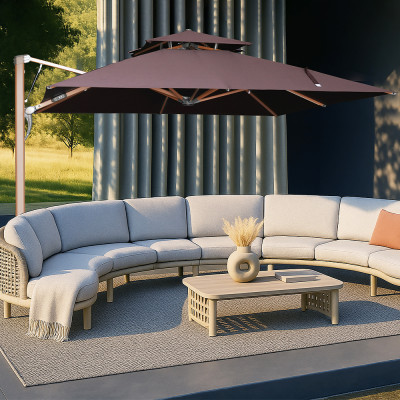
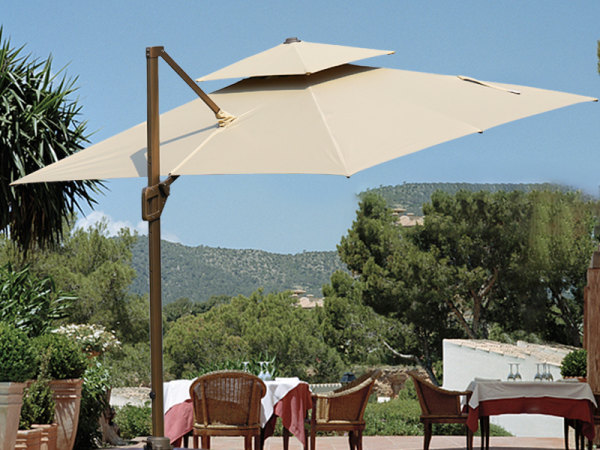
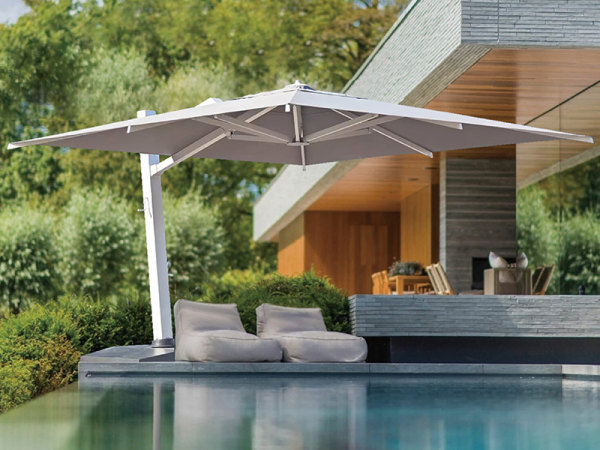
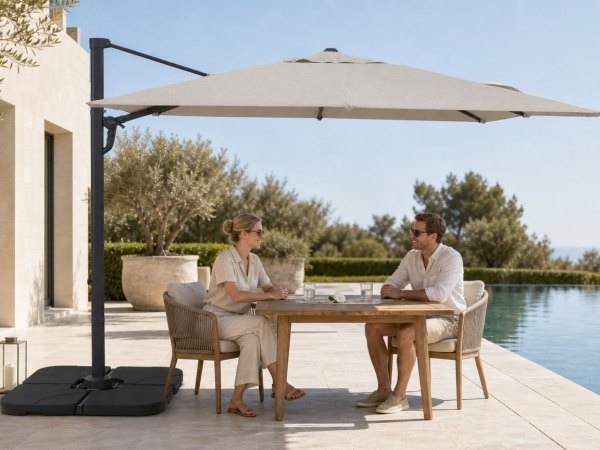
One correction is worth making here because it comes up constantly in product research. A cantilever parasol is not the automatic answer to a windy site. Its offset arm moves the load away from the mast, so the same wind asks more of the base and the fixing than it does on a center-post model. Cantilevers earn their place on the flexibility of the shade, not on an inherent strength advantage. What makes one survive an exposed season is the base schedule, a vented or double-top canopy that lets pressure through, ribs that flex rather than crack, and a closing rule that staff actually follow. For how the frame, the vent and the base each contribute, see What Makes a Commercial Outdoor Umbrella Wind-Resistant and Wind Resistant Commercial Umbrellas: Vent, Frame and Base Compared.
2. "How windy is too windy" is an operating rule, not a spec
The honest answer to the question buyers keep searching is a threshold with a procedure attached. Published industry guidance commonly puts the close-and-retract point for an open parasol around 20 mph (32 km/h, roughly Beaufort 6), with operators told to close above that and to treat anything near 30 mph as beyond a general commercial parasol, unless the specific model carries a published engineered wind-load report for its exact configuration. Coastal and rooftop sites take the lower end of any range. These are industry reference points for how sites are run, not a performance claim for any particular product; the number that governs your site is the one in the report for your model.
That is why the threshold belongs in the operating manual and the method statement, not only in the brochure. A written rule names who decides to close, what the forecast check looks like before service, and how the parasol is inspected before it reopens. A supplier who can attach that document alongside the wind report is answering the real question. One who answers with a larger number alone has not answered it at all. Rooftop and exposed-deck cases add a further layer: the anchoring has to be calculated against the existing build-up by a technician carrying professional liability cover, as set out in the rooftop loading guide.
3. What a usable wind report contains
Ask for the report against the exact model code being quoted, not against a product family. A usable file carries six items:
- Model code, canopy size and fabric as supplied, with the production canopy fitted and the parasol in the open position.
- Test laboratory, report date, and the standard or protocol the test followed, so an engineer can see who produced the figure and how.
- Maximum safe-use wind speed in m/s or mph, stated as an operating limit rather than a marketing ceiling.
- The retraction threshold and the written closing procedure at that threshold.
- A ballast or anchoring schedule matched to canopy size and to the substrate: concrete, timber decking, roof build-up or in-ground sleeve.
- The fire classification of the canopy fabric for the destination market.
The last item is often treated as a separate compliance matter, but it belongs in the same file. Insurers and local authorities on hospitality projects routinely ask for it before a terrace is signed off, and the accepted standard changes by country. Our certification and compliance FAQ and factory documentation page show what can be supplied against a given market.
Higher-specification files go a step further and state material details that matter on a coast: marine-grade 316 stainless at the fixings, a powder-coated aluminium frame, a UPF 50+ fabric rating and a stated recycled content. These do not replace the wind figure; they explain why the figure was achievable and whether it will still be there after a salt-heavy season. A report that gives a speed without the base specification is a frame rating, not a system rating. The base weight and pole fit guide gives the ballast starting points by canopy size.
4. Write it into the RFQ, not into an email
The fastest way to make three quotes comparable is to give all three suppliers the same sentence. The clause below is written from a buyer's side. The values are indicative starting points used in commercial specifications and should be replaced with the project engineer's own figures before issue.
Wind performance shall be evidenced by a laboratory wind-load report for the exact model quoted, tested with the production canopy fitted and the umbrella in the open position. The report shall state the test laboratory, the report date, the model code, the test standard and the maximum safe-use wind speed in m/s. The supplier shall provide a written retraction procedure with a threshold of 20 mph (32 km/h), a ballast schedule matched to canopy size and substrate, a canopy of 280-320 gsm solution-dyed fabric with a 5-year colorfastness warranty, the fabric fire classification required in the destination market, and a spare-parts list with item codes covering ribs, hubs, cranks and canopies with availability for 5 years. Bare-frame tests, general windproof claims and ratings quoted without the corresponding base specification will not be accepted.
Notice what the clause does: it makes the number conditional on the test setup, and it puts the operating rule and the parts commitment in the same sentence as the rating. A supplier who already holds those documents can attach them the same day. One who cannot will usually say so before any commitment is made, which is the best possible time to find out.
5. The warranty will not cover the wind
This is the part most often missed. Read the exclusions in a commercial parasol warranty and the pattern is consistent: damage caused by wind or adverse weather, normal wear, accidents, misuse, salt or chloride buildup, mold and mildew, and placement decisions are excluded. What remains covered is manufacturing defects. Consumer-grade policies are narrower still, frequently one year on the frame, the crank and the canopy, with wind damage and tip-over named as exclusions.
So a five-year frame warranty is not five years of wind cover. It is a statement about defects in materials and workmanship. The questions that actually protect a project are different: how many years on the frame, on the fabric, on the opening mechanism and on any LED or solar components separately; what the exclusions say in writing; and whether a replacement rib, hub or canopy can still be ordered in year five. Spare Parts and Replacement Canopies: What You Can Still Buy in Year Five covers the parts side in detail.
6. The operating day decides the real service life
A hospitality parasol can be opened and closed more than 1,000 times a year. That duty cycle, not the headline wind figure, is what wears out cranks, hubs, runners and stitching. If opening a unit feels like a two-person job during lunch service, staff will either leave it open in marginal weather or force it, and both shorten its life.
- One person can open, close, tilt and rotate the unit without tools, and the lock holds without slop.
- A named person owns the decision to close, with a forecast check before service and a reopening inspection afterward.
- The canopy can be removed for cleaning or winter storage, and the fabric tolerates the cleaning agents used on site.
- On rooftops and exposed decks, anchoring is calculated by a technician carrying professional liability cover, and the existing deck build-up is checked before a base is specified.
The daily and seasonal inspection routine is covered in the restaurant maintenance guide.
7. Before the purchase order
- The same model code appears on the quotation, the test report and the eventual invoice.
- The speed is stated as a safe-use limit in the open position, canopy fitted.
- A ballast schedule matched to canopy size and substrate is attached to the quotation.
- The retraction threshold and closing procedure are in writing.
- The fire classification matches the destination market.
- Warranty wording is split by component, with a spare-parts list and dispatch terms.
- The closing rule and duty cycle have been briefed to the team that will operate the terrace.
None of this makes a parasol stronger. It makes the comparison honest, and it moves the conversation from a number in a brochure to a specification file that an insurer, a facilities manager and an installer can all work from. Choosing the configuration and proving it are two steps of the same decision: the Hospitality Shading and Restaurants and Cafes pages set out the site conditions, and this guide covers the evidence that has to travel with the specification.