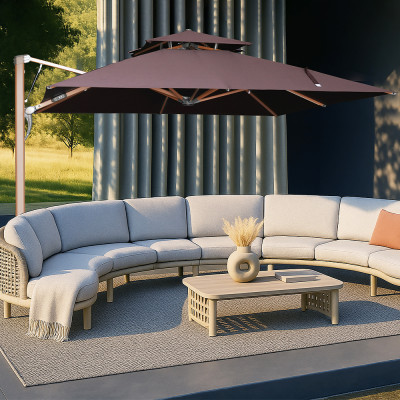
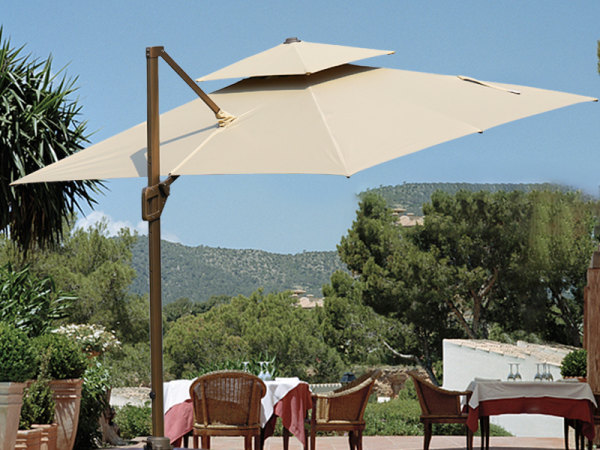
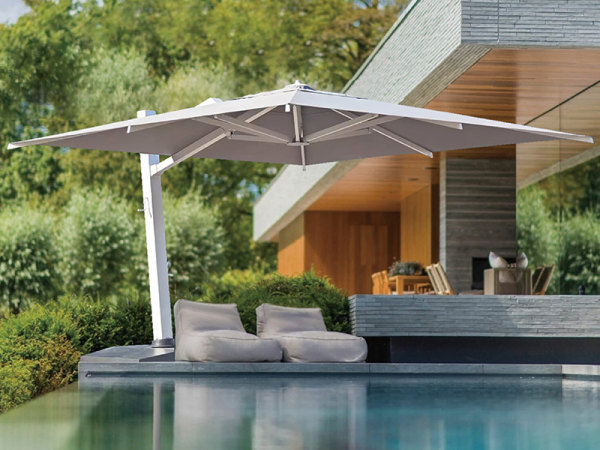


One Umbrella, Two Shade Zones: Why a Wheeled Base Beats a Heavy One You Never Move
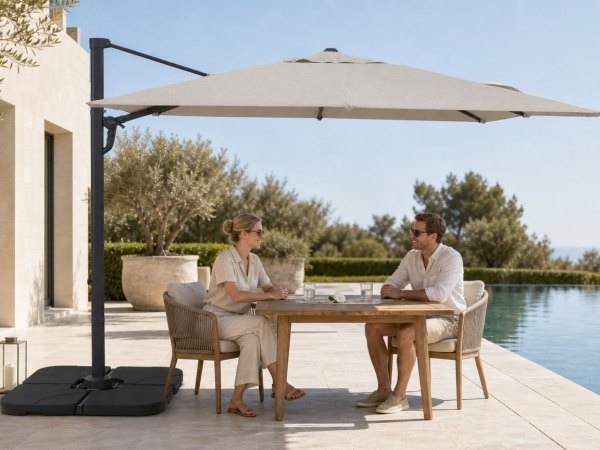
Your umbrella covers the dining table at lunch. By 3 p.m. the sun has moved, the table is still in shade, and the loungers are baking. Moving the shade means dragging a base that weighs more than a person, so nobody does it and half the terrace goes unused. That is the problem a wheeled base is built to solve. Whether it is worth it comes down to three things: how often you actually move it, what the ground is made of, and whether the lock holds.
Key Takeaways
- A wheeled base solves a use problem, not a stability problem. It puts the shade where people actually sit.
- The working rule from installers is simple: if you reposition the umbrella more than once a week, wheels earn their place.
- Wheels never replace ballast. Canopy area, cantilever reach and site exposure still set the base weight.
- Level paving, short distances, one person: fine. Slopes, grass and gravel: take a second pair of hands.
- Specify dual-locking casters and modular ballast you can still service after a season outdoors.
Is it just you, or is this base impossible to move?
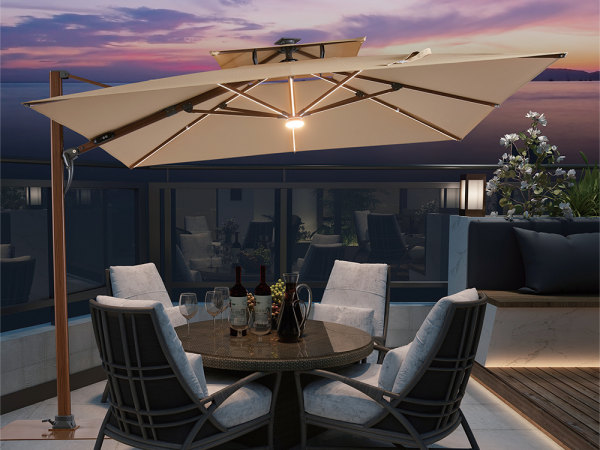
A cantilever umbrella is a lever. The canopy sits off to one side of the mast, so the whole thing wants to tip, and the only thing holding it down is the weight in the base. That weight is not a design flaw; it is what keeps a large canopy upright in wind. It is also why the shade stays exactly where it was installed, even when the sun does not.
The result is predictable. Guests drag chairs into a shrinking patch of shade, or go inside early. Staff stop trying to move the umbrella, because a fully ballasted base is a two-person job and there is never a good moment to stop service for it. The terrace keeps its full seating capacity on paper and loses half of it in actual use.
Whether wheels are worth specifying comes down to one question: how often does the shade need to move? More than once a week, and a wheeled base earns its place within a season. If the seating is fixed and the umbrella never leaves its spot, specify a heavier fixed or in-ground base instead and leave the mechanism out.
There is one case where wheels are the wrong answer even if you do move the umbrella: unattended sites in consistently windy locations. A base that can roll is a base that has to be locked correctly every single time. If that discipline cannot be counted on, fix it to the ground.
A "rolling base" sounds simple. What actually moves?
Three mechanisms turn up in commercial umbrellas, and they are not interchangeable.
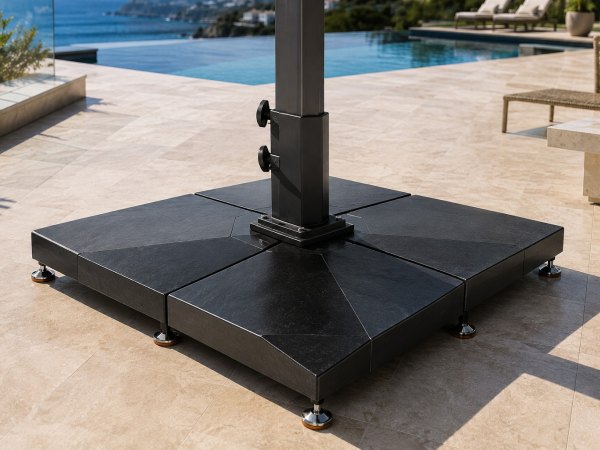
The first is tilt-and-roll. The base sits flat on the ground during use; to move it you tilt the umbrella until small wheels under the base touch the ground, then push. This is the most common design because the base stays level and stable when it matters. The second is an all-ways caster system, where the wheels stay in contact and a separate brake holds the base in position. The third is a modular ballast carriage: the weight is split into removable blocks on a wheeled frame, so you can lighten the load before moving and rebuild it at the new spot.
One misconception is worth clearing up. Wheels are for moving, not for shade. In normal use the base should sit flat and the wheels should carry no load; if a design keeps the wheels down all the time, its locking system has to be that much better. Our umbrella base selection guide walks through the load path in detail, so start there before comparing wheel designs.
| Mechanism | Movement | Stability when parked | Best for |
|---|---|---|---|
| Tilt-and-roll | Tilt to drop wheels, then push | Base flat, wheels unloaded | Most terraces; occasional repositioning |
| All-ways casters | Roll any direction; brake to stop | Depends entirely on the brake | Frequent, small adjustments |
| Modular ballast carriage | Remove blocks, roll lighter frame | Rebuild ballast on arrival | Large cantilevers; longer or sloped moves |
Can you move it by yourself, or do you need a second person?
Honest answer: a fully ballasted wheeled base is still heavy. Wheels change how the weight travels, not how much of it there is. On level paving, most people can move a mid-size cantilever base alone over a short distance — a few metres, not across a car park. Add a slope, grass, gravel or a long push, and you want a second person.
Judge it by the route, not the base alone. Before committing to a wheeled model, walk the exact path the umbrella will take and check three things: is it level, is it hard-surfaced the whole way, and is it clear of steps and thresholds? Two of those three in your favour and one person can manage. If the route is soft, sloped or broken up by steps, either plan on two people every time or remove ballast before moving and rebuild it at the far end.
The sequence matters more than strength. Close the canopy first. Release the tilt or lift mechanism so the wheels take the load. If the ground is uneven, take out some ballast before you start and put it back at the new position. Push slowly, in a straight line. Lock the wheels once you arrive, then reopen the canopy. Never move the umbrella with the canopy open; every manufacturer we work with treats that as a hard safety line, and so do we.
Will the wheels wreck your deck, tiles or lawn?
Ground surface is the most overlooked part of this decision.
On smooth paving and sealed tiles, larger wheels with a polyurethane tread roll cleanly and do not mark the surface. On timber decking the concern is point load: a small, hard caster can dent boards, so spread the weight or lay a protective mat under the wheels. On grass and gravel, small casters sink and catch; you need a wider wheel and a firmer route, or you accept that the base will not travel far.
Before ordering, check three things: the wheel diameter, whether the tread is non-marking, and how the wheels sit when the base is in its normal flat position. A wheel that projects below the base footprint is a wheel that will scrape every time someone moves a chair past it.
What stops it rolling away the moment the wind picks up?
This is the part that matters more than mobility. A base that moves when it should not is a safety problem, not a convenience problem.
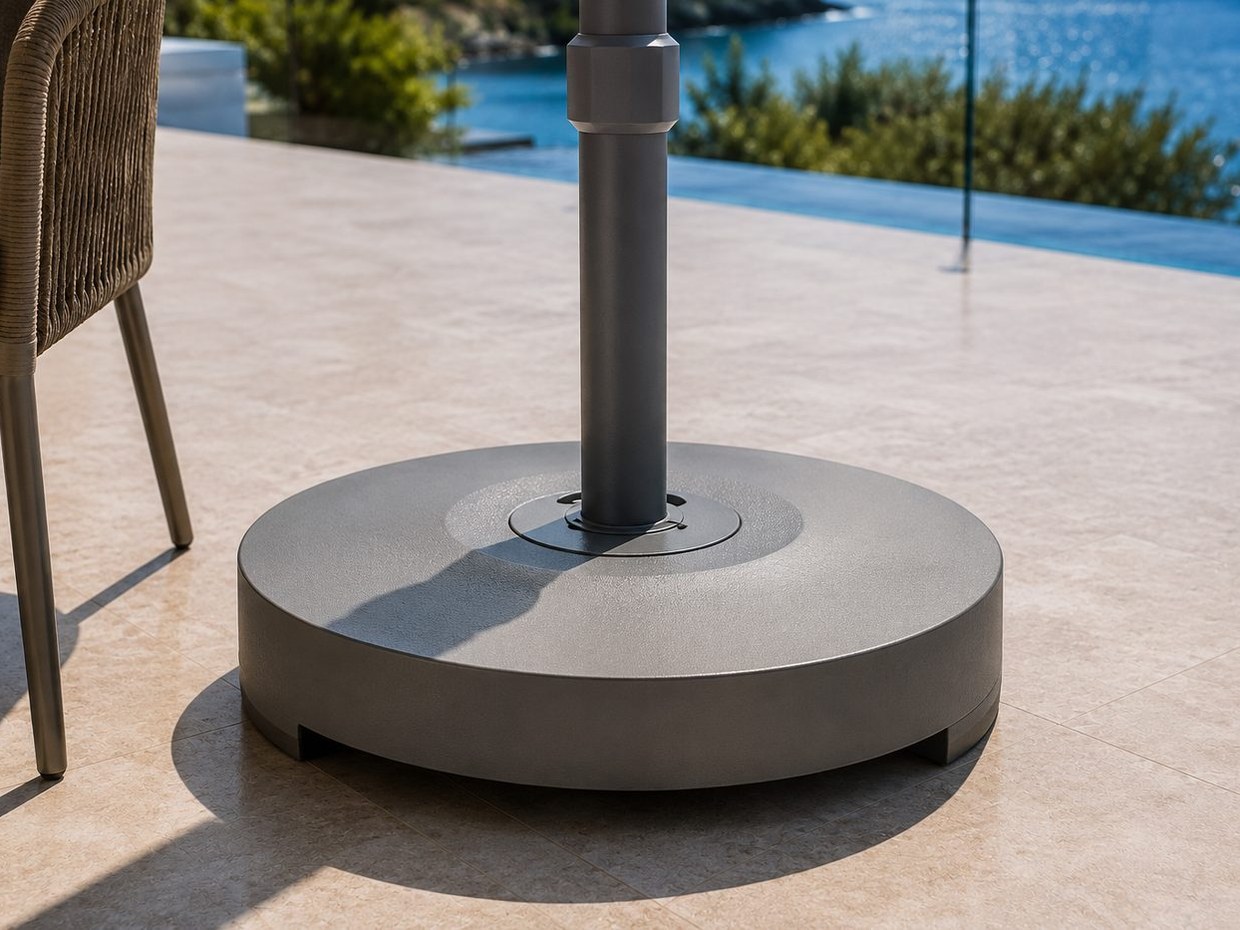
There are two separate actions to look for. The first is positional locking, the mechanism that keeps the base from creeping while the umbrella is open. The second is transport braking, the control that lets you steer the wheels while moving and hold them once you stop. A good wheeled base has both, and they work independently. Dual-locking casters, where one lever brakes the wheel and a second locks the swivel, are what we specify on heavier cantilever units.
Check them in person if you can. Release the lock with one hand, then try to rock the base by hand — it should not creep. Ask whether the wheel assembly can be replaced after a season without scrapping the base. A base whose wheels are welded or riveted in place becomes disposable the moment a caster fails, which is a poor outcome on equipment meant to last years. If any answer is unclear, ask before you commit.
No umbrella is windproof on its own. Wind performance comes from the whole system: canopy venting, frame, ballast, anchoring and how the umbrella is operated. Our wind-rating comparison sets out what each part contributes.
Filled with sand or water. Does that change the moving story?
It does, but not in the way people expect. Sand is denser than water, so for the same base volume it gives more ballast and more stability. Water is lighter and easier to drain, which helps in climates where a filled base can freeze.
The point that gets missed: wheels do not reduce the ballast you need. Stability is a balance between canopy area, the length of the cantilever arm and the weight in the base. A wheeled base that arrives with less ballast than a fixed one is not an upgrade; it is a different, weaker setup. Add wheels to make the same weight movable, not to carry less weight.
As a first-pass rule, installers often start around 10 lb of ballast per foot of canopy diameter for a freestanding umbrella in a sheltered spot: a 7.5 ft canopy lands near 75 lb, a 9 ft canopy near 90 lb, an 11 ft canopy near 110 lb. Rules of thumb vary, and some sources start lower, so always use the figure for the exact model and site. For exposed or windy positions, add ballast on top of that baseline and close the umbrella when winds exceed 25 mph. Treat these as operating guidance, not a Foris warranty claim.
Wheeled, fixed or in-ground: which fits a hotel, a cafe or a home?
| Option | Repositioning | Installation | Wind redundancy | Fits |
|---|---|---|---|---|
| Wheeled | Weekly or daily | Freestanding; flat ground preferred | Lowest, depends on lock discipline | Hotel pool decks, multi-zone terraces |
| Fixed freestanding | Rarely | Freestanding, ballast set once | Moderate, weight driven | Cafes and restaurants with fixed seating |
| In-ground | Never | Sleeved and set in concrete | Highest of the three | Private terraces, windy and coastal sites |
For a hotel pool deck or a large restaurant terrace where one umbrella has to cover two zones, wheels are the practical choice. For a cafe with fixed table positions that never move, a fixed base is simpler and easier to maintain. For a private terrace in a windy or coastal location, in-ground is usually the right call; our guide to commercial umbrellas for high-wind coastal areas explains how exposure changes the specification.
Before you order: five questions to ask your supplier
Can the wheel assembly be replaced on its own? Is the ballast modular, so I can lighten it before moving? Is the lock a single brake or a dual-locking caster? Will the wheels mark timber or stone? Can one person move it, or does the specification assume two?
Ask those five and you will separate bases designed for daily use from ones that only look mobile in a catalogue.
What happens to the wheels after a season outdoors?
This is the question buyers ask after the umbrella is already installed, and it is the one a catalogue never answers. The casters are the only moving part on the base, so they are the part that takes the punishment: salt air near the coast, grit on stone, water sitting in a mechanism over winter.
Three habits keep them working. Rinse the wheel assemblies with clean water at the end of a salty or dusty season and let them dry before storing. Check that the locks still engage fully at the start of each season — a caster that clicks but does not hold is worse than no caster at all. And if the base is water-filled, follow the same freeze protection you would apply to any filled base.
That last point is part of a wider off-season routine. Our guide to winterizing and off-season care for outdoor umbrellas covers the cover, the base and the frame in one place.
Frequently asked questions
Can you move a cantilever umbrella with a rolling base by yourself? On flat ground over a short distance, yes. Slopes, grass and gravel are a two-person job.
Are wheeled umbrella bases safe in wind? They are when the ballast is complete, the wheels are locked and the canopy is closed in strong wind. Wheels do not make an umbrella safer by themselves.
Do you remove the umbrella before moving the base? Close the canopy first. On most units you can leave the umbrella on the base; lifting it off makes a long move easier.
Sand or water for a wheeled base? Sand is heavier and more stable; water is lighter and easier to drain. Match it to the canopy size and the local climate.
Will caster wheels catch on grass or gravel? Small casters will. Use a larger wheel or keep the route on hard surface.
The short answer
If one umbrella has to cover two zones before lunch is over, a wheeled base with dual locks and modular ballast earns its place within a season. If it never leaves its spot, put the budget into a fixed anchor instead.
Either way, the shade is there to be used. Stay Outside a Little Longer.
Continue your research: how umbrella bases work and how to size ballast, and how wind rating changes with size and exposure. Need a specification for your site? Send Inquiry / Get Quote or reach us on WhatsApp.