How Thick Should Outdoor Furniture Cushions Be? Filling, Cover and Replacement Guide
The frame gets the photograph and the cushion gets the complaint. Almost every outdoor furniture question that arrives after delivery is about the seat: too thin to sit on for an hour, too thick to look right, the wrong grey, a cover that cannot be taken off, or a filling that holds water after a storm. None of it is difficult to get right, but all of it has to be decided before the order, because a cushion is the one part of a set that is cut, filled and covered to the frame it belongs to.
How thick should outdoor furniture cushions be? The short answer
Dining chairs take a seat pad, lounge chairs and sofas take a full seat and back cushion, and the thickest cushion in a published range is usually the lounge seat, at around 15 cm. Thickness is the visible number, but the filling decides how it behaves: staple fibre feels softer and packs down, high density foam holds its shape and its height. And if the cover is not removable, nothing else about the cushion matters in year three.
That is the guide in three sentences. What follows is the specification detail behind it, using the thicknesses, fabrics and cover details that are published on our own range, so you can check any quotation against a real number rather than an adjective.
A cushion is three decisions, not one
Buyers ask for "a thick cushion" and get four different things depending on who is quoting. It helps to split the cushion into the three parts that are actually chosen separately, because each one fails in a different way and each one is priced differently.
The filling
What is inside. Staple fibre gives a softer sit; high density foam holds height and shape. The filling sets how the cushion feels in year one and how it looks in year three.
The cover fabric
The woven face you touch. Polyester outdoor fabrics in cream, grey and charcoal are the published colours on the current range, chosen for colour retention rather than for a print.
The detailing
Piped edging, quilting, speckle, plain seams, buttons or none. Detailing is what the cushion looks like from across the terrace, and it is the cheapest part to get wrong.
The three are quoted together, and they are ordered together, because the filling changes the finished height, the fabric changes the lead time when it has to be matched, and the detailing changes what is possible on a removable cover.
The filling: staple fibre or high density foam
Two fillings appear across the range, and the choice is less about comfort than most buyers expect. Both are comfortable on day one. They differ in how much height they keep and how they recover after a season of use.
Staple fibre
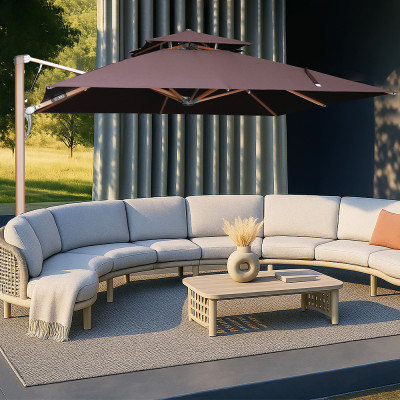
Staple fibre is the filling published on our six-piece corner set, where the cushions are specified as 15 cm thick with removable covers. It sits soft, it compresses under weight, and it recovers more slowly than foam. On a lounge set that is used in the evening, that softness is the point. On a dining chair that is used three times a day, it means the cushion slowly takes the shape of the people who sat in it.
High density foam
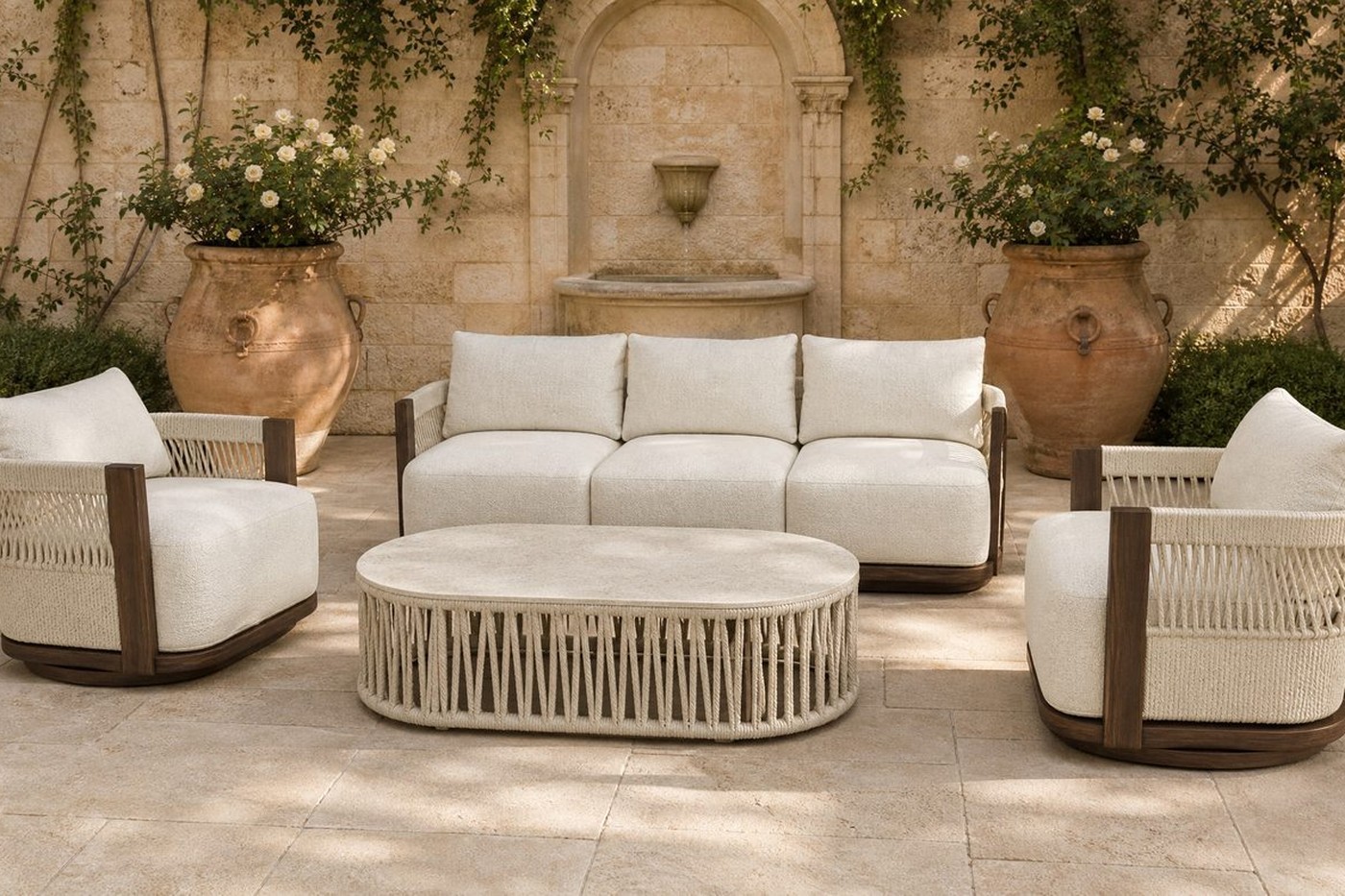
High density foam appears on our rope-weave lounge set, specified as outdoor fabric over high density foam. It holds its height, it does not migrate inside the cover, and it keeps a crisp edge under a piped seam. If a set is going into a hotel or a restaurant, where the cushion is sat on by a different person every hour, this is normally the filling to specify.
| Filling | How it feels | How it ages | Normally specified for |
|---|---|---|---|
| Staple fibre | Soft, slightly compressing, warm | Recovers slowly, takes seat shape over a season | Villas, gardens and terraces with evening use |
| High density foam | Firmer, holds its shape, crisp edge | Keeps height and edge through daily turnover | Hotels, restaurants, clubs and pool decks |
If a quotation names a filling but not a density, the density is the question to ask. Two cushions both described as foam can sit 20 mm apart in finished height, which is the difference between a set that looks finished and a set that looks underfilled.
How thick, for each piece of furniture
Thickness is not one number for a set, because a dining chair and a sofa are doing different jobs. A dining cushion is a seat pad that raises a person to the table; a lounge cushion is the seat itself. The published figures below are the ones a buyer can point at in a quotation.
| Piece | Published specification | What the thickness is doing |
|---|---|---|
| Dining chair | Loose seat pad or a square seat and back cushion, finely piped | Raises the seat to a comfortable height at the table and adds back support |
| Lounge armchair | Thick loose seat cushion in the same fabric as the sofa | Fills a deeper seat frame so the sitting position is not a perch |
| Sofa seat | 15 cm thick, staple fibre, removable covers on the corner set | Sets the seat height of the whole set, and the set is drawn around it |
| Bench | Backless slatted top, normally left without a loose cushion | Low, occasional seating, so a cushion would be in the way |
| Sling seat | Flat taut woven fabric, no loose padded seat | Nothing to remove, nothing to store, nothing to replace |
The number that matters more than thickness
The seat height. Our high-back armchairs are published at 105 cm overall and the dining chairs at 84 to 87 cm, with the lounge seats at 65 to 75 cm and the dining table at 75 cm high. A cushion is what closes the gap between the frame the factory builds and the height a person actually sits at. Ask for the finished seat height with the cushion in place, not the thickness of the cushion, and you will get the answer you were looking for.
The cover: what the detailing tells you
Detailing is where a range separates itself, and it is also the fastest way to date a cushion. Four finishes appear on our own sets, and each one is a decision rather than a decoration.
- Piped edging. A fine cord runs along the seam. It holds the corner of the cushion square and it is what makes a seat and back cushion read as a matched pair. Published on our swivel lounge set and on the round dining set.
- Horizontal quilting. Parallel stitch lines across the cushion face. It holds the filling in place on a wide seat and adds a horizontal rhythm to a plain fabric.
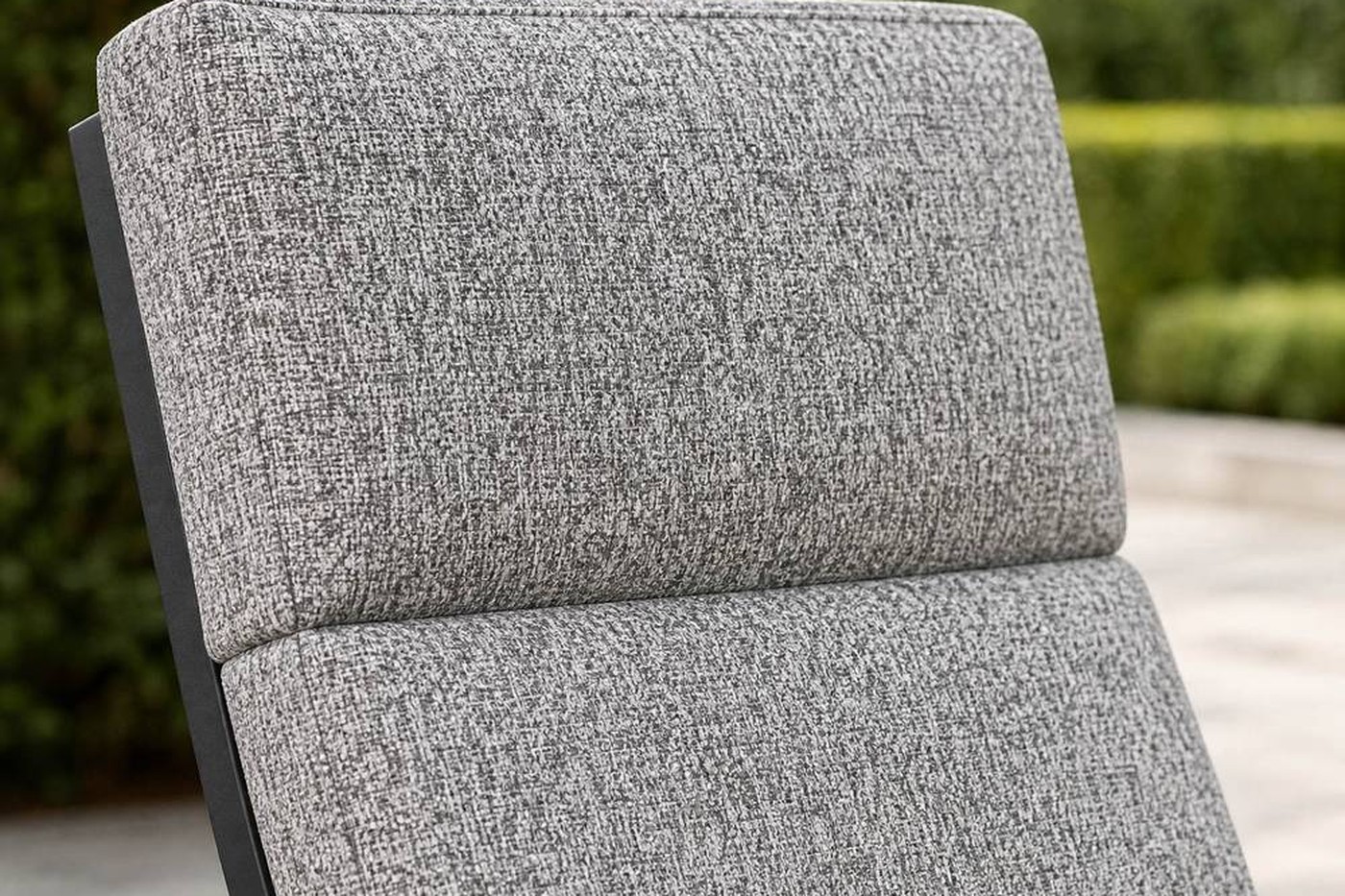
- Speckle. A mid grey heather fabric with fine speckles through it. Speckle hides everyday marks better than any flat colour, which is why it appears on a chair intended for heavy use.
- Plain seams, no buttons, no quilting. The quietest option, and the one that survives cleaning most predictably, because there is nothing to trap water or dust.
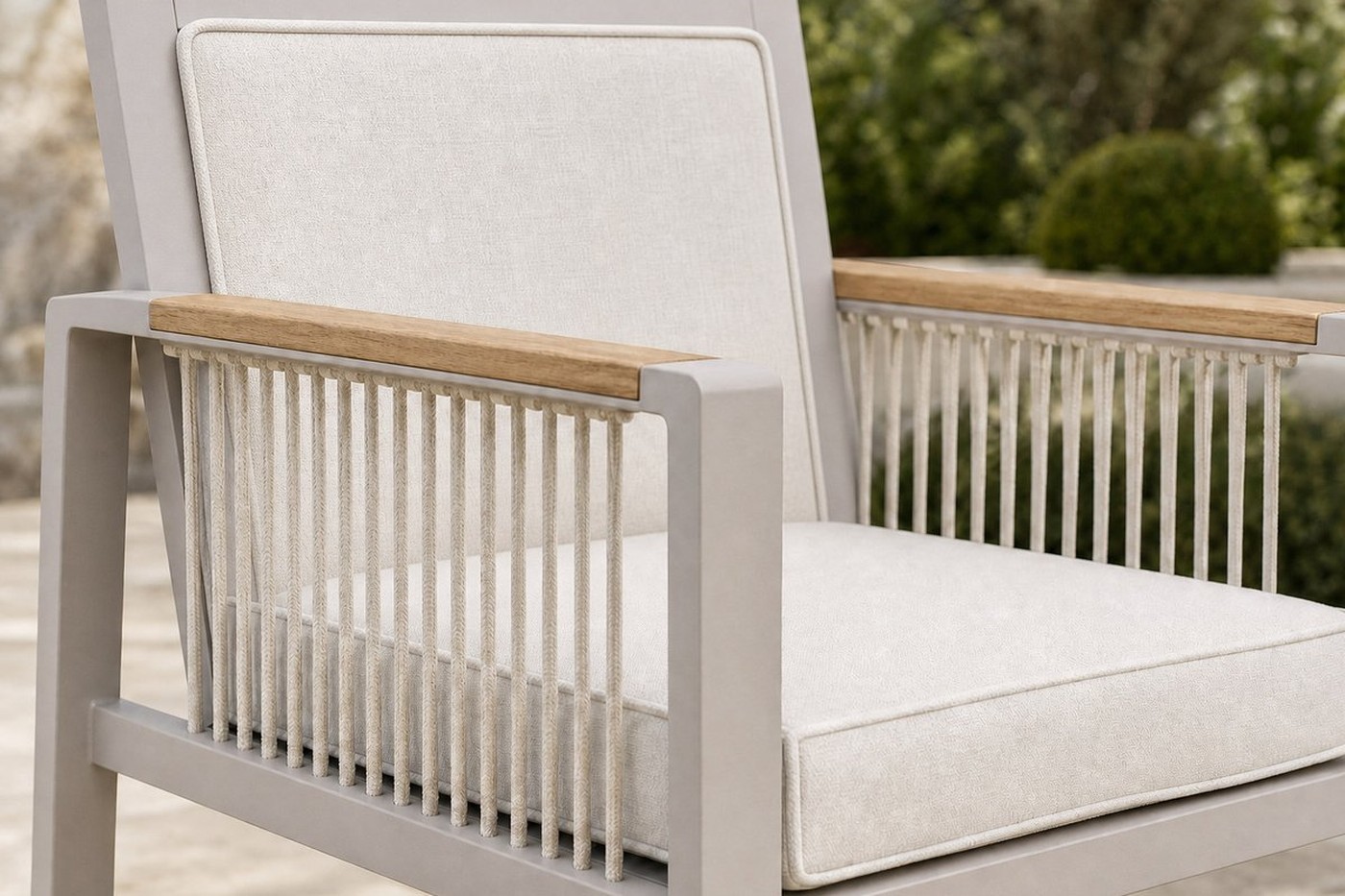
One detail is worth calling out because it is chosen deliberately rather than left off: on our high-back dining armchair the cushion has no buttons and no quilting. The specification says so in as many words. On a chair that is stacked or moved between services, tufting is the first thing to fail, and a plain face with a rounded front edge is the version that still looks right after two seasons.
Colour: fix it before the first order
Three cushion colours are published across the range: cream, mid grey and dark charcoal grey. The pattern is consistent, and it is worth understanding before you choose, because colour is the one specification that is almost impossible to correct later.
- Dark charcoal grey. Published on the four-piece garden lounge. It sits with a charcoal or white frame, it does not show a mark from a wet swimsuit, and it is the colour most commercial terraces specify.
- Mid grey and grey heather. Published on the high-back chairs and the five-piece lounge set. The most forgiving colour in daylight, and the one that reads as neutral against planting.
- Cream, off-white and ivory. Published on the corner set, the swivel lounge set and the round dining set. Cooler under a pergola or a canopy, and the colour that photographs best, but the one that needs a removable cover most.
Frames and cushions are quoted as a set, and a set that is delivered in two phases is the classic version of this problem: the second batch arrives two shades away from the first, because the fabric was supplied against a different reference. Send the colour reference you already own, or the model you already own, and the match is confirmed against that rather than against a screen.
Removable covers, and what that buys you
A removable cover is the specification that decides whether a cushion is a two-year item or a six-year item. It appears in as many words on our own sets: the six-piece corner set is published with 15 cm cushions and removable covers, and the white slat-seat armchair is published with a removable seat pad in a woven-textured grey.
What a removable cover actually buys is three things. The cover can be washed rather than replaced. A single stained cushion can be corrected without touching the rest of the set. And when the fabric finally goes, the filling does not have to go with it, which is the difference between replacing a cover and replacing a set.
If a quotation describes a cushion without saying whether the cover comes off, ask. A sewn-shut cover on a terrace set is a decision that only shows itself in year three.
Cushions and the container: what actually drives loading
Buyers often assume that thicker cushions mean fewer sets per container. On the current range the cushion is rarely the deciding factor. The frame build is.
The clearest example is our high-back garden chair. The same chair, with the same thick loose seat cushion in the same grey woven fabric, loads 400 chairs per 40HQ in the stacked build and 700 chairs per 40HQ in the flat-pack knock-down build. That is a 75% difference in how much furniture fits in the container, and none of it comes from the seat.
| Set or piece | Published volume | Cartons | Loading |
|---|---|---|---|
| Four-piece garden lounge | 1.006 CBM per set | One set per carton, L189 x D71 x H75 cm | 66 sets per 40HQ, 71 kg gross |
| Five-piece lounge set | 1.07 CBM per set, 0.842 CBM on the all-aluminium builds | Two export cartons per set | Confirmed with the quotation |
| Six-piece corner set | 3.23 CBM per set | Four cartons per set | 26 sets per 40HQ, MOQ 52 sets |
| L-shape corner sofa | 1.288 CBM per set | Confirmed with the quotation | 56 sets per 40HQ, MOQ 56 sets |
| White slat-seat armchair | Per chair, carton confirmed with the quotation | Per chair | 870 chairs per 40HQ |
Two things follow. First, ask whether the volume in a quotation is the set as shipped or the frame alone, because a set quoted by frame volume will load short. Second, if loading is your constraint, the answer is normally the build of the frame, not the thickness of the cushion.
For hotels and restaurants: the cushion specification that survives turnover
A cushion on a hotel terrace is sat on by a different person every hour, and it is cleaned by staff who are not going to read a care label. Four specifications do most of the work.
- High density foam rather than staple fibre. It keeps its height under daily turnover instead of taking the shape of the last guest.
- A removable cover. Cleaning happens on the cover, not on the whole cushion, and a marked cushion can be corrected mid-season.
- A colour that forgives marks. Dark charcoal grey and grey heather are published for a reason. Cream is beautiful under a canopy and unforgiving on an open pool deck.
- Consistency across the order. Buy the whole terrace in one specification rather than in phases, or send the reference of the first batch so the second batch is matched to it.
The configuration and loading side of a hotel terrace is covered in more depth in our guide to commercial outdoor furniture for hotel terraces, and the frame materials behind the cushions are compared in aluminium, steel or rope weave. If the terrace is on a roof rather than at ground level, read rooftop terrace furniture before the cushion, because the wind and loading rules change the frame and the base plate.
Sling seats: the option with no loose cushion at all
Not every chair should have a cushion. One line on our range is published with a flat taut grey fabric seat in sling style and no loose padded seat, and on the right site that is the better specification rather than the cheaper one.
A sling chair has nothing to remove, nothing to store overnight, nothing to stack separately and nothing to replace when the filling goes. On an open pool deck, where cushions are carried in and out at the end of every day, the labour of moving cushions is a real operating cost. A sling seat removes it.
The trade is comfort: a sling is a taut surface, not a soft one. If guests sit for a full meal, the padded chair is the right answer. If they sit for twenty minutes with a drink, the sling is the one that is still in good condition in year four.
How we build the cushions with the frames
Cushions are cut to the frame they belong to, which is why a replacement cushion is quoted from the model rather than from a size. Three parts of how we work affect what you receive.
- The frame decides the cushion. A lounge set is drawn around its seat height, so the cushion thickness is fixed when the frame is fixed. Changing the cushion later changes the sitting position, not just the look.
- Filling, fabric and detailing are stated on the product page. You can read the published specification for the filling, the cushion colour and the detailing before you ask for a quotation, and check it against what arrives.
- Custom colour and custom fabric are part of ODM. Several lines are published with custom frame colour and cushion fabric as a named option, and our standard customisation line is custom size, colour and logo. Send a swatch, a photograph, or the model you already own, and the match is confirmed against that reference.
How the frames themselves are judged is set out in what makes outdoor furniture truly good, and the ranges themselves are listed in the outdoor sofa set range, the outdoor dining chair range and the outdoor lounge furniture range. Project work, where the cushions have to match a building rather than a catalogue, is described on project furniture solutions.
Three cushion specifications that work, and one that does not
The villa terrace
A five-piece aluminium lounge set with cream piped cushions, staple fibre, 1.07 CBM a set, in two export cartons. Soft for evening use, and a removable cover for the one cushion that gets rained on.
The hotel pool deck
High density foam, dark charcoal grey, removable covers, and chairs published at 870 per 40HQ so the deck can be replaced in one order rather than in phases.
The restaurant terrace
Dining chairs with a square seat and back cushion, finely piped, and a colour that forgives a lunch service. The seat count per table is worked out in our How many chairs fit an outdoor dining table guide.
The one that does not work
A cream staple fibre cushion, sewn shut, on an open pool deck with no shade. It looks right in the render, it is the cheapest line in the quotation, and by the end of the first season it has taken the shape of the deck chairs, carries a mark that cannot be washed off, and cannot be corrected without replacing the filling as well. Every part of that specification is reversible at the quotation stage, and none of it is reversible afterwards.
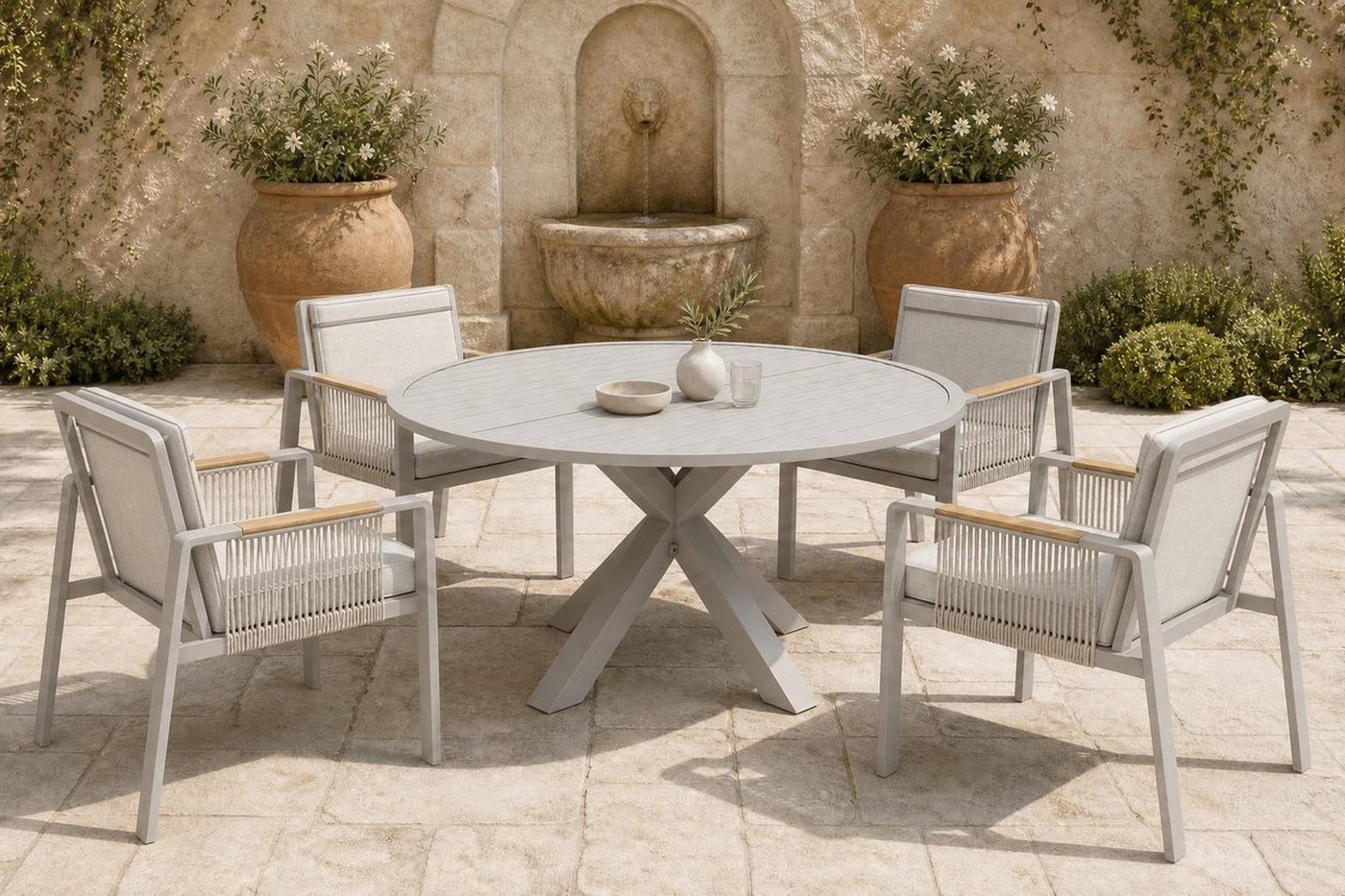
Measuring your own cushions in five minutes
If you already own a set and want a replacement, or you are matching a terrace you are adding to, five measurements are enough. Take them with the cover on and the cushion in place, and write them down in this order.
- Seat width and depth. Across the inside of the frame and from front to back at the widest point. These two decide whether a cushion fits or fights.
- Thickness at the front edge. Not in the middle, where weight has already flattened the cushion. The front edge is the number that shows.
- Back cushion height and width. Measure the panel the cushion sits against rather than the cushion itself, so a replacement lands the same way.
- Whether the cover comes off. Look for a zip or a flap. If there is neither, a replacement means a new cushion rather than a new cover.
- The frame model number. A model number beats every measurement above, because a cushion is cut to the frame rather than to a size.
Send those five with a colour reference and a replacement can be quoted without a site visit. Where a measurement and a model number disagree, the model number wins: a cushion cut to a measured size can miss a frame that was built to a drawing.
Questions we are asked about cushions
Can I buy replacement cushion covers on their own?
The covers on our sets are removable, and a replacement set is quoted against the model, the fabric and the colour you already own rather than against a generic size. Send the model number and, if you have one, a photograph of the cushion in place, and the match is confirmed from that. Lead times and minimum quantities for a replacement are confirmed on the enquiry, because they depend on whether the fabric is a stocked one or has to be matched.
Staple fibre or foam, if I only order once?
Foam, if the set is commercial. Staple fibre, if the set is domestic and the seat is used in the evening. The published range covers both, and the difference in the quotation is smaller than the difference in year three.
How thick should the cushion be for a dining chair?
Thin enough that the person is raised to the table rather than above it, and thick enough to cover the seat frame. On our dining chairs the cushion is a seat pad or a square seat and back cushion, and the range is published at 84 to 87 cm overall with the table at 75 cm high. Give your buyer the finished seat height and let the factory size the pad.
Will the cushion colour match the first batch if I order again?
It will if the second order is matched against the first reference, which is why we ask for the model you already own. Colour is confirmed against a physical reference or a model rather than against a screen, because the same grey photographed on two phones is two different greys.
Does the cushion change what fits in the container?
Rarely. On our high-back chair the same chair and the same cushion load 400 per 40HQ in the stacked build and 700 in the flat-pack build, so the frame build is what moves the number. What the cushion changes is the volume per set, which is published, so a quotation can be checked against a loading plan.
Is the cushion covered by the warranty?
Every set carries a 12-month warranty from the date of loading. What that covers, and what normal wear looks like over the same period, is best settled on the enquiry against the specification you are ordering, because a cushion used on a sheltered terrace and a cushion used on an open pool deck are not the same conversation.
What to send us for a cushion quotation
Cushions are quoted with the set, so the useful brief is the set. Five things are enough for us to come back with a specification rather than a question.
- The pieces and the counts. How many sofas, armchairs, benches and dining chairs, and whether any of them are in a sling rather than a padded build.
- The setting. Covered terrace, open pool deck, rooftop or garden. This decides the filling and the colour before anything else is discussed.
- The shade over the seating. Umbrellas, canopy, pergola or nothing. A cushion under shade and a cushion in full sun are two different specifications. If shade is still open, our pool deck planning guide and the outdoor furniture range both start from the same layout question.
- The colour reference. A swatch, a photograph, or the model you already own.
- The destination port. Loading and freight are quoted from the packing, and the packing is decided by the build you choose.
Send that and the reply is a specification, not a catalogue page: filling, thickness, cover, colour, carton count and loading, with the options that would change any of them.
The takeaways, in one place
- The thickest cushion in a published range is normally the lounge seat, at around 15 cm. A dining chair takes a pad, not a lounge cushion.
- The filling decides behaviour: staple fibre is softer, high density foam holds height. Ask for the density, not just the word foam.
- Ask for the finished seat height rather than the cushion thickness. That is the number the buyer actually cares about.
- Piped edging, quilting, speckle or a plain face: detailing is a choice, and a plain face survives cleaning most predictably.
- A removable cover is what turns a cushion from a two-year item into a six-year item.
- Fix the colour against a physical reference before the first order, or the second batch will not match the first.
- Loading is decided by the frame build, not the cushion. The same chair with the same cushion loads 400 or 700 per 40HQ depending on how it is built.
- On a terrace with no shade, spec the colour and the cover as if the sun is the client.
Tell us the terrace, we will specify the cushions
Pieces, counts, setting, shade and destination port. That is enough for us to specify the filling, the thickness, the cover, the colour and the loading, and to tell you honestly which part of your first idea would not survive year three.
Request a quote and price list