Aluminium, Steel or Rope Weave? Choosing the Best Material for Outdoor Furniture
Most outdoor furniture is chosen on looks and judged on materials. You fall for a silhouette on a terrace, then find out two years later that the finish has chalked, a fixing has bloomed orange and the seat has gone slack. This guide covers the decision underneath the design decision: what aluminium, steel and rope weave each do outdoors, where each is the right answer, and the questions that expose a weak specification before you pay for it.
The short answer: what is the best material for outdoor furniture?
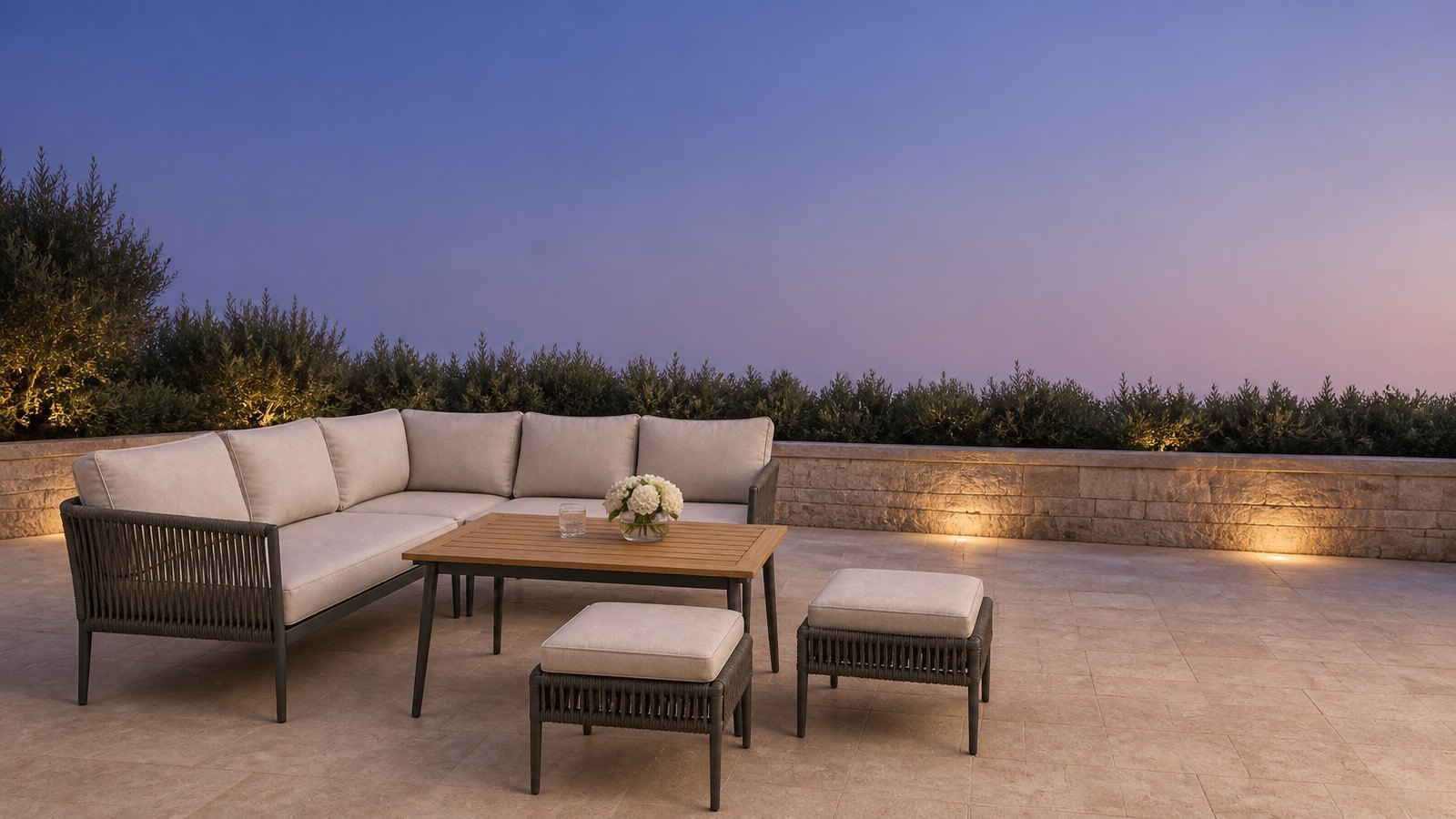
For most outdoor settings, powder-coated aluminium is the best material for outdoor furniture, paired with rope weave for the seating surface. Aluminium does not produce red rust, it weighs about a third as much as steel, and it extrudes into the slim profiles modern terrace furniture depends on. Steel wins only where you want mass, where the piece is fixed, or where the climate is dry rather than salt-laden. Rope weave beats every other seat surface in heat, and its life depends far more on how it is woven than on the rope itself.
Everything below is the reasoning behind that, built so you can check it rather than take it. Claims about specific products are attributed; general recommendations are labelled as recommendations.
Why the frame decides more than the finish
The frame is where the money quietly goes, because it is the only part carrying load and living outside permanently. Cushions can be taken in; the frame sits in the weather for a decade.
- It sets the maintenance ceiling. A material that corrodes under salt keeps corroding, however good the cushions are.
- It sets the weight, and weight sets the logistics. Weight changes container counts, packing, and the landed cost per seat.
- It sets the silhouette. Thin arms and light lines are possible in extruded aluminium, difficult in steel at the same strength.
The useful question is not which material is best in the abstract, but which keeps the design you want, in your climate, at the maintenance budget you will fund.
Powder-coated aluminium
Extruded tube or profile, welded or jointed, then coated. The default for hotel, restaurant and residential terraces. Light, stable, no red rust.
Powder-coated steel
Square or rectangular section, welded and coated. Heavier, stiffer for the same wall thickness, and dependent on coating integrity in a way aluminium is not.
Rope weave
Tensioned rope woven onto a metal frame. A seat surface rather than a structure, and the biggest factor in how a chair feels at 35°C.
A fourth family is usually hidden: the seating surface. Sling, textilene and upholstered foam are alternatives to rope weave on the same frame, and most specification mistakes happen when a buyer chooses the frame carefully and the seat by accident.
The comparison table: seven things buyers actually argue about
The seven columns are the questions that come up in almost every material conversation we have with hotels, restaurants and distributors. Read it as a map of trade-offs, not a scoreboard, no material wins every column.
| Material | Corrosion resistance | Weight | Maintenance | Service life | Relative cost | Best climate and setting | Coastal suitability |
|---|---|---|---|---|---|---|---|
| Powder-coated aluminium | High. Own oxide layer plus a coating barrier. No red rust. | Light, about a third the density of steel. | Low. Rinse salt, touch in chips, mild soap. | Longest of the structural options when coating and fixings hold. | Mid to high, offset by lower freight per seat. | Universal: coastal, humid, desert, alpine. | Very good with stainless fixings. |
| Powder-coated steel | Moderate. No self-healing oxide, so a breach in the coating starts corrosion. | Heavy, two to three times the same aluminium section. | Medium to high. Chip repair and fixing checks matter. | Long, but conditional on coating integrity. | Lower material cost, higher freight per seat. | Dry inland climates, fixed installations, where mass is wanted. | Least suited unless unusually protective. |
| Rope weave seating | Not structural, but the panel is unaffected by salt water. | Light. Adds very little to the frame. | Low to medium. Brush, never pressure wash, check tension yearly. | Set by weave and tension, not fibre grade. | Mid. Labour-intensive, and the labour is the quality. | Hot and humid climates especially. | Good. Dries fast, does not corrode. |
| Sling or textilene | Unaffected by salt air; the frame behind it still decides. | Very light, packs flatter than padding. | Lowest of the seat surfaces. | Set by UV exposure; tension loss is the failure mode. | Low to mid, cheap to replace. | High-turnover commercial dining. | Good. |
| Solid timber | Resistant species do well but move with moisture; end grain absorbs water. | Moderate, heavier than aluminium. | Highest. Oiling or sealing on a schedule. | Long with the right species and regime. | High, and maintenance recurs. | Dry climates, covered terraces, inland courtyards. | Possible with annual care, rarely low-maintenance. |
| Wood-look aluminium | Behaves like aluminium, because it is aluminium. | Same as aluminium. | Low, identical to the rest of the frame. | Matches the frame, not a timber cycle. | Above plain powder coat, below solid timber with maintenance counted. | Where the look of timber is wanted without the upkeep. | Good, and it solves timber on a salt-facing terrace. |
How to read this: corrosion, weight and maintenance describe general material behaviour. Service life and cost are relative, not quoted figures.
Aluminium: why it became the default
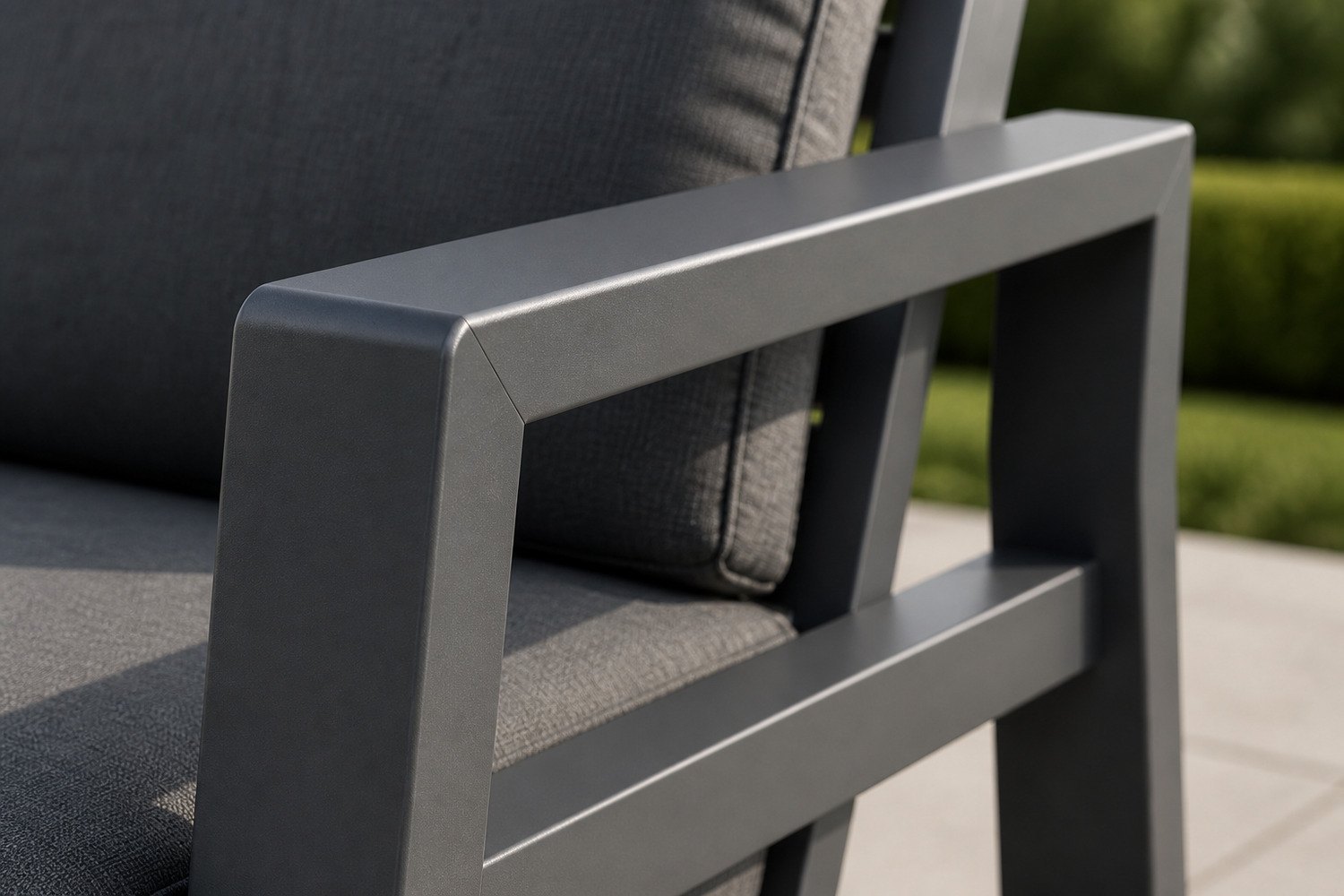
Aluminium forms a thin, tightly bonded oxide layer in air that stops further attack. That is why an aluminium frame does not produce the creeping red rust steel produces.
It is also roughly a third the density of steel, which lets a frame use slimmer sections and still be strong enough, the reason contemporary outdoor furniture can be drawn with thin arms and open silhouettes. And because it does not absorb water or swell, a frame that arrives square stays square.
Published example: the design house Kettal describes its aluminium as extruded and hollow profiles, with corrosion resistance comparable to stainless steel, and 80% recycled aluminium in extrusion.
Powder coating versus anodising: the finish is half the material
Two aluminium frames with identical profiles can behave differently after three years, and the difference is almost always the finish.
| What it is | Powder coating | Anodising |
|---|---|---|
| How it works | A dry polymer powder is applied electrostatically and cured into a film on top of the metal. | An electrochemical process grows an oxide layer out of the aluminium itself. |
| Colour range | Effectively unlimited, including RAL matching and wood grain. | Metallic tones and a narrower set of dyed colours. |
| How damage shows | A chip or scratch that can expose bare metal; touch-up repairs read visible up close. | A scuff or lighter patch; harder to repair locally, but no film to chip off. |
| Coastal behaviour | Very good while the film is intact. Salt attacks edges and fixings first. | Very good, and tolerates abrasion better because nothing is layered on. |
| Ask the factory | How many pre-treatment stages, and whether welds and edges are dressed first. Cheap frames are cheap here. | The anodic layer thickness in microns. A stated figure beats no figure. |
For a resort specification, three questions do most of the work: what is the substrate, how many pre-treatment stages precede the coating, and are welds dressed before coating.
Steel: when it is genuinely the better choice
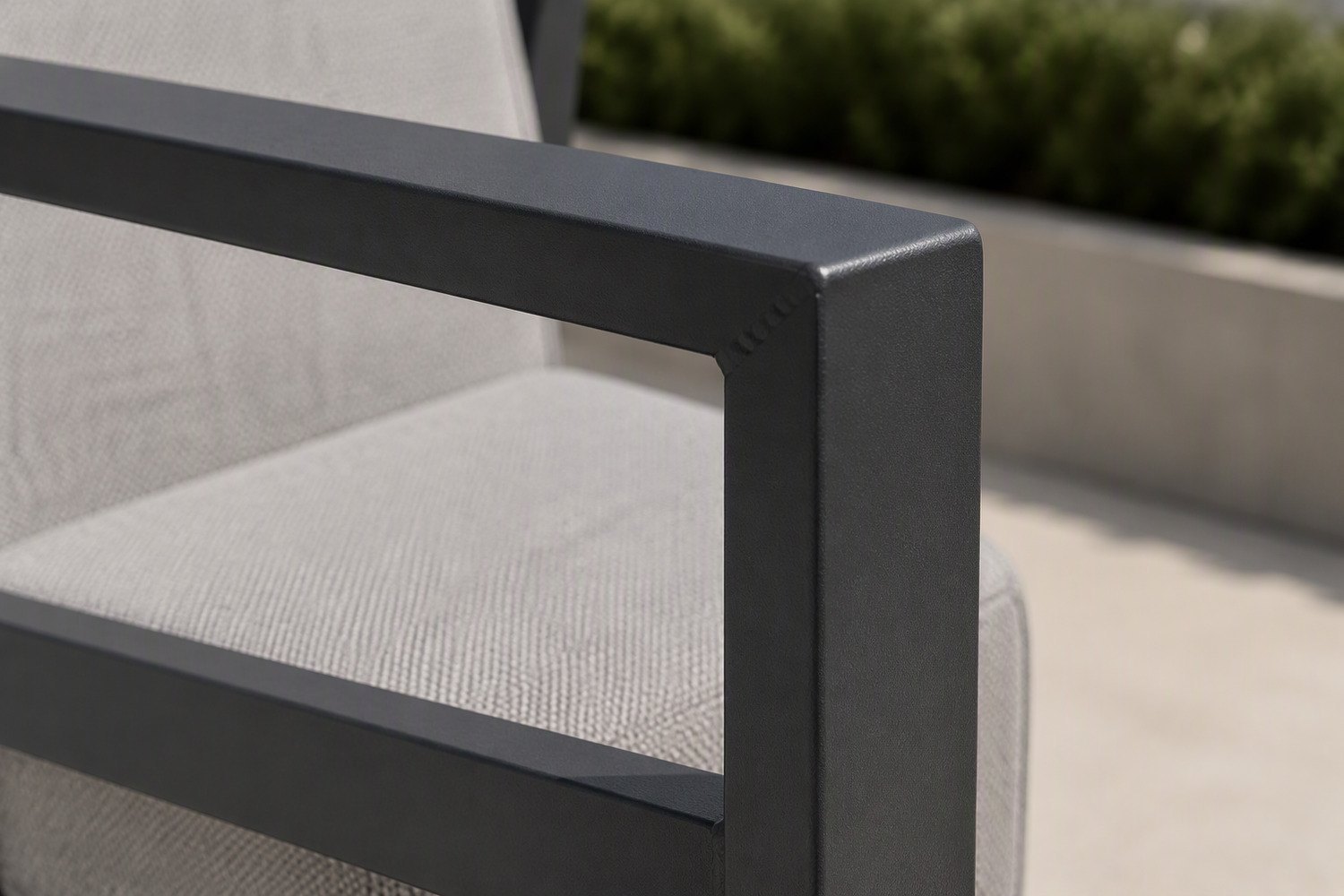
Steel corrodes when its coating is breached, so a steel frame is only as good as its coating and its fixings. Where those are specified properly, steel is a reasonable outdoor material, and sometimes the better one.
- When you want mass. A chair that feels substantial, a bench that does not skate across tiles, a frame that holds position when people lean back. In exposed public settings, weight is also a security argument.
- When a small section must be stiff. For the same dimensions, steel deflects less than aluminium, so a thin member can carry load across a long unsupported span.
- When the site is inland, dry or under cover. A steel chair in a covered courtyard is not a maintenance liability; the same chair bolted to a sea wall is.
If you do specify steel, insist on multi-stage pre-treatment before coating, coating coverage specified at edges, welds and tube ends, stainless fixings throughout, and a stated touch-up regime. Steel is a maintenance commitment rather than a fit-and-forget part.
An honest note from our own catalogue
We should be transparent about where we sit. In our range the overwhelming majority of frames are powder-coated aluminium, and we build exactly one steel model, a dark charcoal adjustable-back dining armchair. We are not the right supplier for a project specified entirely in steel, and we would rather say so than imply a breadth we do not have.
How to tell aluminium from steel without a spec sheet
For samples, competitor quotes or a terrace you are standing on, three field checks get you most of the way. Treat them as indications rather than laboratory results.
Lift it
The most reliable single test. A chair you can lift with one hand is almost certainly aluminium. If you grunt, it is steel or ballasted, and that is the weight your forwarder charges for.
Bring a magnet
Aluminium is not magnetic; ordinary carbon steel is. A magnet that sticks hard confirms a ferrous base metal, but says nothing about grade or coating quality.
Inspect a weld and a tube end
Aluminium welds are usually dressed smooth with capped ends. Steel often shows a raised coated bead and a squarer, thinner wall. Visible care here predicts the rest of the build.
One free extra check: find the fixings under the seat frame. Any discolouration on a sample that has been outside is the real weak point of that specification.
Rope weave: life depends on the weave, not the rope
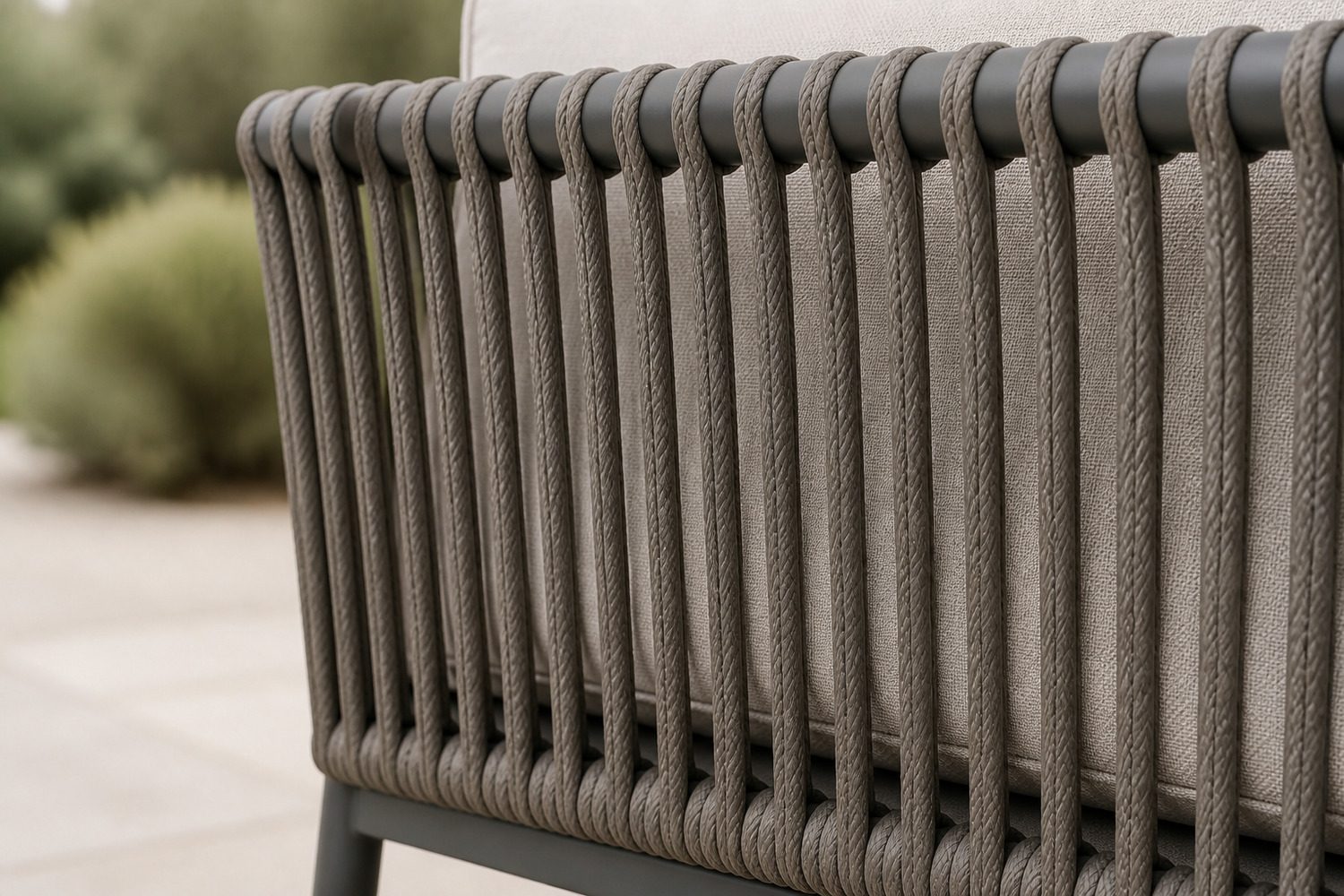
Rope weave changed how outdoor furniture feels. Before it, a breathable seat meant a sling (cool but flat), synthetic wicker (cool but hard) or upholstery (comfortable, hot, wet after rain). The common mistake is judging it by the rope: the rope is a commodity, the construction is not.
- Single layer, parallel, not cross-woven. Strands side by side under consistent tension. Cross-woven patterns look busier and are harder to keep even.
- Even spacing, no slack. Run a hand across the panel. A strand that gives more than its neighbours will sag, and that is where a seat starts to feel tired.
- Ends hidden inside the frame. A visible knot or cut end on the face of the panel is the tell of a cheap weave.
- Even tension around curves. Where the weave wraps an arm or corner, spacing should stay even. This is the hand-worked part that differentiates workshops.
A well-tensioned panel of ordinary rope outlasts a badly tensioned panel of an expensive one, because the failure is mechanical: strands slacken, rub and abrade. The fibre sets colour retention; the weave sets whether the seat is still taut in year five.
Rope weave maintenance: less than you fear, more than nothing
Rope weave has a reputation for being hard to maintain. It is not, provided you avoid one specific mistake.
- Brush, do not blast. Mild soapy water and a soft brush handle normal dirt. A pressure washer drives water into the frame and can shift panel tension.
- Rinse where salt or chlorine lands. On a coastal or poolside terrace, a plain rinse after a busy period removes the deposits that do long-term damage.
- Check tension once a season. Walk the panel with your hand. It takes a minute and it is the only maintenance rope weave asks for.
- Deal with a broken strand early. One abraded strand does not mean a new chair, but the panel should be assessed before its neighbours take extra load.
- Do not treat rope like timber. No oil, wax or sealant. It is a synthetic textile and responds to cleaning, not conditioning.
Sling, textilene and upholstery: the other three seat surfaces
Most specifications never compare seat surfaces explicitly, which is odd, because it is the part guests actually touch.
| Seat surface | Feel | Heat and water | Cleaning | Best application |
|---|---|---|---|---|
| Rope weave | Firm with give; holds shape instead of compressing into a dip. | Does not hold heat; drains and dries fast. | Brush and rinse; nothing to remove or store. | Hot and humid sites, poolside, terraces that get hosed down. |
| Sling or textilene | Firm and taut; flat rather than cushioned, better for upright dining than lounging. | Cool, drains instantly, no foam to soak. | Easiest of all: wipe with a cloth. | High-turnover commercial dining where seats are wiped between covers. |
| Upholstered foam | Most comfortable in cold weather and the most conventional in feel. | Retains heat; holds water if it stays out; foam degrades if stored wet. | Covers off or cushions in. There is always something to store. | Lounging sets under cover, residential terraces, cooler climates. |
| Solid timber slats | Firm and unforgiving over a long dinner. | Cool and drains well, but the timber needs protecting and oiling. | Wipe and re-oil on a schedule. | Benches and accents rather than primary seating. |
Match the surface to how the piece will be used rather than how it will be photographed. A lounging set on a shaded villa terrace and a dining row on an open restaurant deck are different problems.
Wood-look aluminium versus real timber
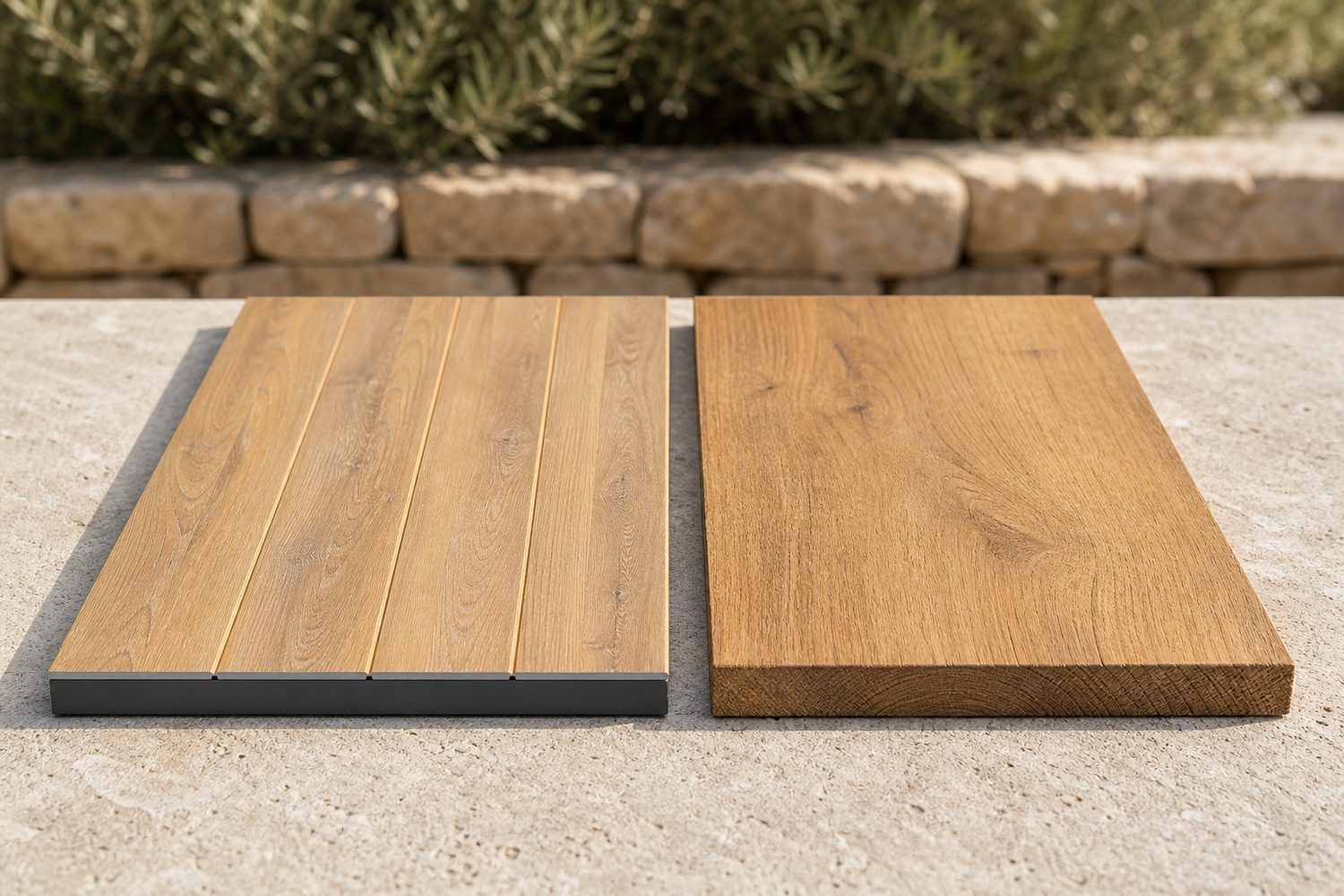
This is the question that fools most buyers: the two look alike in a photograph and behave nothing alike in service. A wood grain on aluminium is produced by sublimation, so it reads as timber while remaining aluminium.
- The grain repeats. Real timber has knots and variation that never repeat; a sublimated finish repeats along the profile.
- The edges are metal. A crisp machined edge and a right-angled section, where timber edges are softer and often show end grain.
- The surface reflects slightly. Even a good sublimated finish carries a faint sheen; untreated timber absorbs light.
Real timber still wins on feel: warm to the touch, ageing rather than merely wearing. The trade is maintenance, oiling or sealing on a schedule, protection for end grain, re-treatment when a surface greys. We use solid timber where it earns its place, such as armrest tops on rope weave chairs.
Coastal, humid or desert: what each material does under stress
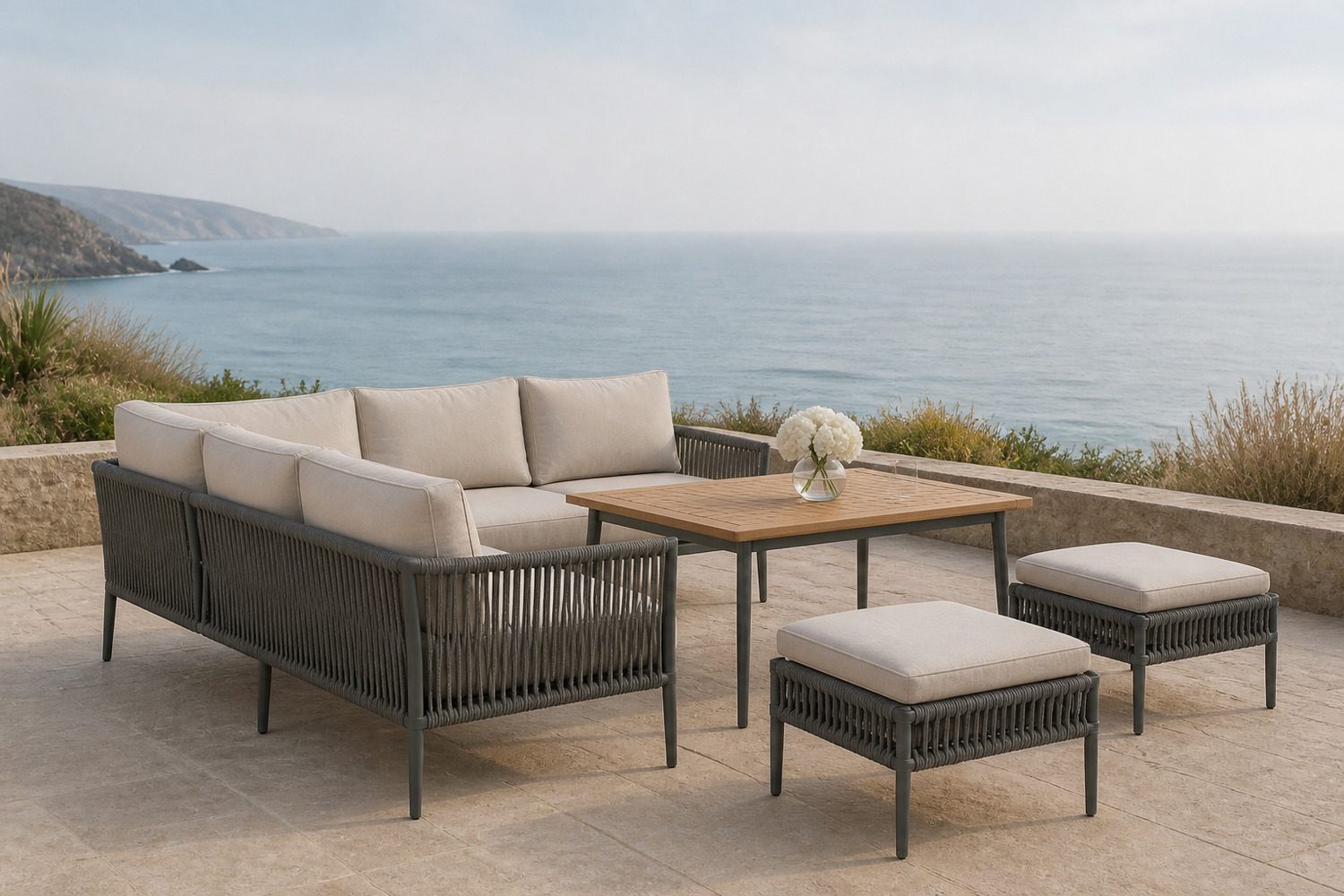
Climate overrides personal preference, so it is worth being specific about what each environment does to furniture.
- Coastal and high-salt. Salt accelerates corrosion on anything ferrous and attacks coating edges and fixings first. Choose aluminium, insist on stainless fixings, rinse on a routine.
- Humid and monsoon. Persistent damp favours materials with nothing to absorb. Upholstered foam is the weak point: it holds moisture, degrades once stored wet, and mould is a cover problem rather than a frame problem.
- Desert and arid. Low humidity makes steel far more viable and UV becomes the dominant stress. Fabric and timber degrade before metal does, so the conversation shifts from the frame to the textile.
- Alpine and freeze-thaw. Less about corrosion, more about water trapped in joints and foam. Aluminium's dimensional stability is an advantage; store furniture dry and elevated, never on wet ground under a cover.
Across all four the pattern is the same: the frame sets the corrosion ceiling, and the seat surface and fixings decide most of the day-to-day outcome.
The hardware rusts before the frame does
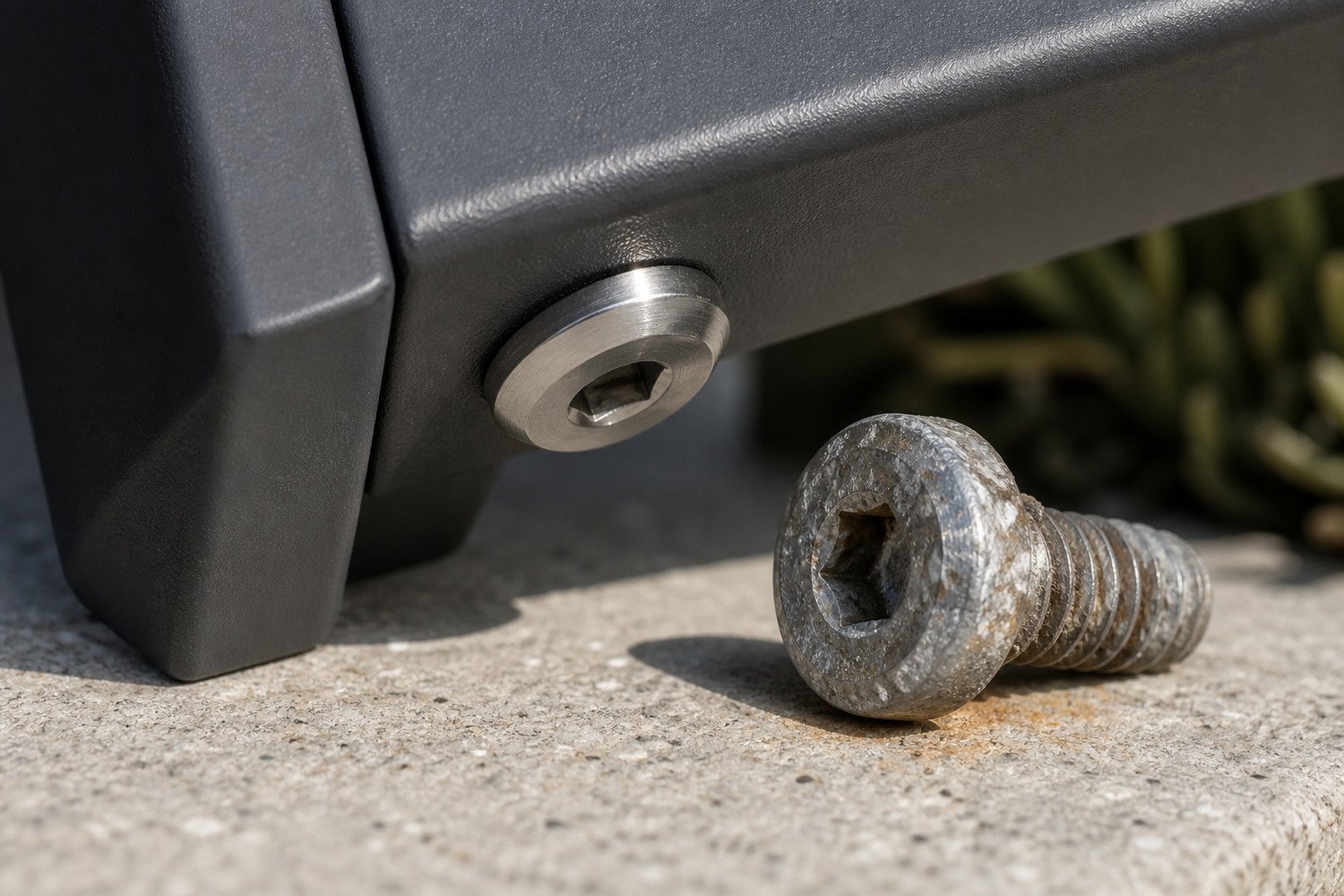
If you remember one technical point, make it this. On a well-built piece the frame is rarely the first thing to fail; the fixings are. A frame carries a continuous factory-applied finish, while a fixing is a small component in contact with the frame, collecting water in a recess and usually the last thing considered in a specification.
- Specify stainless, not zinc-plated. On coastal or humid sites, zinc-plated fasteners are the most common cheap substitution and the first thing to fail.
- Look for isolation between dissimilar metals. A washer or isolating detail at a stainless-to-aluminium joint prevents galvanic corrosion.
- Check that tube ends are capped or sealed. An open tube end is where water sits and where uncoated internal surface is exposed.
- Ask for the touch-up kit. Chips at fixings and edges are normal in service; a supplied touch-up product turns a defect into a five-minute repair.
- Inspect after the first season. One inspection at twelve months tells you more than any promise made at quotation stage.
What leading brands publish about materials, and what that tells you
One useful way to judge a supplier is how much material detail they publish. The top of this market is specific, and that specificity is a signal.
- Outer publishes its frame as 6063 aluminium alloy with a weatherproof powder coating and extruded aluminium tubing, states that frames are hand-welded with clean bead welding, and sets a 10-year frame warranty alongside a 5-year cushion warranty.
- Kettal describes its aluminium in material terms, extruded and hollow profiles, corrosion resistance stated as comparable to stainless steel, 80% recycled aluminium in extrusion, and offers technical documentation and 2D/3D files rather than adjectives.
- DEDON publishes a named fibre with a described weave construction, a dedicated care product for fibre, teak and upholstery, and a warranty document as a downloadable PDF.
- Article is candid in the other direction, describing a steel-framed outdoor sofa as built from solid steel and pairing it with a named performance fabric. Steel is presented as a legitimate choice rather than hidden.
Serious brands quantify: alloy designations, coating systems, lightfast hours, abrasion cycles, warranty periods, downloadable drawings.
Attribution: statements here are as published by the named brands on their own material and product pages. We are not ranking them and no comparison is implied.
Weight, packing and landed cost: the material question nobody frames as one
Material choice is usually discussed in terms of appearance. On a commercial order it is also a logistics decision: aluminium is roughly a third the density of steel, and for a few hundred seats that changes the container count and the freight per seat.
The second variable is the build. A stacking chair and a knock-down chair of the same material load very differently: in our range a rope weave chair reaches 1,200 pieces per 40'HQ stacked, while the knock-down build of one of our charcoal armchairs loads 700. Material and build together decide landed cost, and neither is visible in a photograph.
So compare two quotations at the container, not at the unit price: ask for the loading plan, carton volumes and gross weight.
Where Foris Hortus sits in this material map
We build well-engineered, customisable outdoor furniture that has to work in real hospitality settings. Between entry-level garden furniture and bespoke commissions there is a middle ground: commercially practical, specified in detail and contemporary in design.
In material terms we are an aluminium-first manufacturer. Our frames are powder-coated aluminium, most of our seating is rope weave or sling, we use solid timber selectively, and we build one steel model. We would rather be precise about that than claim a breadth we do not have.
It also means we specify the unglamorous parts: alloy and coating practice, stainless fixings, capped tube ends, and cushions that lift off so a worn cover can be replaced without replacing a frame.
If you are working through a material decision, send us the venue type, the climate, the seat count and the destination port. You can see the range on our outdoor sofa set category, look at a worked example of aluminium-framed seating in the five-piece aluminium outdoor sofa set, or see the one steel model we build, a steel-framed adjustable-back dining armchair.
Materials by project type
The same three constraints, climate, use and maintenance budget, resolve differently by venue. These are recommendations, not universal rules.
Hotel and resort terraces
Aluminium frame, rope weave or sling seat, stainless fixings, removable cushions. The priority is that nothing needs a specialist to maintain it between seasons, and that a worn cushion can be replaced without retiring a chair.
Restaurants and cafes
Aluminium with sling or textilene seats, because seats get wiped between covers. Choose the stacking or knock-down build based on how the site stores furniture overnight, and plan the loading before you compare prices.
Villas and residences
Aluminium with timber or wood-look accents and upholstered seating where the terrace is covered. This is the setting where timber earns its place, because someone is willing to maintain it.
Questions to ask before you approve a material
Print these, or paste them into your next supplier email. Every one of them has a factual answer, and a supplier who cannot answer is telling you something useful.
- What is the base metal, and is it a named alloy or just "aluminium"?
- How many pre-treatment stages precede the coating, and are welds dressed first?
- Are the fixings stainless, and is there any isolation between dissimilar metals?
- How are tube ends finished, capped, sealed or open?
- For a rope weave panel: how is it anchored, is it single-layer, and can I see a weathered sample?
- For any timber: which species, and what is the recommended maintenance interval?
- What is the carton volume and gross weight, so I can check the loading plan myself?
- Which components are replaceable, and which are effectively permanent?
- What is the touch-up procedure for a coating chip, and is a kit supplied?
- Has this exact specification been installed in a climate like mine, and for how long?
A quotation that answers all ten is a specification. One that answers two is a price.
Sources and how to read them
Two kinds of statement appear here. Product-specific claims, alloy designations, published warranties, UV and abrasion figures, are attributed to the brand that published them. General statements about material behaviour are our own engineering view.
Specifying outdoor furniture for a project?
Send us the venue type, the climate, the seat count and the destination port, and we will come back with a material recommendation, the models that match it, and the loading plan for your container.
Talk to the Foris Hortus team