Side Upright Umbrella
Roman umbrellas: side-pole shade with a double-tier canopy
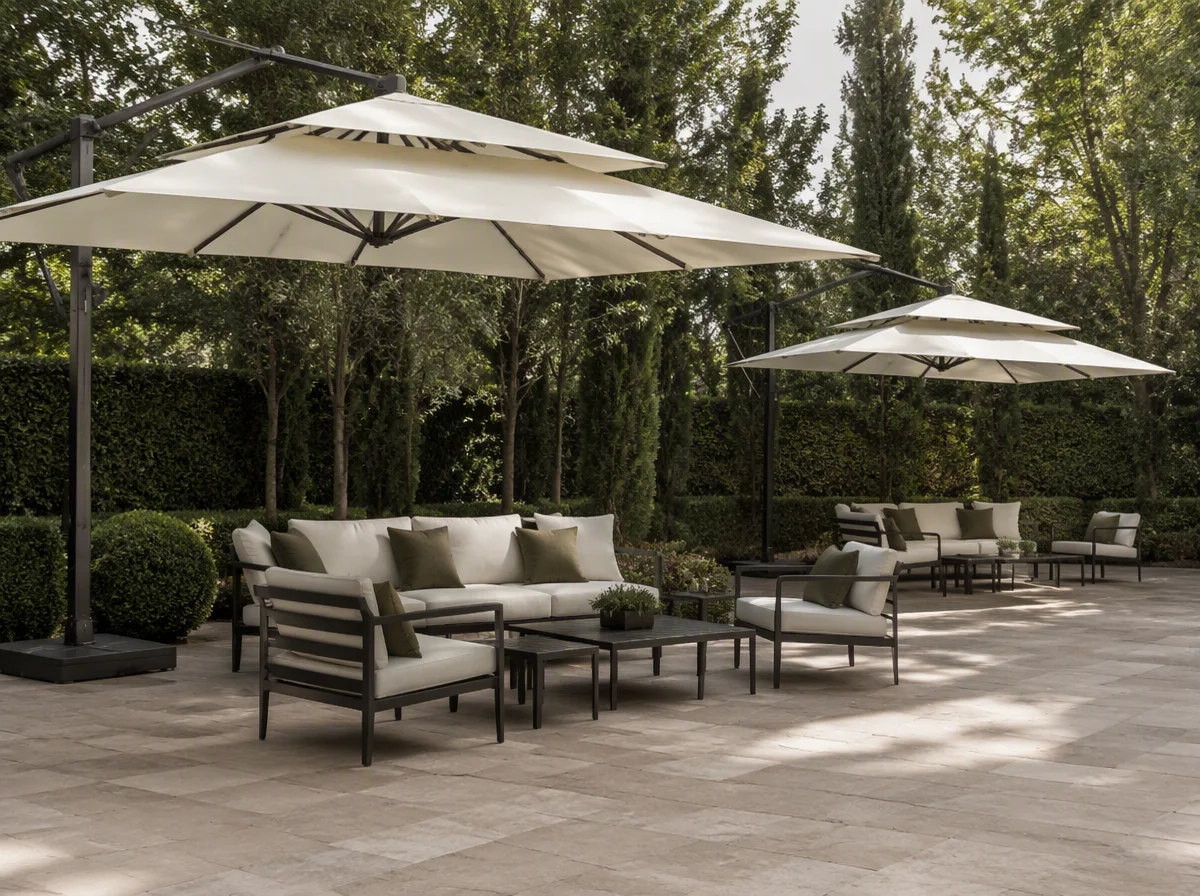
A side upright umbrella carries its canopy on a mast that stands beside the table rather than through it, and the Roman version of that frame is the one hotels, restaurants and resorts specify most often. The signature is the double-tier canopy: a smaller second layer sits above the main one so hot air and gust pressure escape instead of lifting the whole canopy.
That gives you shade with the table completely clear, a canopy that stands up better to wind than a single-tier frame of the same span, and a silhouette that reads as classical rather than utilitarian. Everything below is about specifying that combination for a commercial site without losing the detail that makes it work.
- Double-tier canopy as standard
- Beaufort 4-6 wind resistance
- Anodized or wood-grain frames
- OEM, ODM and bulk supply
What makes a Roman umbrella different
Three things separate a Roman frame from an ordinary patio umbrella. None of them are cosmetic, and each one is worth asking about separately.
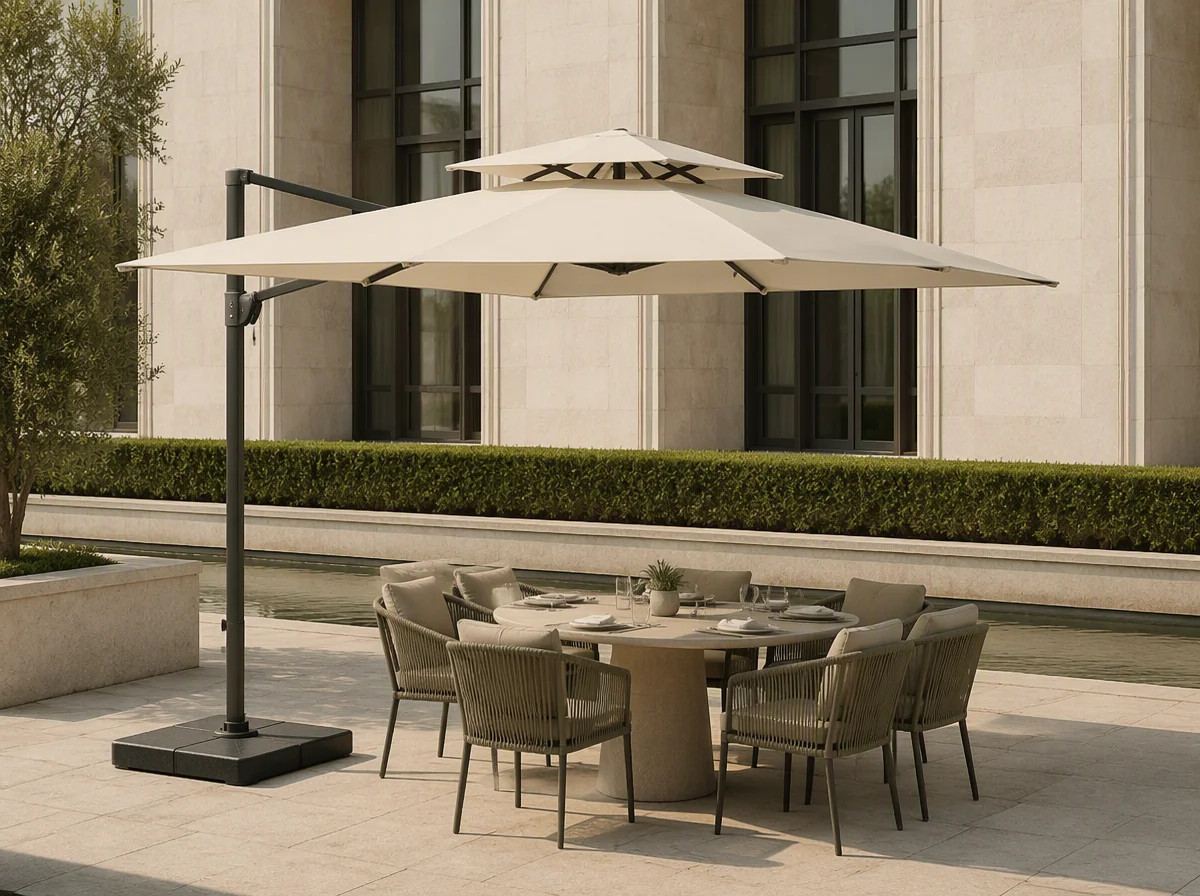
The side upright mast
The mast stands beside the table instead of through it, so the setting keeps its full footprint and nobody sits around a pole.
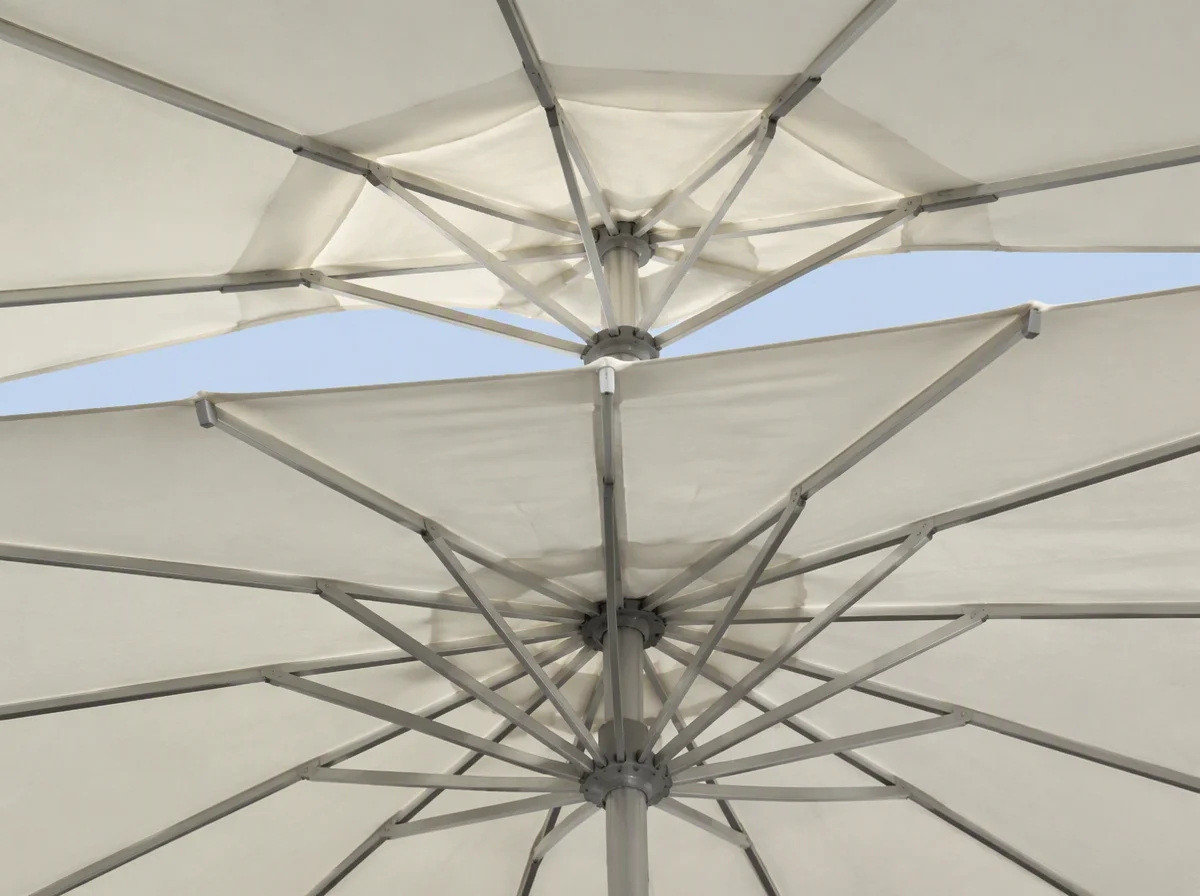
The double-tier canopy
A second, smaller canopy sits above the main one, and the gap between the two layers is what lets air through instead of loading the frame.
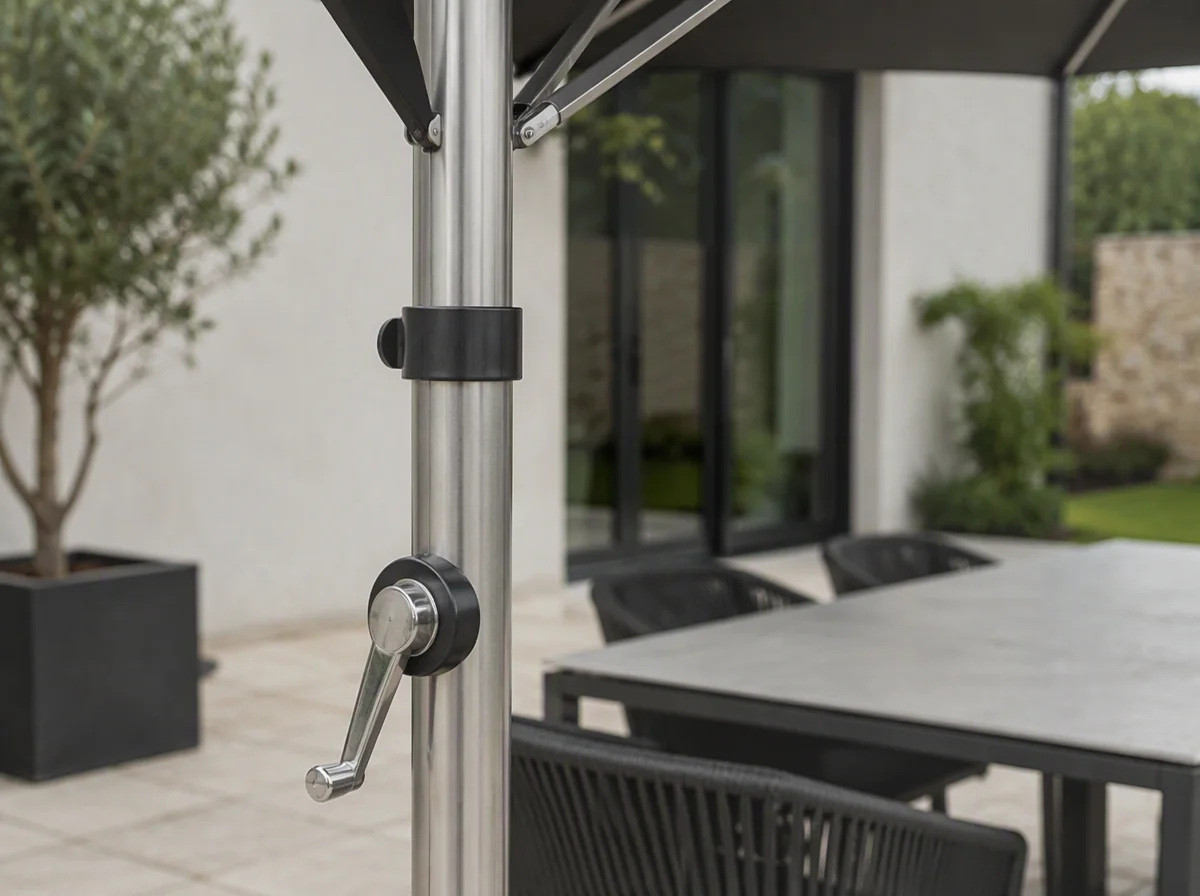
The mast and its mechanism
A rigid mast, a winding crank and a locking collar. At commercial scale this is the part that gets used several times a day.
- Size
- 2.5M*2.5M
- 3M*3M
- Dia 3M
- 3M*4M
- 4M*4M
- Material
- aluminum
- LED
- Long ribs with LED
- Short ribs with LED
- All ribs without LED
- Without LED
- Rib
- 14*24MM
- 18*28MM
- 17*25MM
- 33*20MM
- 20*30mm
- Pole
- 53*77MM
- 55*82MM
- 60*100MM
- 65*105mm
- Top
- Single
- Double
- Stock
- Yes
- No
- Fabric
- Polyester fabric
- Yarn-dyed fabric
- Qing qing fabric
- Short fiber fabric
- Sunbrella
- Grams of fabric
- 180g
- 220g
- 250g
- 260g
- 280g
- 300g
- 200g
- Coating
- PU
- PA
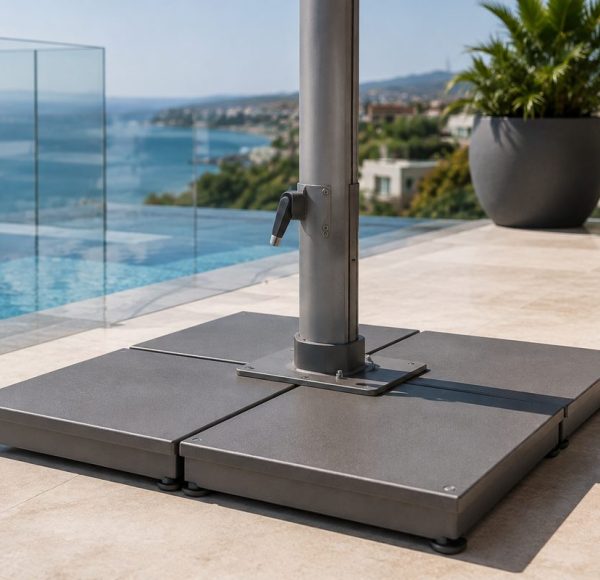
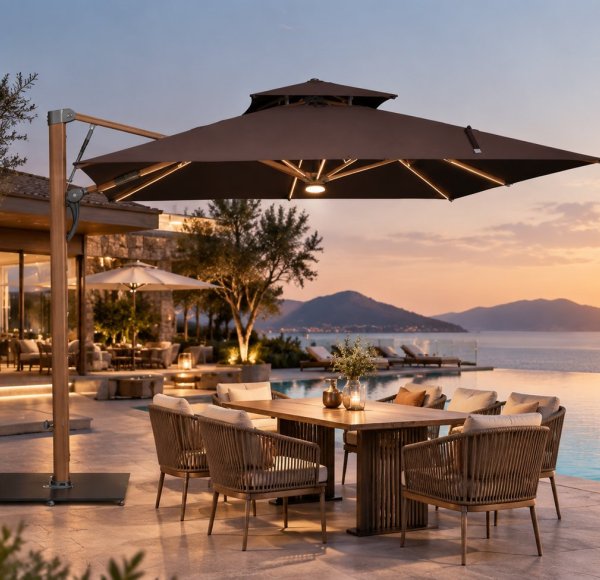
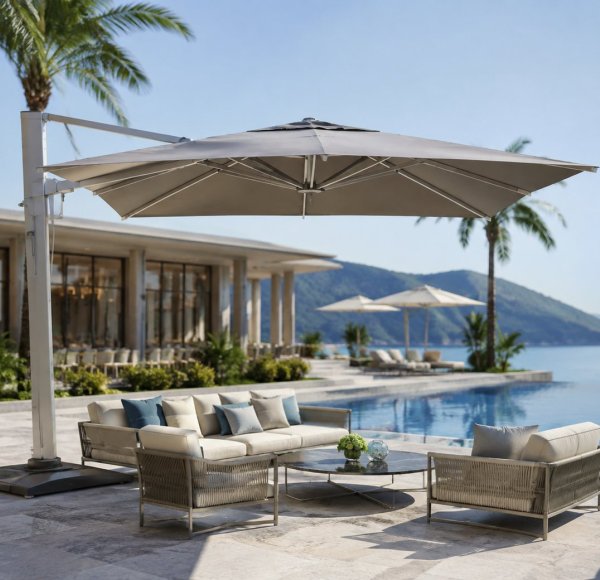
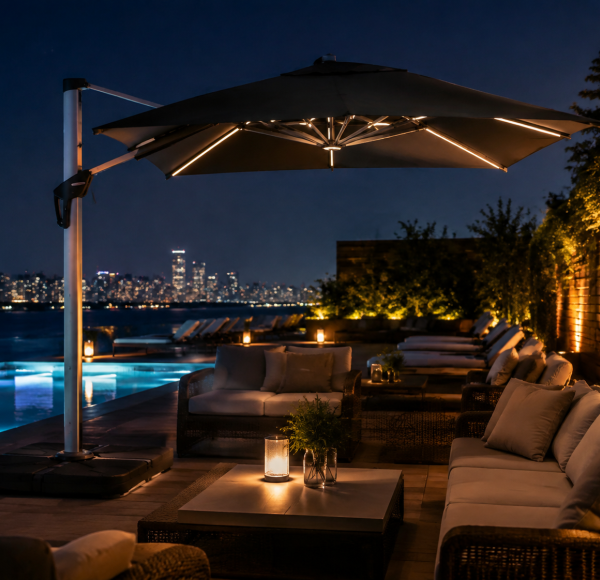
Pricing varies by size, canopy option, and order quantity.
Where Roman Patio Umbrellas Perform Best
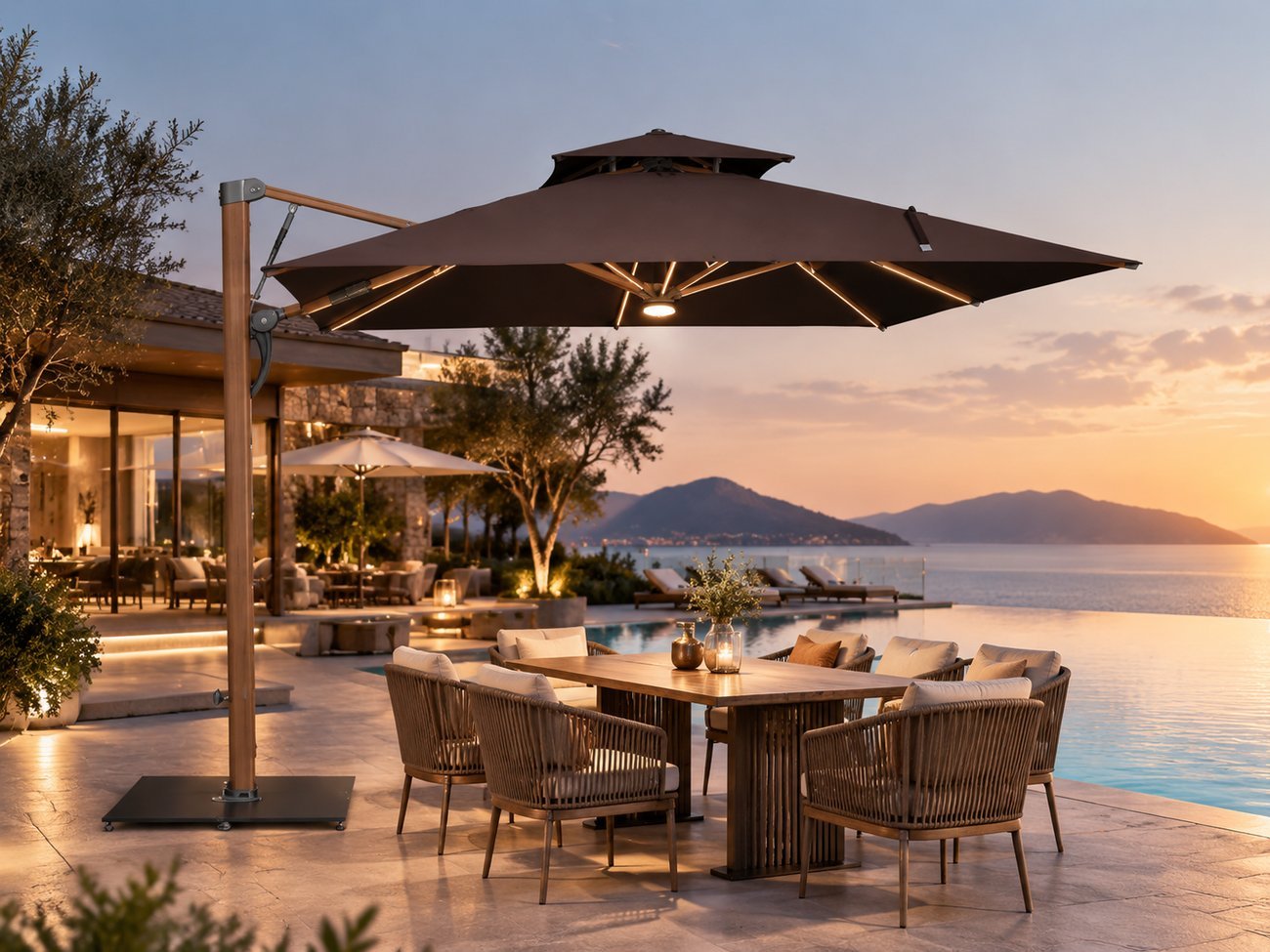
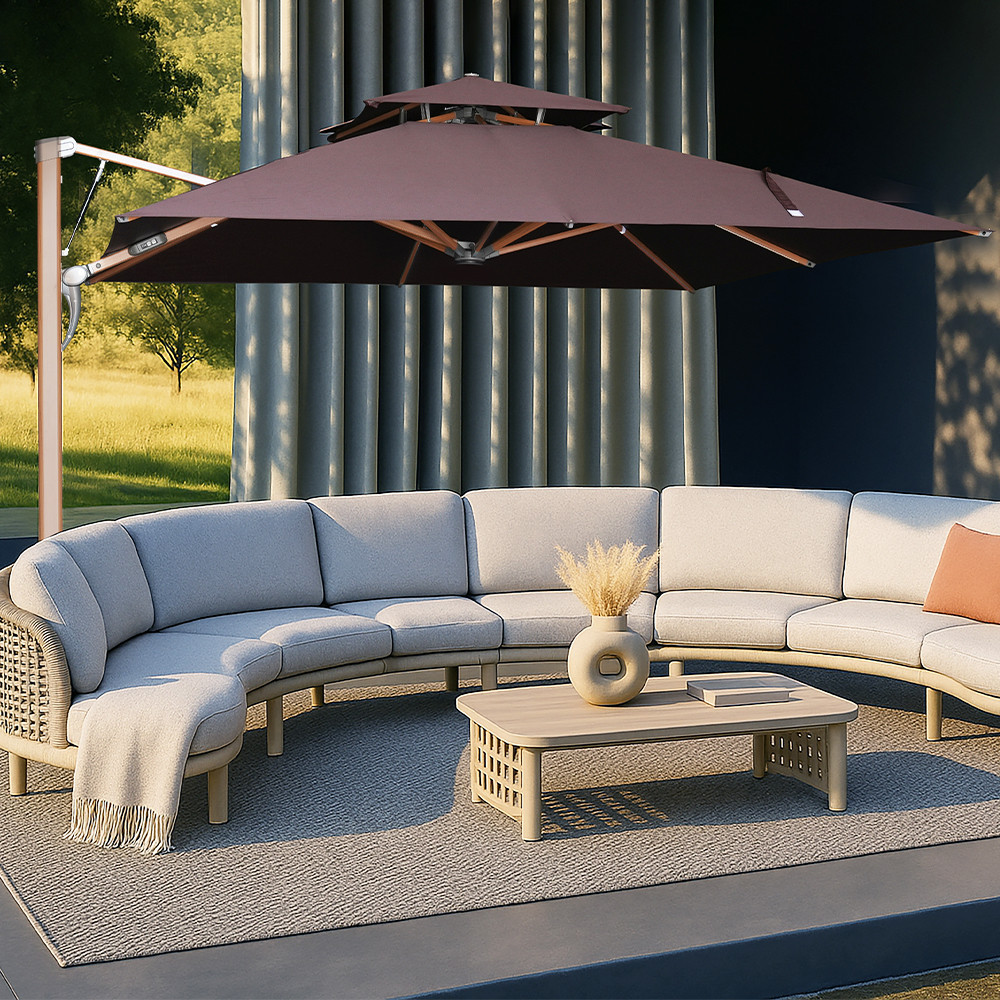
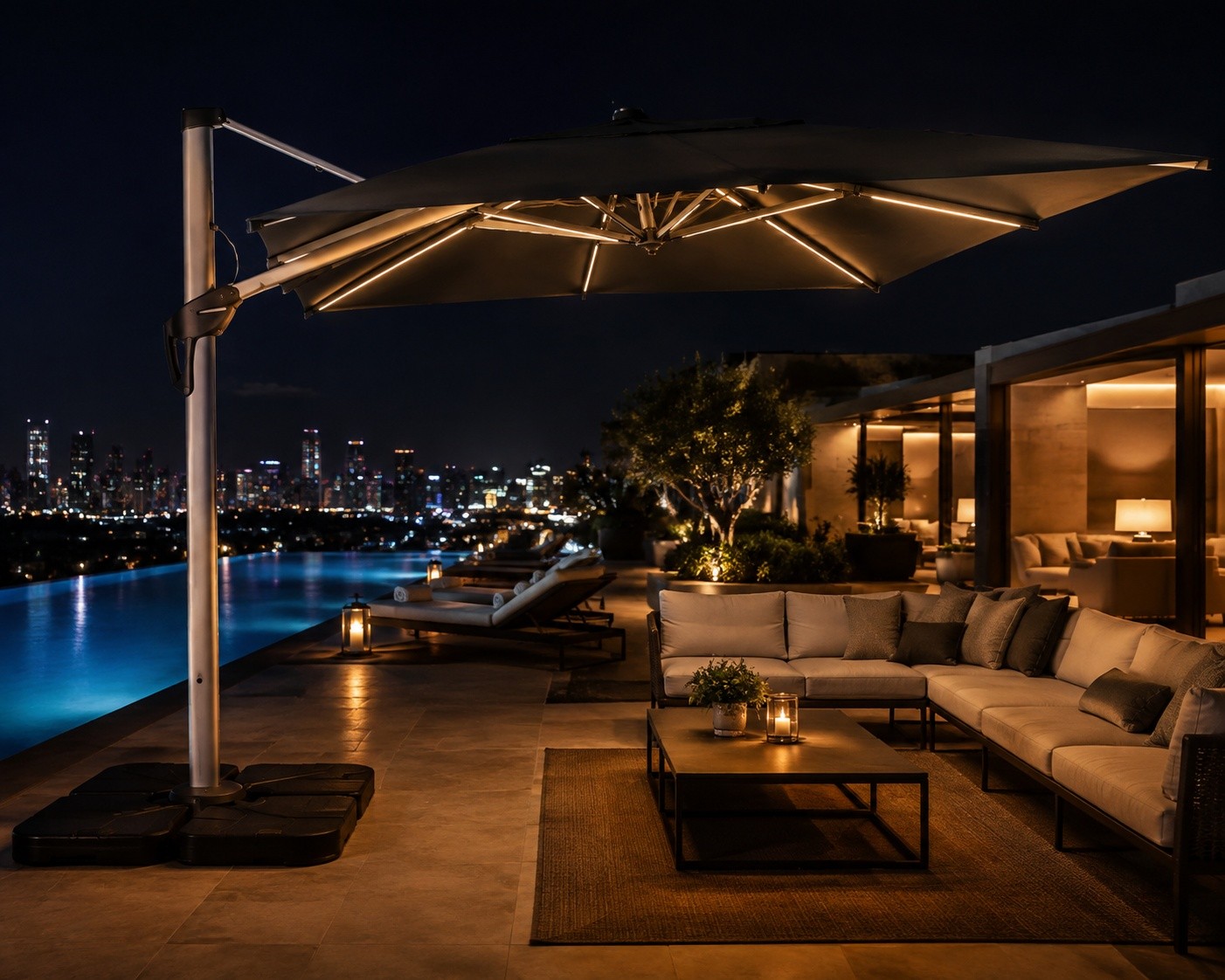
From seaside resorts to restaurant terraces, our outdoor Roman umbrellas deliver generous shade and a refined two-tier profile.
Built for Commercial Roman Umbrella Projects
We support hospitality procurement teams and outdoor furniture suppliers with reliable production, engineering data, and flexible customization.
Factory Direct Manufacturing
Direct production from our own facility — no middle layer, consistent quality and lead time.
Branded Canopy Finishes
Custom colors, logo printing on valances, and pole finishes to match property branding.
Quality Controlled Production
Material checks, assembly inspections, and pre-shipment verification at our facility.
Reliable Global Delivery
Consolidated packing and logistics coordination for hotel and resort rollouts.
Refined Outside, Engineered Inside
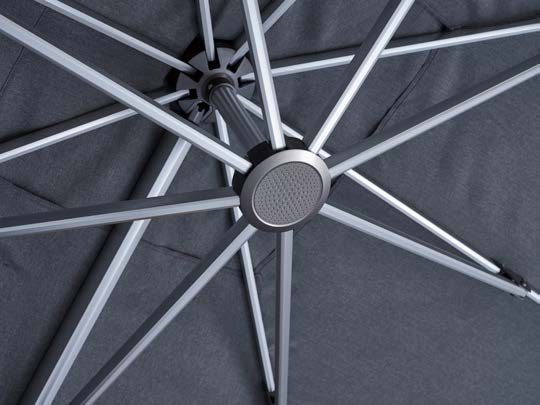
Beneath the Roman canopy sits a corrosion-resistant aluminum frame built for daily hospitality use. Reinforced ribs, smooth crank or push operation, and rotatable poles keep every Roman patio umbrella easy to operate and maintain.
- Double-tier canopy for airflow and reduced wind load
- Anodized or wood-grain aluminum frames resist corrosion
- PA-coated polyester canopies repel water and block UV
- Base options: water tank, resin, steel plate, granite
How Custom Roman Umbrella Orders Work
From first inquiry to global delivery, our team keeps your hospitality shading project on schedule.
Consult & Quote
Share your layout, quantity, and branding. We return a tailored quotation with confirmed lead time.
Design & Sample
Confirm canopy color, logo, size, and base. We provide CAD drawings and a physical sample for approval.
Production & QC
Bulk manufacturing with incoming material checks, assembly inspection, and pre-shipment verification.
Delivery & Support
Consolidated packing and logistics coordination, plus after-sales installation guidance for your team.
Roman Umbrella Buying Guide
Answers to common questions from hoteliers, restaurant owners, and contractors sourcing Roman patio umbrellas.
What makes a Roman umbrella different?
A Roman umbrella is defined by its two-tier, layered canopy. The upper and lower panels improve airflow, reduce wind pressure, and create the distinctive architectural silhouette that suits upscale terraces and gardens.
How is a Roman umbrella related to side pole and cantilever designs?
Roman refers to the canopy style, while side pole and cantilever describe the support structure. Many of our models combine both — a Roman canopy on a side pole or offset cantilever arm — which you can filter within this collection.
Are these umbrellas suitable for windy coastal or hotel sites?
Yes. Our commercial Roman umbrellas use reinforced aluminum ribs and double-vent canopies with heavy base options. Wind ratings vary by size and base — contact us for project-specific guidance.
Can I customize the canopy and add our logo?
Yes. We offer custom canopy colors, logo printing on corners and valances, and frame finishes including anodized and wood-grain aluminum, plus optional solar LED lighting.
Plan Your Roman Umbrella Project
Whether you need a few Roman patio umbrellas for a café or a full resort rollout, Foris Hortus can scale production, customization, and delivery to your timeline.
Side upright, centre pole or cantilever
All three hold a canopy. They differ in where the structure stands and what that asks of the base underneath it.
Side upright (Roman)
A straight mast beside the table with the canopy carried on top. Keeps the setting clear without an offset arm, and is the easiest of the three to walk around.
Centre pole
One mast through the middle of the table. The simplest, most rigid frame, and the right answer where a fixed table hides the pole anyway.
Cantilever
An upright at the edge with an arm carrying the canopy out over the seating. Takes the pole furthest from the guests, and asks the most of its base.
| Consideration | Side upright | Centre pole | Cantilever |
|---|---|---|---|
| Space under the canopy | Clear, with the mast beside the setting | One upright through the middle | Completely clear, upright at the edge |
| Base requirement | Moderate: the mast shares the load | Lightest of the three | Heaviest: counterweight or bolt-down |
| Shade movement | Often rotates and tilts | Fixed, or tilts only | Usually rotates and tilts |
| Best fit | Restaurant rows, hotel terraces, garden lounges | Fixed dining tables | Poolside lounges and wide seating groups |
The double-tier canopy: what it actually does
The second layer is not decoration. It changes how the canopy behaves in heat and in wind, which is why Roman frames are specified for exposed commercial terraces.
It lets hot air out
Warm air collects under a single canopy and pushes up. The gap between tiers gives it somewhere to go, so the canopy sits calmer over the table.
It reduces wind load
A gust that would lift a sealed canopy passes through the vented band instead. That is what raises the usable wind range of the same frame.
It holds its shape
With pressure venting through the tiers, the main canopy keeps its span and does not flap itself loose at the ribs.
It keeps rain out
The upper tier overlaps the vent band, so the opening that lets air through is still covered from above.
Where Roman umbrellas get specified
Four settings where the side mast and the two-tier canopy both earn their place.
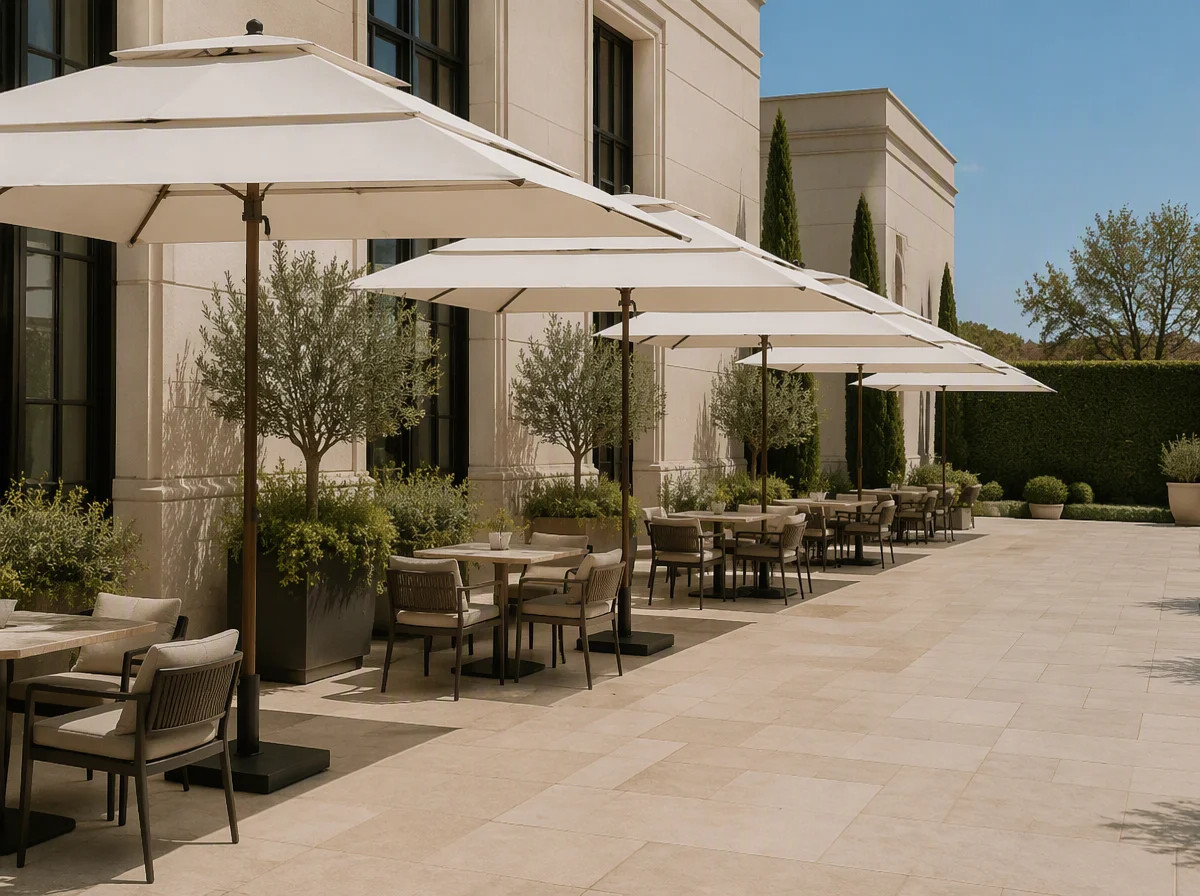
Restaurant terraces
Rows of tables where the service path has to stay clear and the canopy has to be opened and closed every service.
Hotel courtyards
Formal terraces where the frame is part of the architecture and the silhouette matters as much as the coverage.
Pool and spa decks
Vented canopies handle the updraught off water better than a sealed single-tier frame of the same size.
Garden lounges
Lounge groups under a wide canopy, with the mast planted in the border rather than in the seating.
Rotation and tilt: what to ask for
A Roman frame is often specified precisely because it can follow the sun. These are the four details that decide whether it actually can.
Rotation range
Ask how far the canopy swings round and whether it locks. Full rotation is what lets one frame cover a table from breakfast through to late afternoon.
Tilt positions
Ask how many tilt positions there are and how the tilt is held. A tilt that slips puts the shade somewhere else by mid-afternoon.
How it is operated
Hand-pull, crank or gas-spring assist. Larger canopies need more help, and staff will use whatever is quickest.
Clearance when tilted
Ask the height of the canopy rim at full tilt. Too low and guests duck; too high and the shade drifts off the table.
Frame finishes: anodized aluminium or wood-grain
The frame finish is the choice guests notice and the one that decides how the umbrella ages. Three options cover almost every commercial specification.
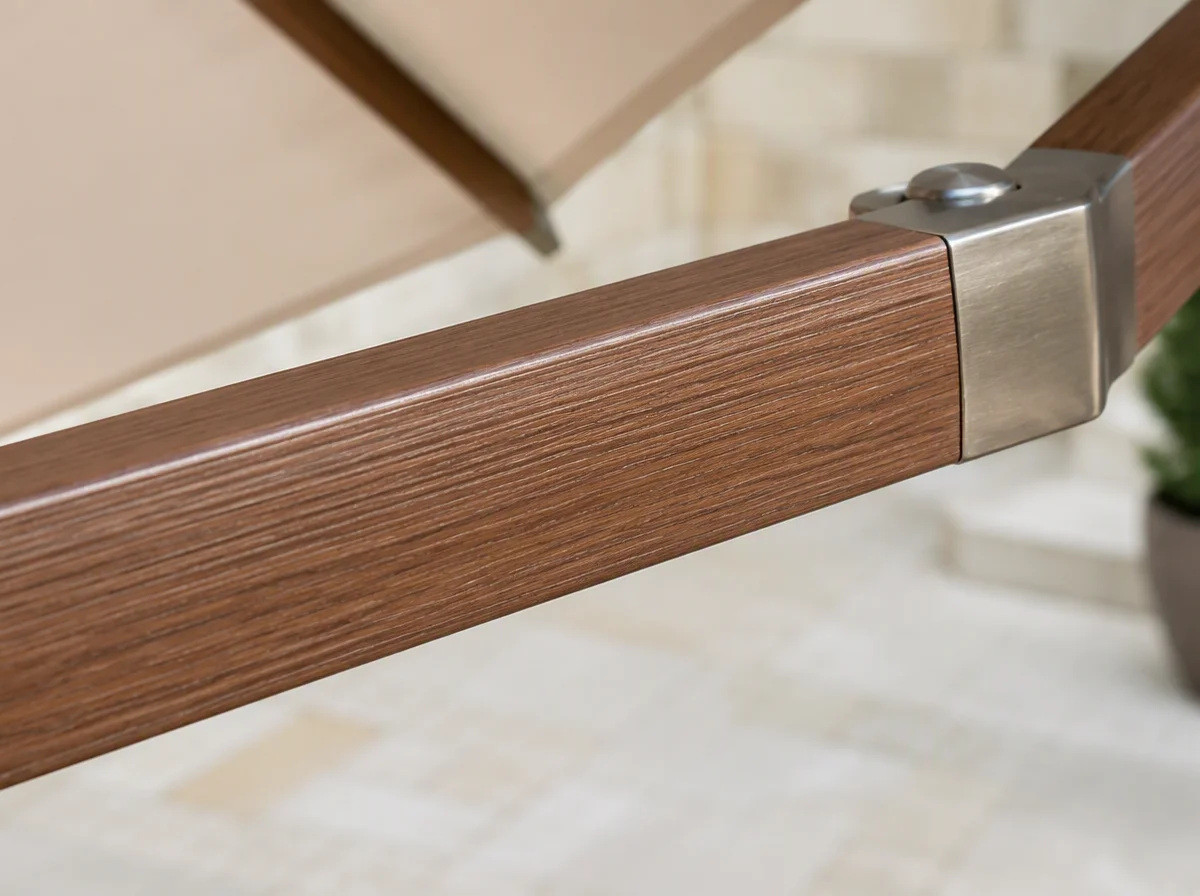
Anodized aluminium
The default commercial finish. The surface is treated rather than painted, so it resists corrosion and does not chip off.
Wood-grain aluminium
A printed grain on the same aluminium profile, for terraces where timber would look right but would not survive the weather.
Powder-coated colour
Where the frame has to match a scheme, ask how the coating holds up to cleaning and to salt air on a coastal site.
Fixings and fittings
Check that the collar, crank and bolts are corrosion-resistant too, because they are the parts that seize first.
Roman umbrella specs at a glance
Standard ranges across our commercial Roman umbrella collection. Every figure below is a starting point, not a limit.
| Specification | Standard range |
|---|---|
| Canopy size | 2.5 m to 5 m across; project sizes on request |
| Canopy structure | Double-tier Roman silhouette |
| Frame material | Anodized aluminium or wood-grain aluminium |
| Wind resistance | Beaufort 4-6 |
| Rotation and tilt | Rotatable and tilting frames on the models that specify it |
| Customisation | Size, colour, branding and frame finish fully customisable |
What a Beaufort 4-6 rating actually means
A wind rating is only useful if the people running the terrace know what it looks like outside. Beaufort 4 to 6 covers the normal working range of a commercial canopy.
Beaufort 4 - moderate breeze
Around 20-28 km/h. Dust and loose paper lift, small branches move, and a canopy starts to work in the wind rather than sit still.
Beaufort 5 - fresh breeze
Around 29-38 km/h. Small trees sway and the canopy is visibly loaded. This is ordinary operating weather on an exposed terrace.
Beaufort 6 - strong breeze
Around 39-49 km/h. The top of the rated range. Canopies should be closed at or before this point, not left open to ride it out.
The closing policy matters more
Most commercial umbrella damage happens to open canopies in wind. Agree the speed at which staff close them and write it into the handover.
Canopy sizes and what they suit
Size is a layout decision first. Work back from the seating group and the sun angle, not from the canopy that looks best in a photograph.
2.5 m to 3 m
A single table or a small group. The lightest frame in the range, easiest to reposition, and the size that suits a café row along a frontage.
3 x 4 m
A rectangular canopy over a long table or a pair of two-tops. The size most restaurant terraces settle on once they measure the actual covers.
Up to 5 x 5 m
The oversized end of the range, for hotel and resort seating areas where one frame has to cover a large group without a second mast.
What to check before you specify
Five details that decide whether a Roman umbrella still looks right and still stands straight in year three.
The vented band is real
Check that the gap between the tiers is a working vent with an overlapping upper canopy, not a decorative second layer sitting flat on the first.
Frame and rib construction
Confirm the profile material, the rib count and whether the frame is built for daily commercial operation rather than occasional use.
Rotation and tilt mechanism
Ask how the canopy rotates and how the tilt is held, and check both through their full range before the order is placed.
Canopy fabric
Ask whether the fabric is yarn-dyed, what coating it carries, and whether a replacement canopy can be ordered on its own.
Base and anchoring
Match the base to the frame and to the surface. A side upright frame needs more base than a centre pole of the same canopy size.
Planning questions we ask before quoting
Six answers decide the frame, the canopy and the fixing. None of them are technical.
How many covers per umbrella?
It sets the canopy size directly, and the canopy size sets the frame and the base behind it.
Is the seating fixed or loose?
A fixed dining row suits a side upright or centre pole. Loose loungers usually need the shade carried further across.
How exposed is the terrace?
An inland courtyard and a seafront terrace need different answers for the same canopy size, even inside the Beaufort range.
Does the shade need to move?
If the terrace runs all day, rotation and tilt stop being extras and become the deciding features.
What does the ground allow?
Bolted plates, ballasted bases and in-ground sockets suit different surfaces and different load limits.
What frame finish has to match?
Anodized aluminium, wood-grain or a powder-coated colour, chosen against the rest of the terrace rather than on its own.
Common specifying mistakes
Six things that are cheap to get right at quotation stage and expensive to correct once the terrace is in service.
Choosing the canopy from the photograph
A canopy that looks right in a wide shot may leave the covers in the sun at four in the afternoon. Size from the sun angle, not the image.
Assuming both tiers do the work
A second layer that sits flat on the first vents nothing. The vent band has to be a real opening, covered from above.
Skipping the wind closing policy
Beaufort 4-6 is a working range, not a promise. Without an agreed closing speed, the rating is not doing anything on site.
Specifying the base last
A side upright frame asks more of its base than a centre pole. Deciding that after the paving is laid is the expensive order to do it in.
Forgetting the frame finish where it matters
On a coastal or heavily cleaned terrace, the finish and the fixings age first. Choose them for the site, not for the sample board.
No replacement canopies planned
Canopies wear long before frames do, and a colour that has been discontinued turns a canopy swap into a full re-order.
Getting a Roman umbrella onto the terrace
The order matters, because a wide canopy is not something to reposition once the base is set and filled.
- 1
Set out the masts and check the shade
Mark where each mast will stand and check the coverage over the actual covers at the busiest hour, not at noon.
- 2
Fix or place the base
Bolt the plate down where the surface allows; otherwise position and level a ballasted base sized for the canopy.
- 3
Stand the mast and check the mechanism
Set the mast in the base, then run the crank and the rotation through their full range before the canopy goes on.
- 4
Fit and open the canopy
Fit the canopy, open it fully and check the tension across both tiers and the height of the rim when tilted.
- 5
Test it in wind and hand over
Check the frame on a breezy day, then agree and document the wind speed at which staff close the canopies.
Care, storage and canopy replacement
A Roman frame is designed to outlast several canopies. These four points decide whether it gets the chance to.
Cleaning the canopy
Canopy fabric is cleaned on the frame or off it, so check what the maker recommends before the first season rather than after the first stain.
The crank and collar
The winding mechanism and the locking collar are the moving parts. Keep them free of grit and check them at the start of each season.
Closing overnight
On an exposed terrace, closing the canopy overnight takes the standing load off both the frame and the base.
Replacing the canopy
Confirm before ordering that replacement canopies are available in the same colour. Frames outlast canopies by several seasons.
What to order with a Roman umbrella
The frame is the visible part of the order. These are the items that decide whether the first season runs smoothly.
The base and its fixings
Matched to the frame type and to the surface on site, not chosen from the catalogue page.
The fill medium
Fillable bases ship empty. Agree what they are filled with and who does it before the terrace opens.
A spare canopy
Where the terrace runs every day, one spare canopy in the same colour avoids a table being out of service.
Spare crank and collar
The two parts that wear with daily use, and the two that stop the umbrella opening when they fail.
A combined spare-parts list
One list covering the frame, the canopy and the base, so a single order keeps a mixed terrace running.
Make it yours - custom Roman umbrellas
Choose the canopy colour, print your logo, match the frame finish and engineer the exact size your terrace or poolside needs. From a single branded prototype to a full resort rollout, we turn your specification into production.
- Canopy size and shapeRectangular and round canopies, sized to the seating group rather than to the catalogue.
- Colour and brandingCanopy colour to match a scheme, with print or logo on request.
- Frame finishAnodized aluminium, wood-grain, or a powder-coated colour.
- Frame configurationSide upright, centre pole or cantilever, with rotation and tilt to your brief.
Tell us the terrace, the covers per umbrella and the finish you are working to, and we will come back with the frame options, the canopy specification and a delivered price.
Why choose Foris Hortus Roman umbrellas
Every Roman umbrella pairs a signature double-tier silhouette with commercial-grade materials and long-term outdoor performance. We build the frame rather than trade it, which is the substance behind the experience, expertise, authoritativeness and trust that B2B buyers need before they commit.
- Signature double-tier canopy
- 360 degree rotation and tilt
- Solar LED options
- Factory direct OEM and ODM
Common questions about Roman umbrellas
The questions buyers ask most often before they specify a side upright frame for a commercial terrace.
What is a Roman umbrella?
A side upright umbrella with a double-tier canopy: the mast stands beside the table and a smaller second canopy sits above the main one to vent air and reduce wind load.
Why does the second tier matter?
It lets hot air and gust pressure escape instead of loading the whole canopy. That is what raises the usable wind range of the frame and keeps the canopy shape over a wide span.
Side upright or cantilever?
A side upright keeps the mast beside the table with no offset arm, so it is simpler and lighter on the base. A cantilever takes the pole right out of the seating and asks far more of the base.
How do I read the Beaufort 4-6 rating?
It covers roughly 20 to 49 km/h: Beaufort 4 is a moderate breeze and Beaufort 6 a strong breeze. Canopies should be closed at or before the top of the range.
Can the frame rotate and tilt?
On the models that specify it, yes. Ask how far the canopy rotates, how many tilt positions there are and how the tilt is held, because that is what lets one frame follow the sun.
Do you support custom sizes and branding?
Yes. Canopy size, colour, frame finish and branding can be tailored, and we work direct from our factory with samples and CAD support before bulk production.
Terms used on this page
Short definitions of the words that come up most often in a Roman umbrella quotation.
Related umbrella pages
Where to go next, depending on the frame and the finish you settle on.
Specifying side upright shade for a terrace?
Send us the covers per umbrella, whether the seating is fixed or loose, how exposed the site is and what the ground allows, and we will come back with the frame, the canopy, the base and a delivered price. Start a quotation request.

Elevate Garden Living
- Phone
- *Title
- *Content