Center Pole Umbrella
Centre pole umbrellas: the simplest frame, specified properly
A centre pole umbrella puts one mast through the middle of the setting and spreads the canopy evenly around it. Nothing else in the range is as simple, as rigid or as easy to repair, which is why it is still the default frame for hotel patios, restaurant tables and poolside lounges.
What decides whether it works is not the canopy but the details around it: the canopy shape that suits the furniture, the opening system the staff will actually use, the base that holds the mast down, and the fabric weight that survives a full season outdoors. Everything below covers those four decisions in order.
- Square canopies up to 4x4 m
- Anodized or wood-grain frame
- Push-pull or crank opening
- OEM, ODM and bulk supply
Three ways a centre pole umbrella gets used
The same frame covers a dining table, a lounger row or a whole terrace run. What changes is the canopy shape and the size of the base underneath it.
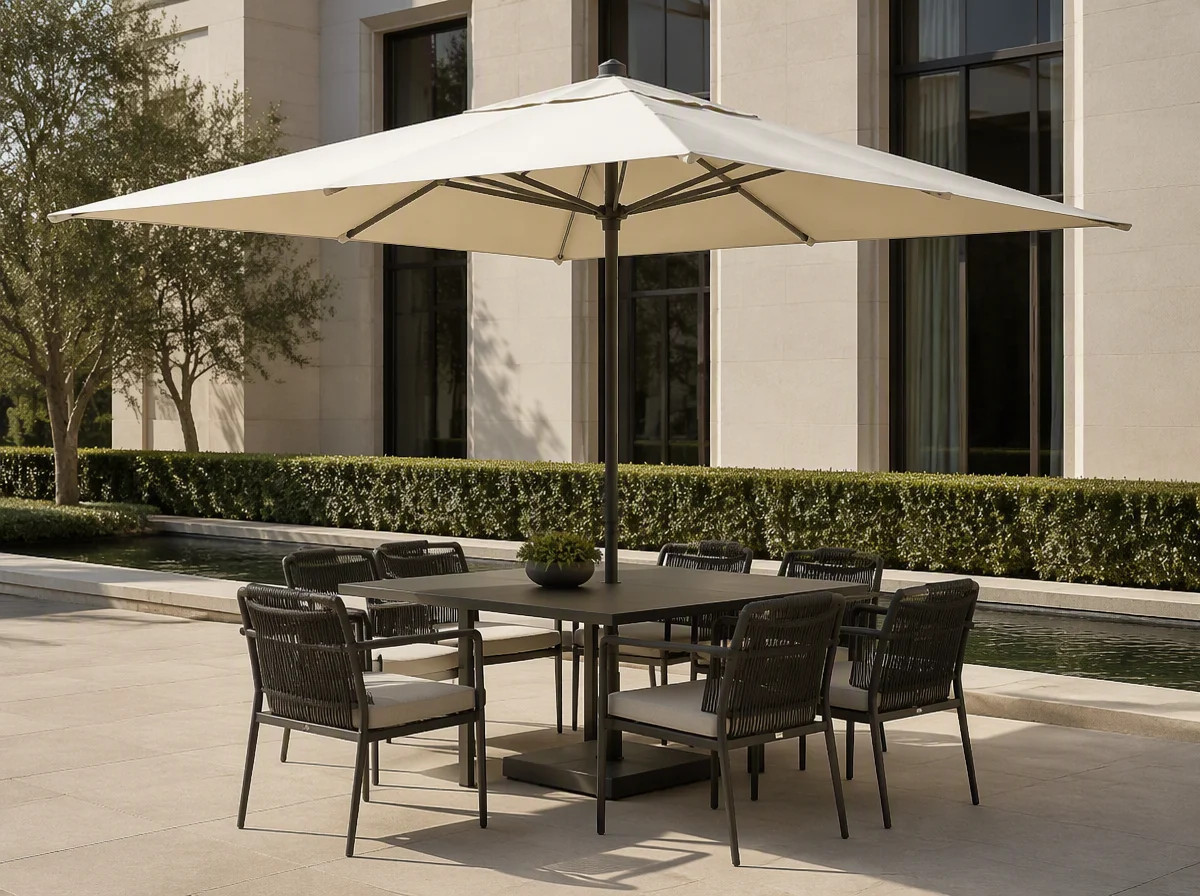
Over a dining set
A square canopy matches the table footprint, so the shade covers the whole group without overhanging the service path behind it.
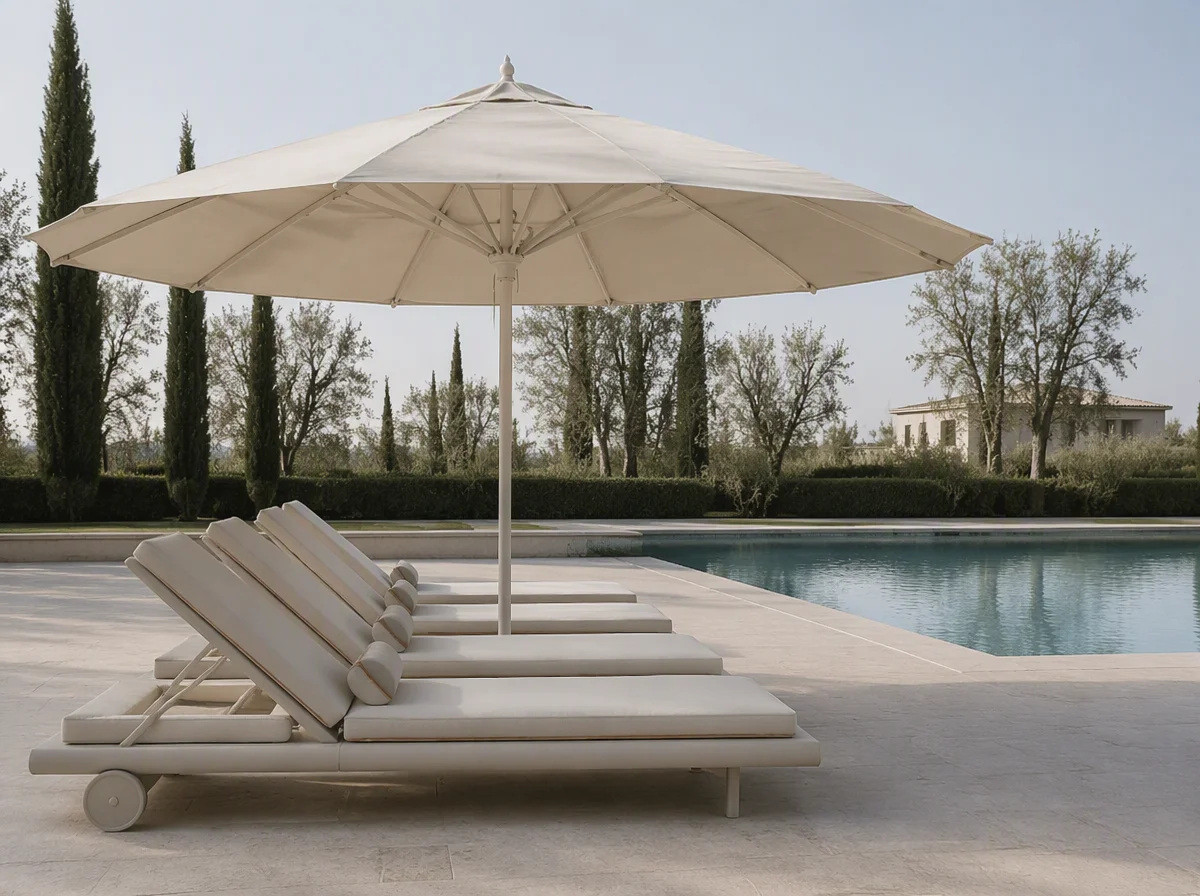
Over a lounger row
A round canopy spreads evenly around the mast, which suits a group of loungers arranged on all sides rather than a single table.
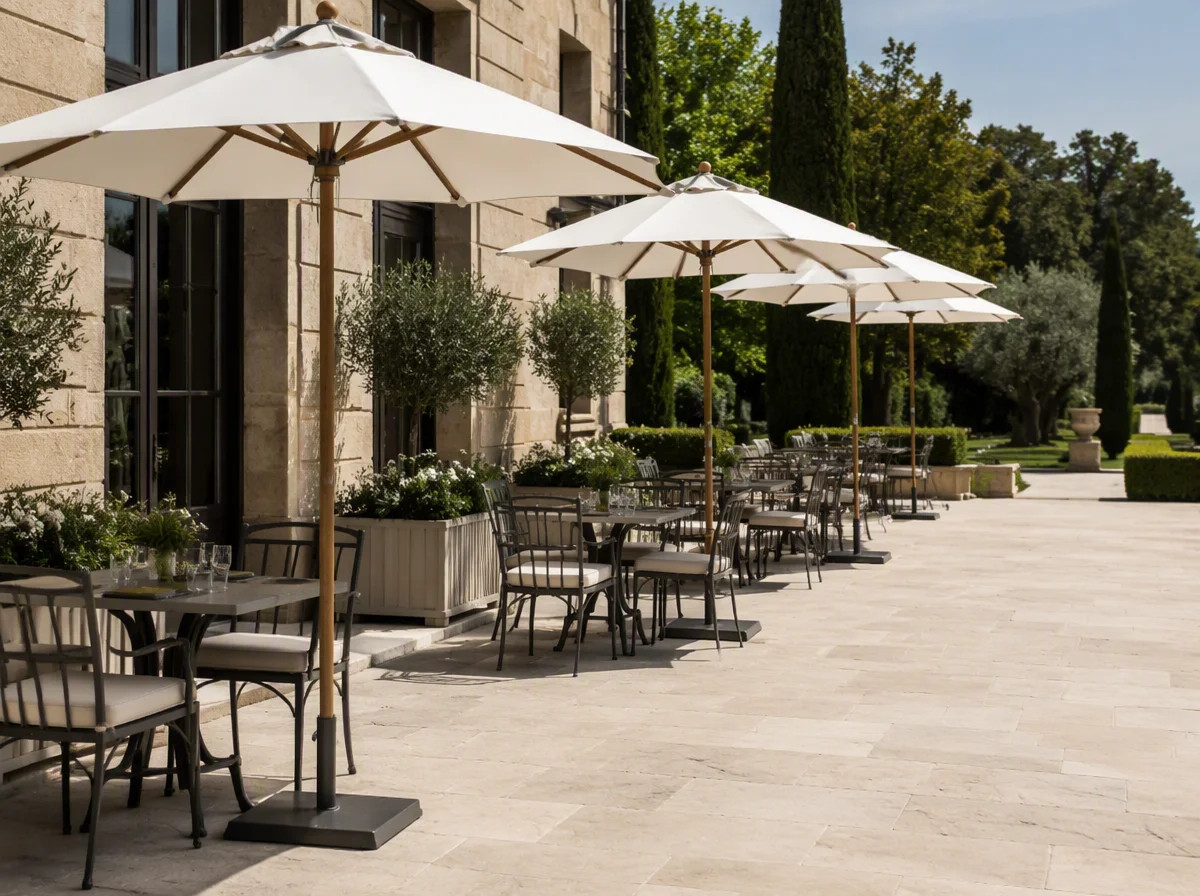
Along a terrace run
Repeated down a terrace, a centre pole frame is the easiest row to lay out, base, and keep serviceable across a whole site.
- Size
- 2.1M*2.1M
- 2.5*2.5M
- Dia 2.7M
- Dia 3M
- 3M*3M
- 3M*4M
- 4M*4M
- 7M*7M
- 5M*5M
- Material
- Aluminum
- LED
- Long ribs with LED
- Short ribs with LED
- All ribs with LED
- Without LED
- Rib
- 10*18mm
- 12*18mm
- 18*30mm
- 14*24mm
- 17*22mm
- 20*30mm
- 25*33mm
- 35*22mm
- Pole
- 38mm
- 48mm
- 67mm
- 80mm
- 86mm
- 100mm
- Top
- Single
- Double
- Triple
- Stock
- Yes
- No
- Fabric
- Polyester fabric
- Yarn-dyed fabric
- Qing qing fabric
- Short fiber fabric
- Sunbrella
- Grams of fabric
- 180g
- 220g
- 250g
- 260g
- 280g
- 300g
- Coating
- PU
- PA
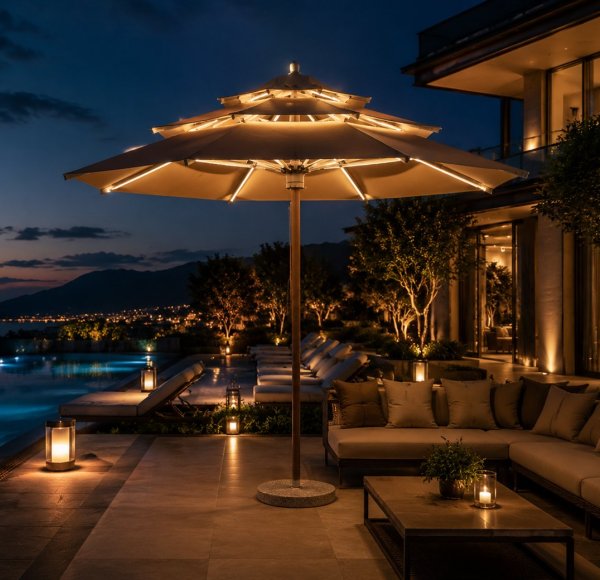
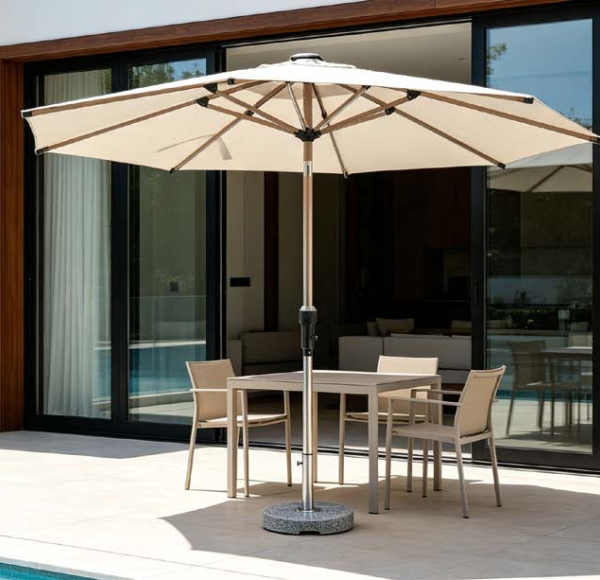
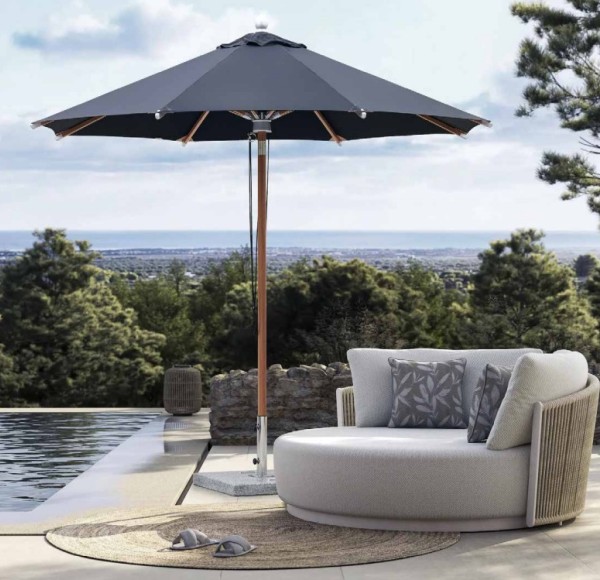
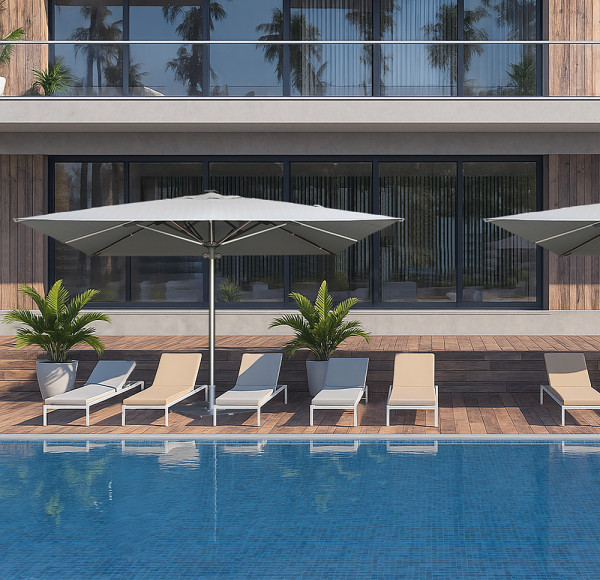
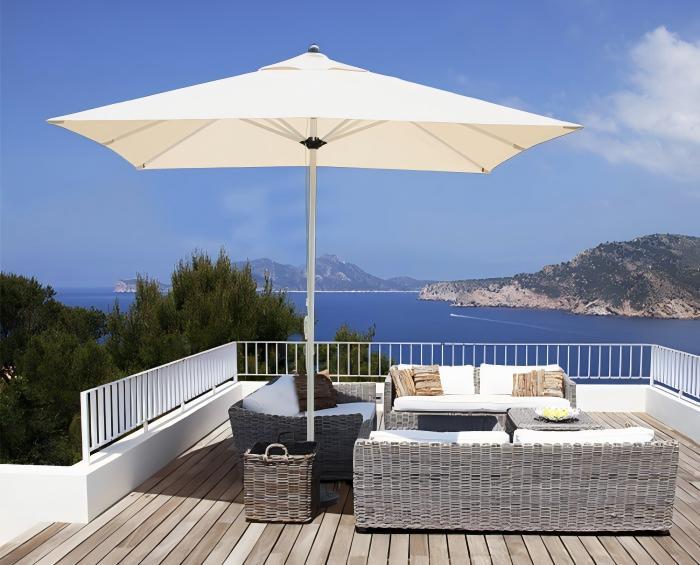
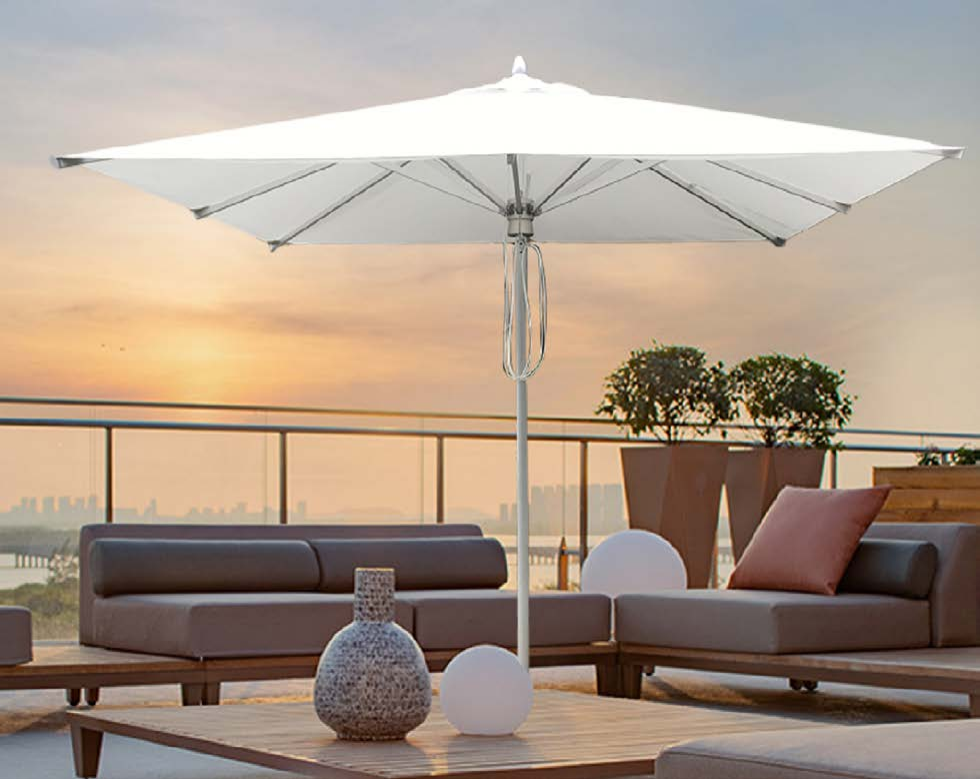
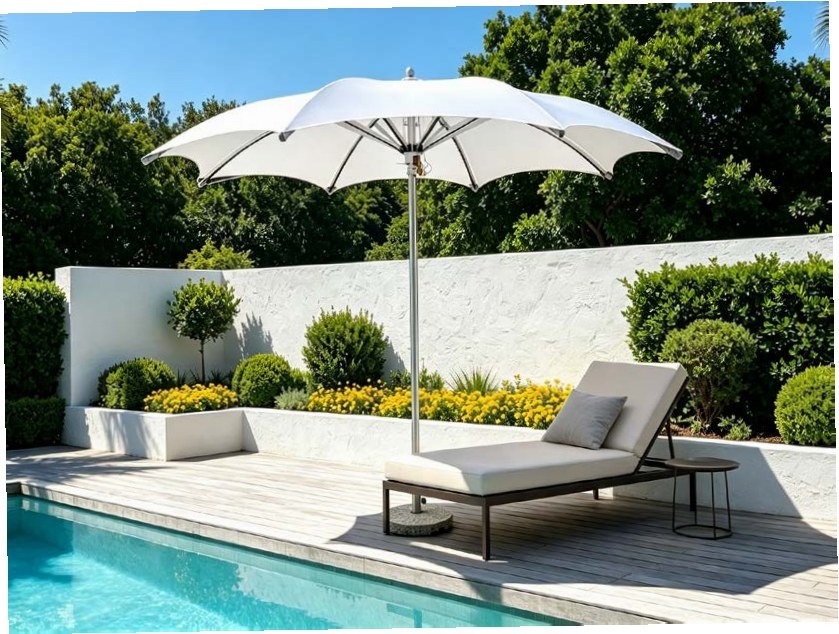
Where Center Pole Patio Umbrellas Perform Best
From seaside terraces to restaurant courtyards, our outdoor centre pole umbrellas deliver stable shade and a clean, classic profile.
Built for Commercial Center Pole Umbrella Projects
We support hospitality procurement teams with reliable production, engineering data, and flexible customization.
Structural Engineering Support
CAD drawings, wind-load guidance, and base recommendations for safe installation.
Branded Canopy Finishes
Custom colors, logo printing on valances, and pole finishes to match property branding.
Quality Controlled Production
Material checks, assembly inspections, and pre-shipment verification at our facility.
Reliable Global Delivery
Consolidated packing and logistics coordination for hotel and resort rollouts.
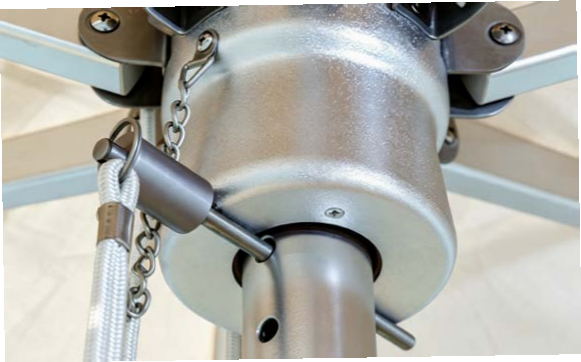
Smooth Operation, Built to Last
Our waterproof center pole umbrella collection is designed for low maintenance and simple daily use. Push-pull systems reduce mechanical wear, while crank-lift models let staff open and close umbrellas effortlessly.
- Anodized aluminum poles resist corrosion
- PA-coated polyester canopies repel water and block UV
- Multiple base options: water tank, resin, iron plate, granite
- Sizes from 2.1M up to 4M for flexible layouts
How Custom Center Pole Umbrella Orders Work
From first inquiry to global delivery, our team keeps your hospitality shading project on schedule.
Consult & Quote
Share your layout, quantity, and branding. We return a tailored quotation with confirmed lead time.
Design & Sample
Confirm canopy color, logo, size, and base. We provide CAD drawings and a physical sample for approval.
Production & QC
Bulk manufacturing with incoming material checks, assembly inspection, and pre-shipment verification.
Delivery & Support
Consolidated packing and logistics coordination, plus after-sales installation guidance for your team.
Center Pole Umbrella Buying Guide
Answers to common questions from hoteliers, restaurant owners, and contractors sourcing commercial centre pole umbrellas.
What is a center pole umbrella?
A center pole umbrella has its support mast positioned in the middle of the canopy. This classic design offers balanced shade, easy placement over tables, and a clean look for patios and terraces.
Are your center pole umbrellas suitable for commercial use?
Yes. Our commercial centre pole umbrellas use anodized aluminum frames, reinforced ribs, and heavy-duty base options designed for hotels, resorts, restaurants, and cafés.
Can I customize the canopy color and add a logo?
Yes. We offer custom canopy colors, corner and valance logo printing, and frame finishes including natural anodized and wood-grain aluminum.
What base options are available?
We supply water tank, resin, iron plate, and granite bases. For fixed installations, in-ground anchors and deck-mount kits can also be provided.
Plan Your Center Pole Shading Project
Whether you need a few patio umbrellas for a café or a full resort rollout, Foris Hortus can scale production, customization, and delivery to your timeline.
Square or round: choosing the canopy shape
Shape is a layout decision. It decides how the shade lands on the furniture and how much room you leave between one frame and the next.
Square and rectangular
Matches rectangular tables and rows of two-tops, and wastes less shade on the gaps between neighbouring frames. The usual choice for dining terraces.
Round
Spreads evenly in every direction, so it suits a single round table or a lounger group arranged on all sides of the mast.
Curved profile
A canopy whose edge curves downward rather than sitting flat. The curve sheds wind pressure instead of catching it, which matters on an exposed terrace.
| Consideration | Square | Round | Curved profile |
|---|---|---|---|
| Shade pattern | Even over a rectangular footprint | Even in every direction | Even, with a lower edge all round |
| Best fit | Dining tables and terrace rows | Round tables and lounger groups | Exposed pool decks and coastal terraces |
| Wind behaviour | Standard | Standard | Better: the curve sheds pressure |
| Typical spans | 2.5x2.5 m up to 4x4 m | 2.1 m up to 3 m across | Sized to the lounger group |
Push-pull or crank: choosing the opening system
Both open the same canopy. They wear differently, and the one your staff will prefer depends on how many umbrellas they open every morning.
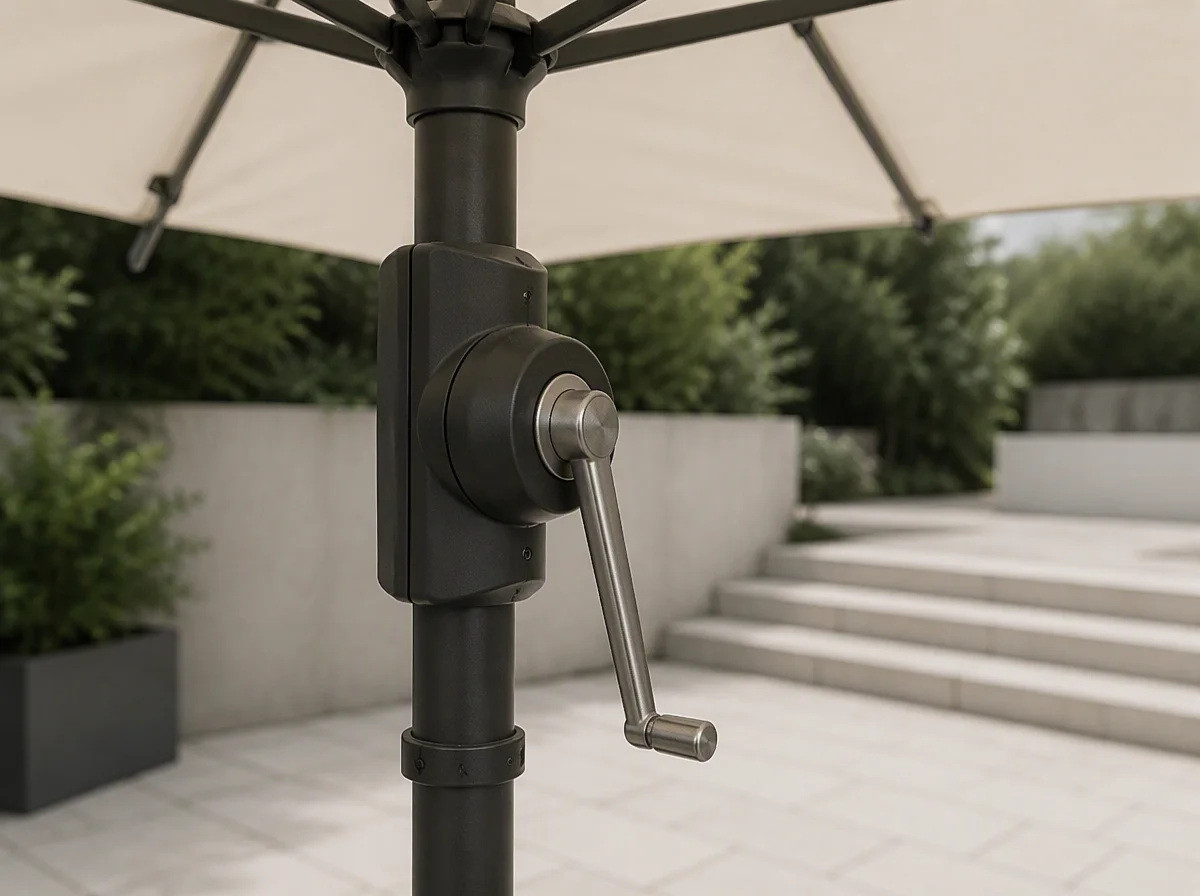
Crank opening
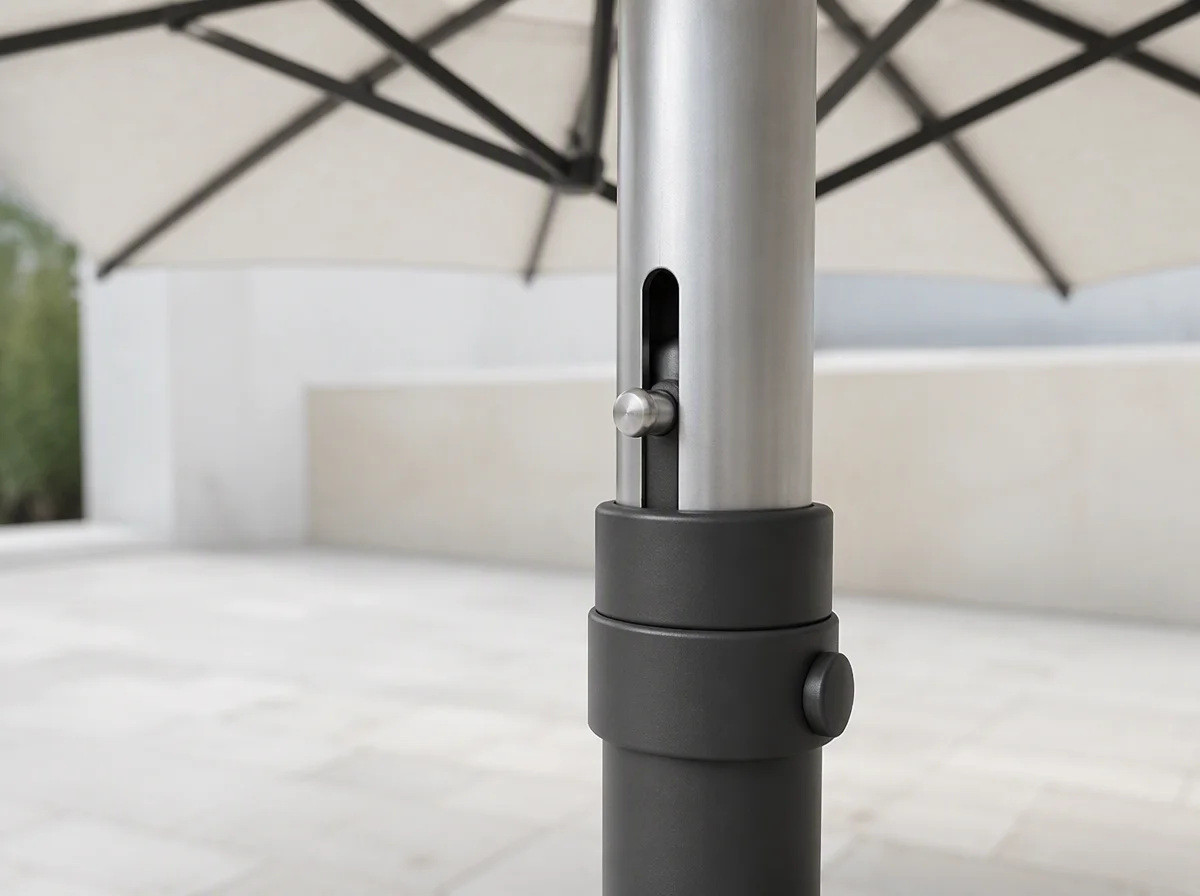
A winding mechanism lifts the canopy with little effort, which matters as canopy size grows. More moving parts, so the crank and collar are the items to keep spare.
Push-pull opening
A pin and slot with a locking collar. Mechanically simpler and cheaper to maintain, and the usual choice on smaller canopies and frames used less often.
Who operates it
If one person opens twenty frames every morning, the effort per frame matters more than the part count. Ask the team, not the catalogue.
What to keep spare
Whichever system you choose, a spare crank or pin assembly turns a broken umbrella into an afternoon's repair rather than a written-off frame.
How a centre mast behaves in wind
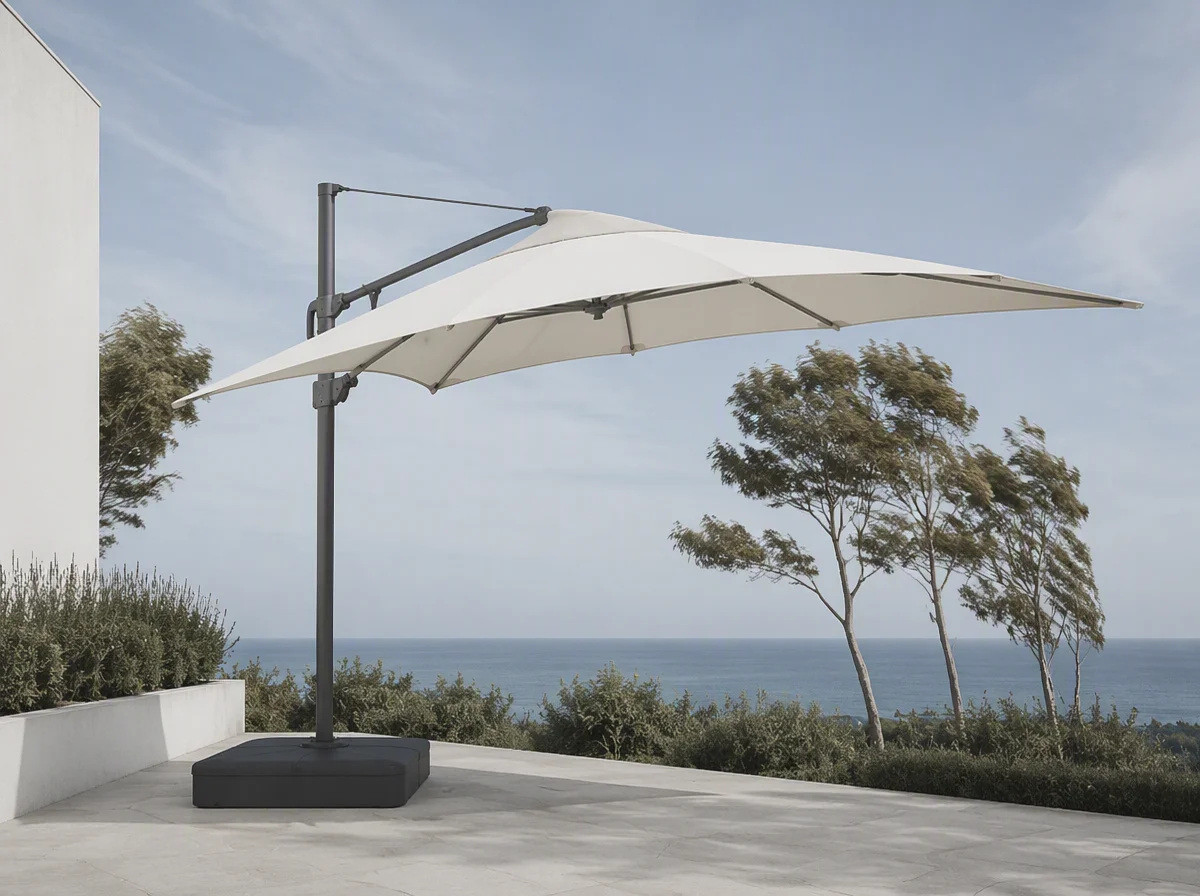
A centre pole shares the load between the mast and the base, which is why it needs less base weight than an offset frame of the same canopy size. Four things decide how it copes on your site.
Balanced load
The mast carries the canopy down through its centre, so wind load is shared rather than turned into leverage. That is the centre pole's main structural advantage.
Canopy profile
A flat canopy catches wind across its whole area. A curved profile lets pressure slide off the edge, which raises the usable wind range of the same frame.
Base weight and fixing
Even a balanced frame needs a base sized to the canopy. Bolting down lets you use a lighter base than ballast alone, where the surface allows it.
The closing policy
Most commercial umbrella damage happens to open canopies in wind. Agree the wind speed at which staff close them and write it into the handover.
Where centre pole umbrellas get specified
Four settings where a single central mast is still the most practical answer.
Restaurant patios
Fixed tables where the mast passes through the middle anyway, so the frame costs nothing in layout and gains rigidity.
Hotel terraces
Long rows of identical frames, easiest to lay out, base and keep serviceable across a whole property.
Poolside lounges
Round canopies spread shade evenly over loungers arranged on every side of the mast.
Cafés and garden terraces
Smaller frames opened and closed every day, where a simple mechanism and a light base do the job.
Fabric, UV protection and rain
Fabric is where a commercial umbrella either keeps its colour for a decade or fades in two seasons. Four things decide which one you get.
UV protection
Look for a stated UPF rating. UPF 50+ fabric blocks the harsh part of the spectrum and protects guests as well as it protects itself.
Coating and rain
A PA coating on the canopy repels light rain and stops the fabric holding moisture. It is what keeps a canopy usable through a changeable afternoon.
Fabric weight
Around 250g to 280g polyester is the commercial working range: heavy enough to hang cleanly across the span, light enough to open easily.
Replacement canopies
Confirm before ordering that a replacement canopy can be supplied in the same colour. Canopies wear long before frames do.
Canopy sizes and what they suit
Size is a layout decision first. Work back from the furniture and the sun angle rather than from the canopy that looks generous in a photograph.
2.1 x 2.1 m
A single small table or a pair of chairs. The lightest frame in the range and the easiest to move when a terrace is reconfigured.
2.5 x 2.5 m to 3 x 3 m
The working size for restaurant and café terraces: four to six covers under one canopy, in square or round format.
Up to 4 x 4 m
The oversized end of the range, for dining sets and lounge groups where one frame has to cover a large group without a second mast.
Centre pole umbrella specs at a glance
Standard ranges across our commercial centre pole collection. Every figure is a starting point, not a limit.
| Specification | Standard range |
|---|---|
| Canopy size | 2.1 m up to 4 m across; square canopies 2.5x2.5 m to 4x4 m |
| Frame material | Anodized aluminium, or aluminium with a wood-grain finish |
| Opening system | Push-pull in the classic models, crank lift on larger canopies |
| Fabric | 250g-280g PA-coated polyester, UV and water repellent, UPF 50+ options |
| Wind resistance | Beaufort 4-5 |
| Lighting and base options | Optional warm-white LED strips; granite and weighted base options |
| Customisation | Canopy colour, corner logo printing, frame finish |
What a Beaufort 4-5 rating actually means
A wind rating is only useful if the people running the terrace know what it looks like outside. Beaufort 4 to 5 covers the normal working range of a centre pole canopy.
Beaufort 4 - moderate breeze
Around 20-28 km/h. Dust and loose paper lift, small branches move, and a canopy starts to work in the wind rather than sit still.
Beaufort 5 - fresh breeze
Around 29-38 km/h. Small trees sway and the canopy is visibly loaded. This is the top of the rated range for these frames.
Shelter changes the answer
A courtyard shielded on three sides behaves differently from an open frontage. Same rating, very different real loads.
The closing policy matters more
Most damage happens to open canopies in wind. Agree the speed at which staff close them, and write it into the handover.
What to check before you specify
Five details that decide whether the frame still looks right and still stands straight in year three.
Canopy shape against the furniture
Check that the shape matches the seating footprint, so the shade lands on the guests rather than on the gap between frames.
Opening system and effort
Confirm which system you are ordering and how much effort it takes. Staff open these daily; the catalogue photograph does not show that.
Fabric weight and UPF
Ask for the fabric weight and the stated UPF, and whether a replacement canopy in the same colour will be available later.
Wind rating and profile
Ask for the rated wind speed, and whether a curved profile is available for an exposed or coastal terrace.
Base and fixing
Match the base to the canopy size and the surface. A centre pole needs less base than an offset frame, but it still needs the right one.
Planning questions we ask before quoting
Six answers decide the frame, the canopy and the fixing. None of them are technical.
What is the furniture layout?
A fixed dining row, a loose lounger group and a café frontage each point at a different canopy shape.
How many covers per umbrella?
It sets the canopy size directly, and the canopy size sets the base behind it.
Who opens and closes them, and how often?
Daily use by staff changes which opening system makes sense, and what spares you should hold.
How exposed is the terrace?
An inland courtyard and a coastal frontage need different answers even within the same wind rating.
Does the terrace run into the evening?
If it does, LED canopy strips stop being an extra and become part of the specification.
What does the ground allow?
Bolted plates, ballasted bases and in-ground sockets suit different surfaces and different load limits.
Common specifying mistakes
Six things that are cheap to get right at quotation stage and expensive to correct once the terrace is open.
Choosing the canopy from the photograph
A canopy that looks generous in a wide shot can still leave the outer covers in the sun by mid-afternoon. Size from the sun angle.
Ignoring who opens the umbrellas
A mechanism that is awkward for staff gets left closed. The best opening system is the one the team will actually use every morning.
Treating fabric weight as a detail
Light cloth on a wide span flaps itself loose. Fabric weight is a structural choice, not a cosmetic one.
Skipping the wind closing policy
Beaufort 4-5 is a working range, not a promise. Without an agreed closing speed, the rating does nothing on site.
Specifying the base last
Even a balanced centre pole needs a base sized to the canopy. Deciding that after the paving is laid is the expensive order to do it in.
No replacement canopies planned
Canopies wear long before frames. A discontinued colour turns a simple canopy swap into a full re-order.
Getting a centre pole umbrella onto the terrace
The order matters, because a canopy this size is not something to reposition once the base is set and filled.
- 1
Set out the masts and check the shade
Mark where each mast will stand and check the coverage over the actual furniture at the busiest hour, not at noon.
- 2
Fix or place the base
Bolt the plate down where the surface allows; otherwise position and level a ballasted base sized for the canopy.
- 3
Stand the mast and run the mechanism
Set the mast in the base, then work the crank or push-pull pin through its full travel before the canopy goes on.
- 4
Fit and open the canopy
Fit the canopy, open it fully and check the tension evenly around the mast and the clearance under the ribs.
- 5
Test it in wind and hand over
Check the frame on a breezy day, then agree and document the wind speed at which staff close the canopies.
Care, storage and canopy replacement
A centre pole frame is designed to outlast several canopies. These four points decide whether it gets the chance to.
Cleaning the canopy
Check what the maker recommends for the specific coating before the first season, rather than after the first stubborn stain.
Crank, pin and collar
The opening mechanism and the locking collar are the moving parts. Keep them free of grit and check them at the start of each season.
Closing overnight
On an exposed terrace, closing the canopy overnight takes the standing load off both the frame and the base.
Replacing the canopy
Confirm replacement canopies are available in the same colour, and keep the frame and canopy part numbers together.
Make it yours - custom centre pole umbrellas
Pick the canopy colour, print your logo, match the frame finish and engineer the exact size your terrace or pool needs. From a single branded prototype to a full resort rollout, we turn your specification into production.
- Canopy size and shapeSquare, rectangular and round canopies from 2.1 m up to 4 m across.
- Colour and brandingCanopy colour to match a scheme, with corner logo printing on request.
- Frame finishAnodized aluminium or a wood-grain finish on the same profile.
- Lighting and base optionsOptional warm-white LED strips, and granite or weighted bases to suit the site.
Tell us the furniture layout, the covers per umbrella and the finish you are working to, and we will come back with the frame options, the canopy specification and a delivered price.
Why choose Foris Hortus centre pole umbrellas
Every commercial centre pole umbrella is engineered for stable shading, simple daily operation and long-term outdoor performance. We build the frame rather than trade it, which is the substance behind the experience, expertise, authoritativeness and trust that B2B buyers need before they commit.
- Balanced centre mast construction
- UV and waterproof canopy fabric
- Push-pull or crank opening systems
- Factory direct OEM and ODM
Common questions about centre pole umbrellas
The questions buyers ask most often before they specify a centre mast frame for a commercial terrace.
Centre pole, side upright or cantilever?
A centre pole is the simplest and most rigid, and needs the least base weight. A side upright keeps the mast beside the table, and a cantilever takes the pole right out of the seating at the cost of a much heavier base.
Square or round canopy?
Square matches rectangular tables and terrace rows and wastes less shade on gaps. Round spreads evenly in all directions, which suits lounger groups arranged around the mast.
Push-pull or crank?
Push-pull is mechanically simpler with fewer parts to wear. A crank takes less effort as the canopy grows, which matters when one person opens many frames each morning.
How do I read the Beaufort 4-5 rating?
It covers roughly 20 to 38 km/h: Beaufort 4 is a moderate breeze and Beaufort 5 a fresh breeze. Canopies should be closed at or before the top of the range.
Can the umbrella be lit for evening service?
Yes. Warm-white LED strips can be integrated into the canopy structure on the models that specify lighting, so a terrace can run past dusk without separate lamps.
Do you support custom sizes and branding?
Yes. Canopy size, colour, frame finish and logo printing can be tailored, and we work direct from our factory with samples before bulk production.
Terms used on this page
Short definitions of the words that come up most often in a centre pole umbrella quotation.
Related umbrella pages
Where to go next, depending on the frame and the fixing you settle on.
Specifying centre pole shade for a terrace?
Send us the furniture layout, the covers per umbrella, whether the terrace runs into the evening and what the ground allows, and we will come back with the frame, the canopy, the base and a delivered price. Start a quotation request.

Elevate Garden Living
- Phone
- *Title
- *Content